A small world in the middle of Budapest – Comfort food and international tunes from morning to night at Goli
Goli opened about two and a half years ago, so it's still a new restaurant. How do you feel about that?
Of course, it's still very fresh. I think this is just the beginning in the life of a restaurant, and I really hope that it's just the beginning for us too. We've learned a lot over the past period, we've become much more mature: in terms of food, music and atmosphere. We're constantly changing and developing. For example, we just installed a new sound system, because I think music is very important here.
What kind of music can you hear?
The playlist is the same all day long and is very diverse: old music from the fifties, sixties, seventies, techno, deep house, we play a lot of Arabic, Turkish, Greek songs, but we also have Hebrew, Spanish, French, Italian, so music from all over the world. I think this also defines who we are: a small world in the middle of Budapest. Our team is also international, as we have a Greek sous chef, a Chilean, Romanian and Brazilian chef, Hungarian colleagues, a Turkish barmaid, Egyptian, Jordanian, Iranian colleagues. The music reflects this diversity, as does the food. Goli is not about coming in and eating, but much more than that, more complex, a kind of sensory experience. If a place lacks this, I wouldn't want to be a guest there.
What has changed since the beginning? Is there anything that you thought was unthinkable at the beginning that you are doing now?
Goli became what I wanted, not what the owners originally planned. They envisioned something more casual, somewhere between a restaurant and a fast food restaurant. Although we started with food served in pita, we had restaurant-quality food, not just falafel, and after a while I got tired of pita. I said let's do better, let's be more creative.
There are also a few formats that you've only recently started experimenting with, like your brunch. Where did the idea come from?
The starting point was burekas, which is a stuffed pastry known everywhere in the Balkans, and one of my most important memories is also connected to it. When I was a child, when I was late for school and my teacher scolded me for it, I always consoled myself with this on the way. Then I bought a spinach burekas every single day, even for a shekel. It's true that this is also reflected in my weight, but this food means the deepest connection, the greatest comfort to me, so when I share it, I share myself.
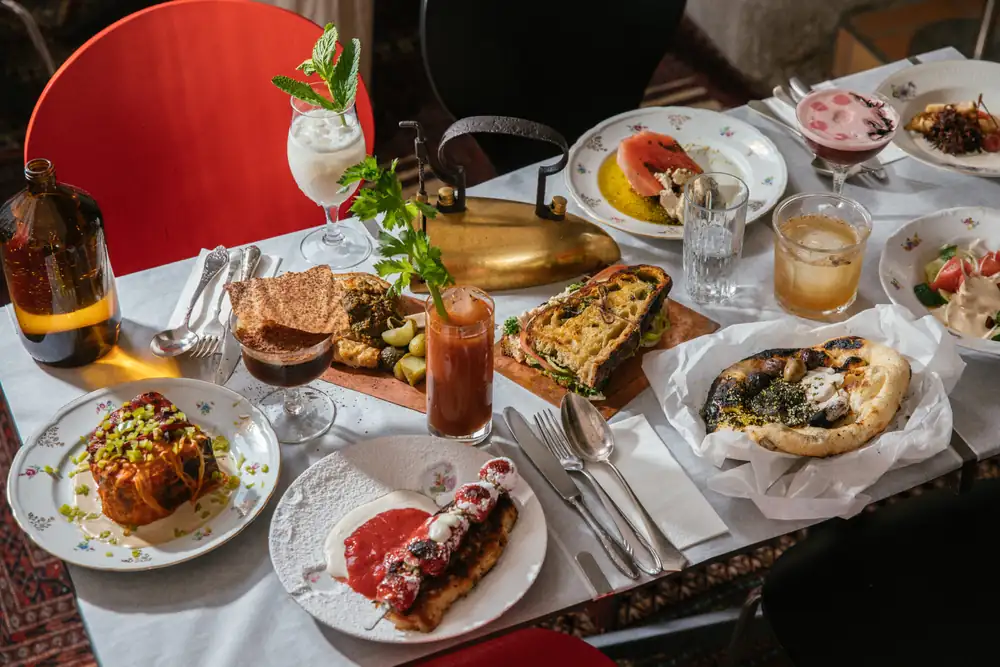
By the way, there are a lot of brunch places in Budapest right now, but we work without eggs and dairy products, so we had to come up with a completely different concept. That's why we created this new format: in the morning time slot, with more relaxed, comfort foods, but we don't treat it as a classic brunch. For example, there are also exciting elements like our strawberry granola cocktail, which is an evolution of the classic yogurt-granola dish into an alcoholic cocktail.
You have also extended your opening hours, so you can reserve a table as early as 10 pm. Do you want to bring the Middle Eastern, Mediterranean dinner culture here?
It started when I kept complaining that you can't eat well in Budapest after 10pm. I come from a place where you can go to a café for a flat white at midnight. If I finish work at 2am, I like to sit down somewhere, it's my time to think and process the day, but unfortunately I didn't find that here. This is not just a problem in Budapest, it's a problem in all of Europe. I understand it partly because people want to live their lives, not work all the time - the mentality is different here. But I would like to sit down in a restaurant at 9 or 10pm for a delicious meal, I would like to have a choice besides döner and hamburgers. Tourists want this too: they came on holiday, they stay up late, they need a place where they can eat well. I also want to make Budapest a little livelier.
You recently opened the doors to private events.
Yes, and I love organizing these. We can do everything that we can't do in a normal catering: we serve the food in large portions, scattered around the table, everything is chaotic, the music is loud, there's an open bar, the place has a party atmosphere. We haven't done many so far, but I'd like to do at least one a month.
Let's move on to the menu! Harel, I understand you used to go to the farmers market yourself – what was the last thing you brought back from there?
Yes, I try to buy everything myself. That's why I recently brought home ten kilos of za'atar from Israel in my suitcase. I went out with an empty suitcase to buy it in the villages and bring it home, because you simply can't get it here. Also, I go to the market every Wednesday, for example, now the corn has started to ripen, it's sweet now, I brought it from that. We simply roast it over coals, with wild garlic oil, which I also make. Last year I started preserving seasonal things: I ferment, pickle, make vinegar. I have a bunch of jars with all kinds of preparations.
Have you ever had an ingredient that was so good that you completely changed the menu for it?
Unfortunately, there hasn't been one like this before, but I'd love to have one. I like having to rethink things every day. For example, I'm just now starting to really discover the possibilities of fermentation. This year we fermented white asparagus, dried it, and then made a salt out of it, which gives it a brutal umami flavor and can be used all year round.
What seasonal items are on the menu now?
Mainly fruits: apricots, cherries, peaches. I especially like apricots, they are fantastic here in Hungary. We also use them for cocktails: we burn the fruit, squeeze it, mix it with habanero, and it makes a very smoky, tropical drink. The menu now includes strawberries, and more seasonal desserts are expected soon.
I heard you also work with your own farmers.
Yes, and it’s a huge deal. We found a farmer, Ágoston Nobilis from Csoroszlya Farm, who grows wheat. Last year we started talking to him about wanting to grow our own freekeh, which is a smoked grain made from green wheat from Arab countries. This year he harvested and smoked the first batch as an experiment – if it goes well, he will grow a larger quantity for us next year. Another farmer, Áron Pető – who is one of the first organic farmers here in Hungary – planted a special Israeli tomato, Maggie, and cucumbers for us as an experiment. If it goes well, we will continue on a larger area next year.
The best part is getting to know the farmers, seeing the work on their hands, their passion. I love these people: they come to the market with their trucks, where everyone sells one or two things, one has potatoes and carrots, the other cauliflower and cabbage. It's really exciting that they don't outsource it to someone else, but they sell the goods themselves. I can't really explain why, but it's the right thing to do, and it's a wonderful thing. For me, the greatest privilege I have as a chef is to be able to work with them.
If someone comes here for the first time and wants to eat something that has the essence of Goli in it, what would you put in front of them?
The Jerusalem salad. It's very simple: tomatoes, onions, cucumbers, lemon juice, olive oil, salt. For me, the goal is to put the simplest thing on the plate, with the greatest care. If you do something simple but with a lot of attention, it will be better than anything complicated. We mix this salad by hand for thirty seconds so that the flavors come together, the juices are absorbed back into the vegetables, and in the end it's not a bunch of separate flavors, but something completely different, a sixth flavor. This is the most exciting dish on the menu for me.
If you had to describe in one sentence where Goli is now, what would you say?
This is a tough question, but I would say that we are breaking out of our own shell. We are becoming bolder, we are daring to of ourselves. There is a Hebrew word for this that is hard to translate - something like "brazenly brave." It means that you are doing something that is scary, but you know it will be good and you will get a lot out of it. It is basically stepping out of your comfort zone.
Is there something you'd like to do right now, but haven't dared to start yet?
I want to open a techno club with good food. Seriously. If I could, that's what I would do. Goli will stay what it is - it has its identity, we take care of it - but we are looking for a new place for something different. First of all, we want to make our own bread, because bread is the only thing on the menu that we don't make. We have cornbread, but there is not enough space for regular bread. We need another space for that. But we have a lot of ideas and we are waiting for the right place to find us - we believe that space also sends signals and shows us the right direction.