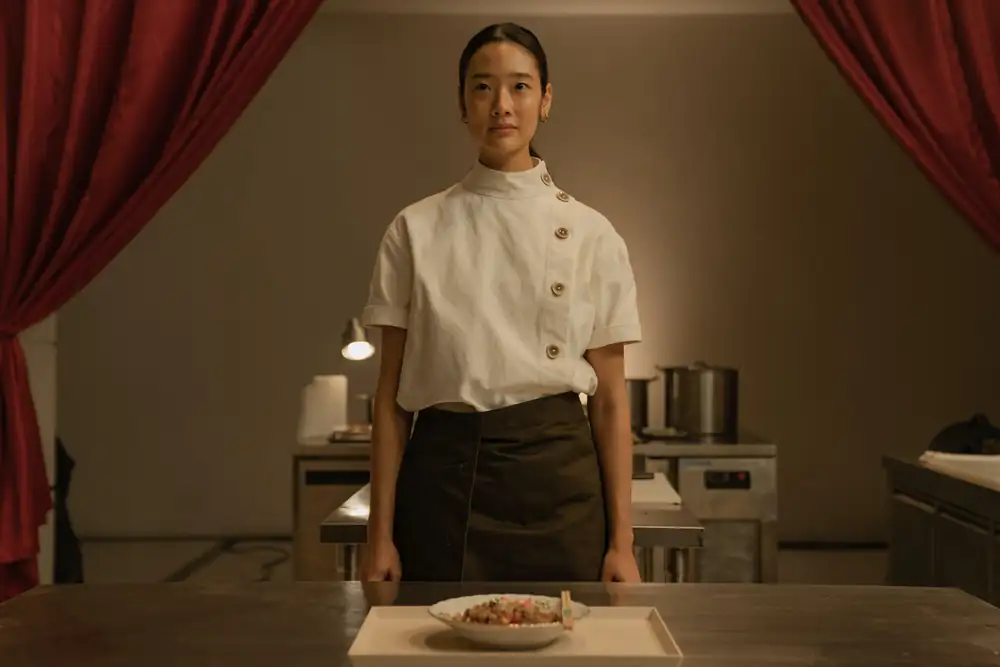
The film “The Craving” depicts the journey of a young Thai chef
Hunger takes us to Bangkok, where Aoy (Chutimon Chuengcharoensukying), the eldest child of a young woman named Aoy, runs her family's noodle restaurant while dreaming of much bigger things.
Famous for his impressive and lavish food and shows, Chef Paul (Nopachai Chaiyanam) both motivates and destroys his students in order to achieve the best results. A charismatic man in his fifties, driven by anger at inequality, his goal in life is to make people crave him and his food.
Aoy represents that food and cooking are essentially fueled by love, family heritage and values, and tries to grow up to the task, slowly becoming a professional chef. He soon becomes a competitor with Chef Paul, and as Aoy learns the contradictions of the fine dining world, he slowly loses himself. The struggle of the two chefs introduces us to the complexity of the fine dining world, with the conclusion that we often have to reevaluate our desires in order to find ourselves again.
Craving often works with thriller-like scenes, drawn-out characters, and elemental sequences, but it tries to capture many elements from the world of fine dining that are hidden from most people's eyes.
Eternal competition
The basic premise of Craving is that the winners in the world are always those who are driven by the greatest forces and motivations, those who crave more and greater things the most.
Many chefs dream of working in the world of fine dining and in the highest-level kitchens. Such a place can offer a young chef a lot, an opportunity to get acquainted with quality ingredients, advanced techniques, amazing food, professional staff, and the promise of opening their own restaurant one day. In addition to showing how one can climb the culinary ladder, Sóvárgás also deals with the stress that can come with achieving goals. After Aoy reaches the point of owning her own restaurant in a world dominated by men, she also has to deal with the fact that staying at the top is not easy.
The character of Chef Paul depicts the state of mind of a chef who is in a competition with himself and everyone else, while drifting towards complete burnout and disillusionment. The image of the shouting, arrogant, unbridled chef who takes out his own frustrations on others in order to achieve the maximum in order to serve perfect food to his guests day after day is not unknown. The pressure to perform, the stress of expectations, and the high work ethic can often lead to irresolvable tensions. The scenes set in the kitchen sensitively depict the constant pressure on chefs in fine dining restaurants and the daily struggle, where there is a risk of losing oneself and the love of cooking, which is why one originally chose this profession.
Allegories and reality
This isn't the first time filmmakers have turned to the world of gastronomy to satirize social inequalities. (The Menu, or tangentially, The Triangle of Sadness.)
In the world of Craving, fine dining is the privilege of the rich, and chefs who have come from the working class cannot even afford the food they prepare, and they constantly struggle with this contradiction.
Food and eating are the quintessence of existence, of survival, and its culture has risen over the centuries to a level that today represents high artistic value. Craving deals with this uniquely complex formula, stating that “What you eat represents your social status. Those living on the margins of society eat to satisfy their hunger. But when it takes someone more than just basic needs to be met, then your hunger, your craving, is insatiable.”
While The Yearning is a provocative and often downright drastic critique of the unbridgeable gap between the Thai working class and the elite, it also delves into psychological depths and speaks to the possibility of loss of value.
In a key scene in the film, Chef Paul serves a bagged soup to guests at a luxurious party, who enjoy it with the same pleasure as the world's most expensive wagyu steak. The scene and the character of Chef Paul raise the question of whether, after a while, the creative chef behind the fame and recognition reaches the top and ceases to be a representative of innovative, value-creating cuisine and becomes just a name, a symbol.
Behind the scenes secrets
The film's director, Sitisiri Mongkolsiri, made sure that the cast got the most intimate insight into the world of gastronomy before playing their roles. In this, they were assisted by Bangkok chef Chalee Kader, who did his best to ensure that the actors authentically prepared and served the Thai food epics seen in the film, whether it was a family recipe called pad ngor ngae, a wagyu steak, or a whole roast beef.
Chalee Kader's 100 Mahaseth cuisine, which focuses on meats and offal, has been awarded a Bib Gourmand. Her philosophy is nose-to-tail, or the creative use of an animal from its nose to its tail.
In addition to addressing universal questions about self-discovery, women’s empowerment, and social inequality, Craving is an undeniable celebration of the complexity and diversity of food culture. The film’s protagonist, Aoy, returns to her family restaurant at the end of the film, carrying on not only her family’s pad ngor ngae recipe, but also the values of fine dining cuisine. Her passion, her genuine love of food and cooking, her determination, and her desire to be unique will help her one day create her own signature menu.