“Even as a child, it was natural for a dish to start with the ingredients” – interview with Bencé Várkonyi, chef of Galuschka
We talked to the chef about returning home, the flavors of Borsod, and how long it's worth touching a dish that almost everyone has their own memories of.
Galuschka recently opened, and you recently returned to Tokaj-Hegyalja after working in several parts of the country. What made you finally choose the region and Galuschka?
I grew up in Tiszaladány, a small village near Tokaj, which also gave me a decisive foundation professionally. Our family farmed, had a large garden, and kept animals, so a significant portion of the ingredients came directly from the garden or the farm. Even as a child, it was natural that preparing meals began with the production and processing of the ingredients. Later, in Budapest and Esztergom, I learned a lot about modern kitchen technology, professional work organization, and the operation of high-level hospitality. At the same time, the knowledge and ingredient culture that I brought from Tiszaladány became increasingly valuable to me, so my roots definitely played a role in this.
The opportunity for Galuschka was approached by the store manager, with whom I had worked before. We knew each other and each other's work well, so I was happy to listen to him when the project came up. After learning the details, I really liked the concept, I could easily identify with it, so I felt it was worth taking the plunge.
You've already started developing the menu together. What were the first few dishes or ingredients that you thought would define the menu and the restaurant?
The name Galuschka already defined the main direction, so we wanted to show the dumpling in as many forms as possible and use it as often as possible. We have egg dumpling, chicken paprika dumpling, golden dumpling, and currently we also have daragaluska. This gave the backbone of the menu and the basic direction of the cuisine: we build on classic Hungarian flavors, in our own way. Here we didn't necessarily want to display favorite dishes, but rather ingredients that we enjoy working with, that we can identify with.
Speaking of ingredients, how important is it to you to source them from Tokaj-Hegyalja or its surroundings?
It is very important, we try to work with as many local producers and farmers as possible. And we manage to get most of our raw materials from here: meat, sour cream, cheeses, mangalica, microgreens, vegetables. Fortunately, we can cover a significant part of our raw material needs with local farmers and producers. We have permanent suppliers. We have a baker in Tokaj, we work with local mangalica producers, there is Zemplén Cheese, Mádi Cheese, and the beef also comes from here, from the area.
Is there anything you need to go further for?
We only get our poultry from further afield, from the Szeged area, from Kendermagos on the Kurca River: chicken, duck and other poultry. Apart from that, we are very well supplied by the locals.
You basically bring more classic Hungarian cuisine, and every Hungarian guest probably has a very specific idea about these dishes. What do you keep from the classic version, and what do you change?
We try to keep the main elements of the dishes, their backbone, while trying to present the given dish in its best possible form. You can add different elements, but the basic flavor remains the same, it is important that it is recognizable in the taste of the dish. For example, with egg dumplings, the egg dumplings themselves remain, but we supplement them with perfect eggs, dehydrated egg yolks and egg espuma. For other dishes, we also work with additional elements that refresh and make the overall effect more exciting: marinated vegetables, fried capers, dried cherry tomatoes or drizzled sour cream. We ferment and acidify vegetables and fruits a lot, and fermentation and smoking are also very characteristic of our cuisine and our dishes.
You've also worked in a Michelin-starred kitchen. What is it that you brought with you from that world that you can apply here?
All my previous jobs have taught me a lot. I learned not only about cooking and preparing food, but also about how to approach work, people, and actually myself. I learned humility, discipline, the importance of teamwork, respect for ingredients, and what makes a restaurant and a kitchen work really well together. I try to incorporate a lot of everything I brought from my previous jobs into the team, the kitchen, and the ethos here.
You've talked about Borsod cuisine and your passion for it several times before. What does this reflect in the Galuschka kitchen?
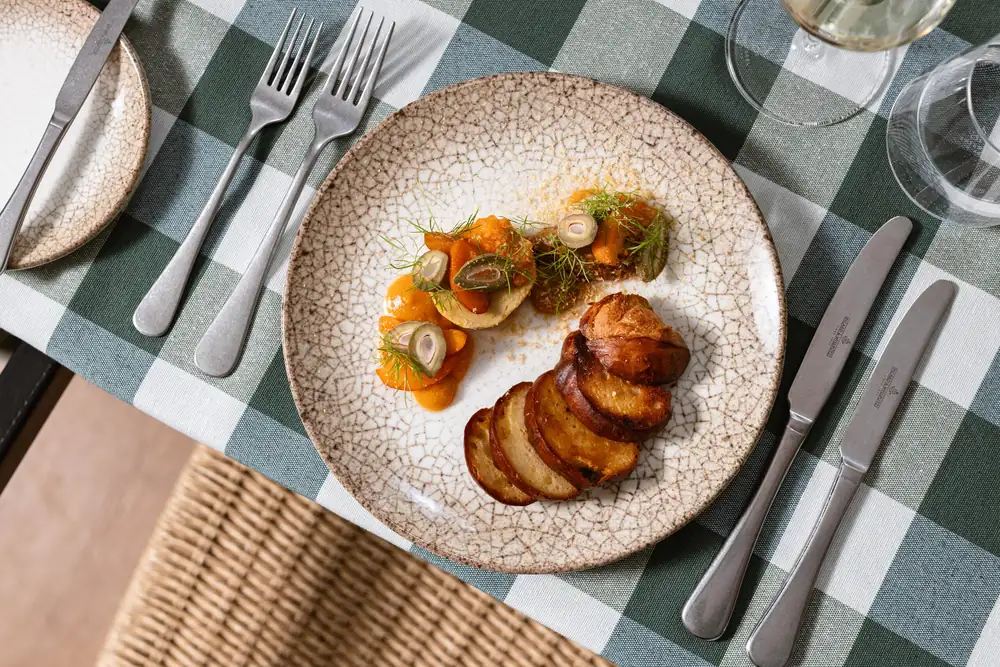
Offal has a strong tradition in the cuisine of the region, and I really enjoy working with it. It's still a less obvious choice for guests, but it's good to and more people opening up to it. Our mangalica marrow toast, for example, is becoming increasingly popular.
You've already had your first summer. What are your experiences so far: how did the audience react, did you have to rethink anything, and which dish was the most popular?
During this time, we had to find a balance between the needs of our guests and the dishes I enjoy making, so that both locals and visitors to Tokaj could find something to their liking. Our clientele has now settled in. Tourists are also present in large numbers, but we have also managed to open up to guests from the surrounding area. Currently, the ratio is roughly 60-40 percent in favor of tourists. When we opened, they were mostly locals, from the surrounding area, but now during the tourist season the ratio has reversed.
The biggest crowd favorite is probably the golden dumpling, they love it very much.
As the colder weather approaches, there will likely be fewer tourists. How are you preparing for this and what programs do you have planned for this period?
Our goal is to have as many regular, returning guests as possible. The basic concept remains the same, but the menu always changes seasonally. The favorite signature dishes remain, but we always want to come up with some surprises.
We also try to organize as many programs as possible to fill Galuschka with life and turn the restaurant into a bit of a community space. We are planning wine dinners, workshops, barbecue events on the grill terrace, we are preparing for goose days and a pig roast event is also planned. We would like Galuschka to be a place where it is good to return all year round, not only for a dinner, but also for the programs and the community.
The wine list is of course particularly important in Tokaj. What was the basis for compiling it, and how does the food relate to it?
The wine list was put together by Enikő, the store manager. We work with a lot of local wineries, and she tried to include as many small and large wineries from Tokaj-Hegyaljár on the wine list as possible. The dishes were created independently, but at the same time, it was important when designing them that they worked well with the wines and that a good pairing could add to the experience. Personally, my favorite pairing is our duck liver with the 2018 Oremus 3 Puttonyos Aszú.
You also use aszu as an ingredient. How does it appear in dishes?
For the golden dumplings, the golden raisins are marinated in aszú, and the duck liver is marinated with aszú. We try to feature Tokaji wine and aszú in our dishes as much as possible, while trying to maintain the originality of the wine.
We also work with Dobogó Winery, who have a very interesting and exciting product. A blue cheese that uses aszú to ripen. Dobogó Blue is made with aszú marc grains enriched with aszú essence, which we also use as an ingredient.
Is there anything you're working on right now, either on the menu or in the restaurant itself?
Of course, we are always working on something. We will keep our classic dishes, but there will also be new dishes through which we can better show ourselves and the knowledge we have gained on our journey. We will be constantly improving and adapting to guest needs.