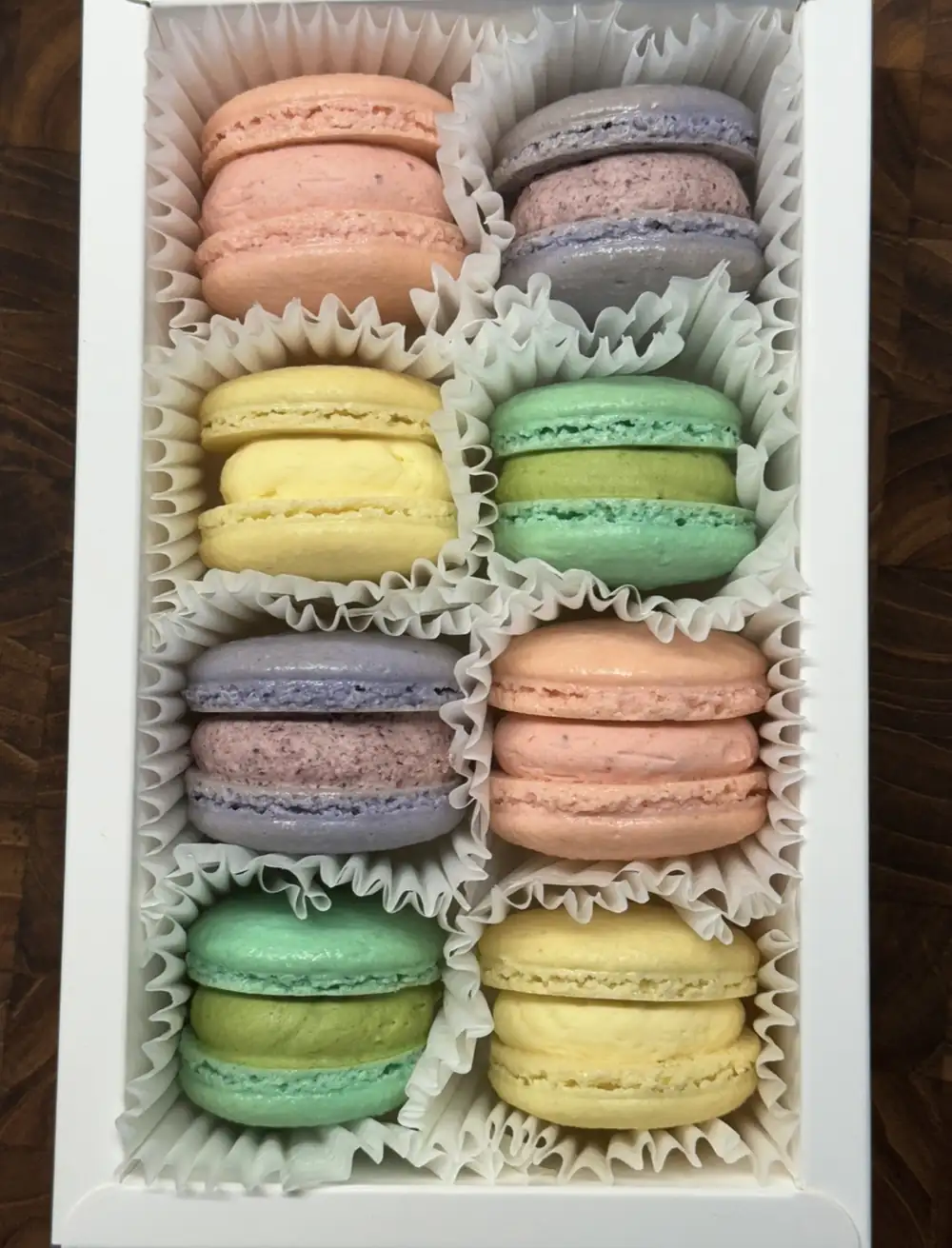
French Macarons: A Complete Guide and Recipe
What Are French Macarons?
- 114 g almond flour
- 127 g powdered sugar
- 80 g egg whites
- 70 g granulated sugar
- 2 large egg yolk
- 55 g granulated sugar
- 20 g water
- 113 g unsalted butter (salted butter works too, I honestly like it more to give more depth of flavor)
- 1 tsp vanilla extract
- In the bowl of a stand mixer, begin whipping the room temp egg whites on medium-low speed until they become foamy with large bubbles.
- Add one-third of the granulated sugar and continue mixing until the bubbles become smaller and tighter, like beer foam.
- Add the second third of sugar, continuing to beat until the mixture begins to look cohesive and glossy.
- Add the final third of sugar and continue whipping until the sugar is incorporated. Add in your food coloring (I reccomend gel) and slightly increase your mixer speed and continue whipping until stiff peaks form. Check by swirling and lifting the whisk—you should see sharp, upright points.
- To your meringue, sift in your almond flour and powdered sugar.
- Fold and scrape the batter around the sides and through the center until it reaches the consistency where it flows off the spatula and forms a V-shape.
- Transfer the batter to a piping bag fitted with a round tip and pipe onto a nonstick reusable mat or parchment-lined tray.
- Tap the tray on the counter a few times to release air bubbles. Use a toothpick to pop any visible bubbles.
- Let the shells rest at room temperature until they form a dry skin—about 30 to 60 minutes depending on humidity.
- Bake at 300°F for about 14–16 minutes (or 275°F in convection). Rotate the tray at the 10–12 minute mark if needed. Shells should not wiggle when touched.
- Allow to cool completely before removing from the mat.
- In a heatproof bowl or stand mixer, begin beating the egg yolks on medium speed. The goal is to get them light and fluffy.
- In a small saucepan, combine the sugar and water. Heat until the syrup reaches 240°F (soft-ball stage).
- With the mixer running, slowly drizzle the hot syrup into the egg yolks in a thin stream. Make sure you stream the syrup along the edge of the mixer bowl not directly into the egg yolks (this ensures that it will not cook the egg yolks). Continue beating on high speed until the mixture is thick, pale, and fully cooled to room temperature.
- Add the butter in chunks, a few pieces at a time, until fully incorporated. Beat until the buttercream is light and fluffy.
- Add vanilla extract or other flavorings as desired. Use immediately or store in the fridge and rewhip before using.
- Make sure your shells are completely cool before assembling—any residual warmth can melt the filling.
- Match up similar-sized shells in pairs so your macarons are uniform.
- Fill a piping bag with your buttercream or other filling of choice.
- Pipe a generous dollop of buttercream onto the bottom shell.
- If desired, add a secondary filling in the center—such as jam, curd, ganache, or compote—for flavor contrast and texture.
- Gently press a second shell on top to sandwich the filling.
- Place assembled macarons in an airtight container in a single layer.
- Let them mature in the fridge for at least 24 hours (preferably 36–48 hours). This allows the shells to absorb moisture from the filling and develop the ideal chewy texture.
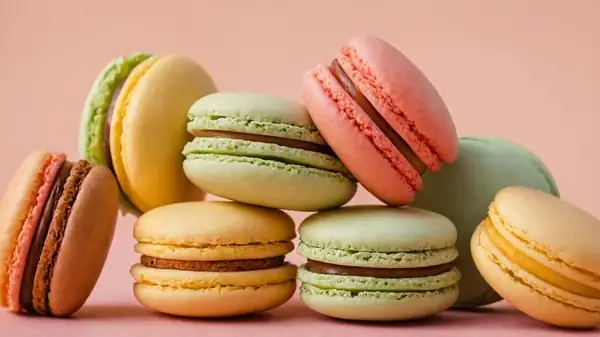
French macarons are delicate sandwich cookies made from whipped egg whites, sugar, almond flour, and powdered sugar. They’re crisp on the outside and chewy inside, filled with buttercream, ganache, or jam.
There are a few different methods for making macarons:
French macarons use a simple French meringue (egg whites whipped with granulated sugar) and are known for their approachability.
Italian macarons use a sugar syrup poured into whipped egg whites, making for a more stable meringue.
Swiss macarons heat the sugar and egg whites together before whipping.
This recipe focuses on French macarons, which are slightly less stable than Italian but easier to master for home bakers and arguably taste lighter. While recipes from reputable sources generally work well, most macaron issues stem from technique —not the recipe. Common problems include:
Hollow shells
Cracked tops
Wide or ruffled feet
No feet or lopsided shells
The three pillars of macaron success are:
Meringue
Macaronage (batter mixing)
Oven temperature
Mastering the Meringue
I make my meringue by adding sugar in thirds. Here’s the breakdown:
Start with room temperature egg whites — cold egg whites are harder to whip and less stable. I beat them on medium-low speed until they foam. At this stage, bubbles are visible but loose.
Add the first third of the granulated sugar and continue whipping. Once the foam becomes tighter and starts to resemble beer foam, add the second third of the sugar.
Keep mixing on medium-low until the mixture becomes cohesive and glossy. It shouldn’t be at soft peaks yet, but the sugar should be mostly dissolved. Add the final third of sugar.
Now slowly increase the speed slightly— don’t go too fast, or the meringue can whip too quickly and collapse. Take a “slow and steady” approach to develop a strong, stable meringue.
Whip until stiff peaks form. To test, swirl the whisk around the bowl and lift up— you should see strong, stable horns that hold their shape. If it looks like stiff peaks but droops or looks soft when moved, it’s not ready.
Macaronage (Mixing the Batter)
This is the step where most things can go wrong—but if you’ve nailed the meringue, you’re already halfway there.
Macaronage is the folding of the almond flour/powdered sugar mixture (tant pour tant) into your meringue. The goal is a smooth, glossy batter that flows slowly but doesn’t spread too thin.
Undermixed: Peaks don’t settle, bumpy tops, small or no feet.
Overmixed: Wide, ruffled feet, cracked or collapsed shells, sticky tops.
My personal tip is to undermacaronage slightly —when you transfer it to a piping bag, the batter will naturally deflate a little more. Piping also agitates the batter slightly. If you mix it to the textbook “lava flow” in the bowl, it often ends up overmixed by the time it’s piped.
Instead of waiting for full ribbons or a figure 8, I scoop up some batter with a spatula and let it fall. If it drops off and forms a nice V-shape, I stop. It may look a bit too thick in the bowl, but it evens out after piping.
Oven Temperature
Be very aware of your oven type:
Conventional ovens (no fan) are ideal.
Convection ovens (with a fan) may require reducing the temp by 10–25°F.
You want the true oven temp to be 300°F. A separate oven thermometer is a must—many home ovens are inaccurate.
Too high: cracked shells, large feet that flare out, burnt bottoms. Too low: underbaked centers, dull shells, no feet or uneven rise.
For convection ovens, I bake at 275°F, fan off or on lowest setting. You may need to rotate the tray about 10–12 minutes in, once the feet are fully set.
Don’t Throw Out the Yolks!
For a no-waste macaron recipe, use those extra egg yolks to make Pâte à bombe buttercream (French buttercream made by whipping egg yolks with sugar syrup and beating in butter). It’s luscious, rich, and pairs perfectly with delicate macaron shells.
My Favorite Baking Surface
I use a reusable nonstick parchment sheet like this one on Amazon. I’ve found it releases shells far more easily than standard silicone mats or parchment. It also leads to more even bottoms and better heat distribution.
My Macaron Recipe
I prefer macarons that are less sweet than the traditional versions. That’s why my base macaron and buttercream ratios are designed to tone down the sugar without compromising structure or texture. Traditional macarons often follow a 1:1:1 ratio of almond flour, powdered sugar, and egg whites (by weight), and fillings like pâte à bombe or Swiss buttercream can lean heavily sweet.
This recipe intentionally uses slightly less powdered sugar in the shells and a reduced-sugar pâte à bombe buttercream to ensure the final macaron isn’t overwhelmingly sweet.
If you want to follow the classic route, here are traditional proportions:
But in the actual recipes below, you’ll see my custom reduced-sugar version, which I find more balanced and enjoyable.
* scale your recipe proportionally according to how much your egg whites weigh for 2 large eggs
Pâte à Bombe French Buttercream
Macaron Shells
Pâte à Bombe Buttercream