Artificial intelligence in restaurants
It's a recurring theme to predict the role of artificial intelligence in the culinary world, naturally accompanied by elaborate opinions from experts, including the doomsayers. But how is AI applied in the restaurant industry?
Let's demystify the basic concept of AI a little, since, so far, the technological advances applied do not actually correspond to the reproduction of complex cognitive processes such as intelligence, the capacity for reflection, or the abstract thinking characteristic of Homo sapiens.
AI responds to established and pre-programmed protocols, a series of data and possibilities of combining these, guided by a "non-artificial intelligence".
AI is currently applied to all aspects of data processing, using refined algorithms to identify customer behaviors and preferences, allowing for the creation of appropriate and personalized offers. It is used as a practical tool in communication, sales, customer acquisition, and marketing, as well as in the reservation process within the restaurant industry.
Usefulness in systematization
AI is being successfully implemented both in the back office – cost management, billing, automatic purchases, ratios, connection with consumption, waste, stock replenishment – and in the front office – facilitating orders and invoicing.
The brilliance of AI is dazzling the entire functional, systematization, and data processing sector in record time, just as the first assembly line or the steam engine revolutionized production and large-scale industrialization. AI has been implemented in all standardized processes, based on instructions for its management, enabling it to generate countless combinations, scenarios, deviations, analyses, and define metrics, connecting and interpreting the data.
But if we talk about the abilities that differentiate us from other animals, such as creating or imagining, it seems unlikely to succeed in the gastronomic restoration, quoting Ferran Adrià: "To create in the kitchen at a professional level, artificial intelligence is not necessary; human intelligence is more than enough."
However, it can be a tool to create, recreate and inspire, generating a thousand combinations between products, techniques, tools and/or intermediate elaborations that facilitate our work; we have already seen it applied in different disciplines such as the creation of songs, images or paintings.
The most tangible evidence of AI application can already be seen in fields like pastry making, where it allows us to "create" our own cake, pastry, or semifreddo. As we mentioned, it first allows us to incorporate our customers' preferences, but it can also modify the composition of these creations, replacing ingredients that cause allergies or intolerances with others, balancing the formula so we can create a successful dessert that perfectly suits our customer's taste—a complete personalization.
How useful it would be for many chefs if, at any given moment, when a reservation informs them of an allergic or intolerant profile in their restaurant, they could instantly obtain the possibility of making the various preparations conceptually the same as their proposal but without the allergenic ingredients and thus offer the same experience to a table with several diners.
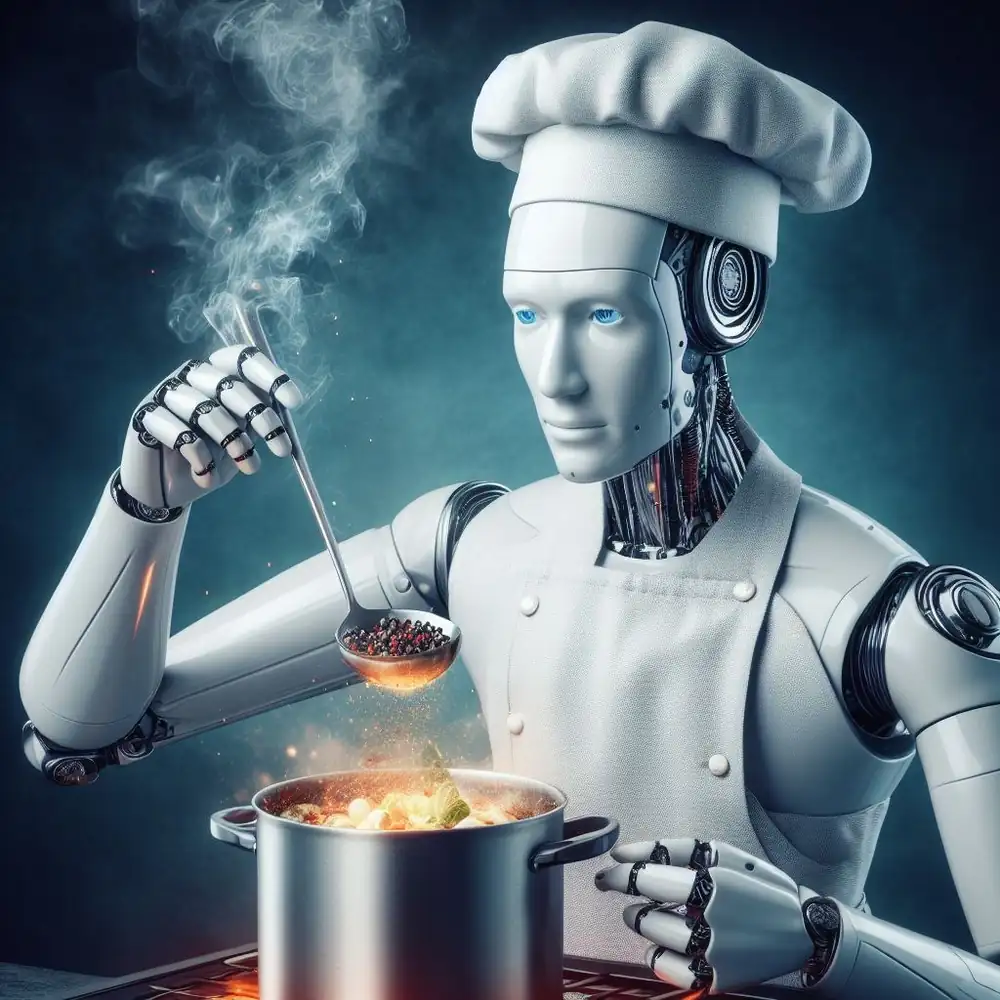
For now we're talking about data, about creating a recipe; from here, its reproduction could be done by robots, we've already seen its viability and it's not science fiction, but this might still raise eyebrows.
Artificial empathy
Although it is difficult to defend the treatment and warmth of service in these times, it is something that humanizes us and perhaps, although we see applied technology and robotics to compensate for the overwhelming staff shortage, undoubtedly as it is presented it can hardly displace the professional in the dining room.
The other day, talking to someone in the industry, they told me that in a restaurant, you can "save a bad meal with good service, but the reverse is unlikely to result in a customer returning." I wonder how far science has advanced in "Artificial Empathy."
The shadows lie in those problems that are being generated and that perhaps have not been taken into account, or perhaps have, such as data protection or the type of discrimination generated by algorithms and the very traps we apply that dehumanize this Intelligence.
Personally, I am about to reset and embark on a search for the HI (Human Intelligence) that is so often lacking.