Haute cuisine raises its voice at Madrid Fusion and acknowledges being suffocated by over-regulation
Fine dining is a major asset for Spain on the international stage. An ambassador for culture, tourism, and the national agri-food sector…
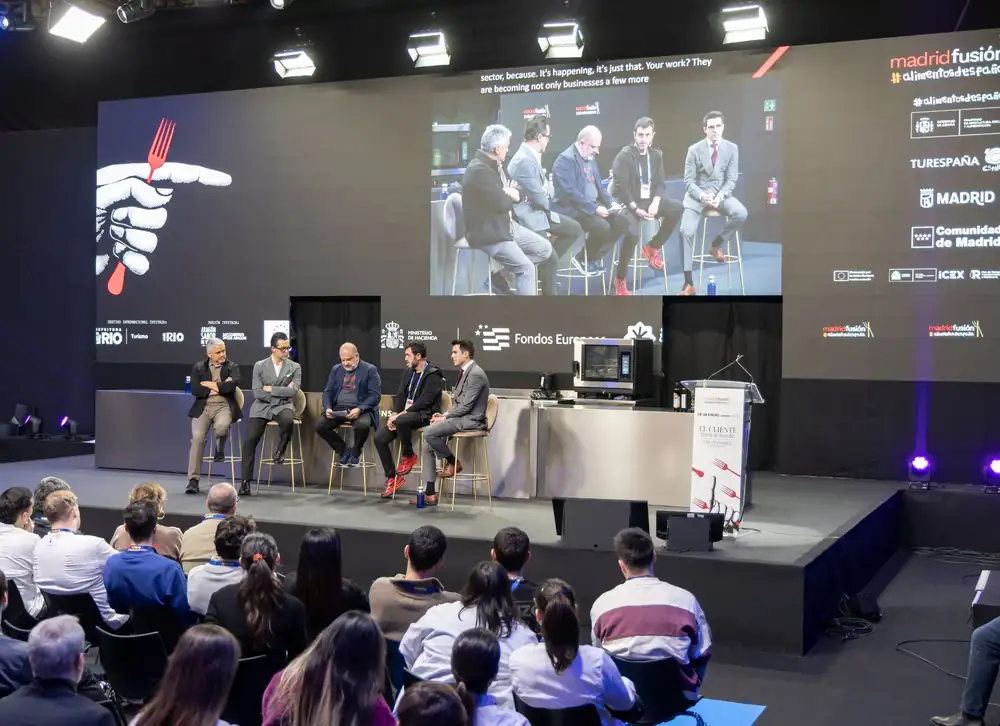
The presentation, entitled 'Self-Sustainability and the Future of the Culinary Profession', addressed a reality that Ricard Camarena summarized as follows: “We are a strategic sector and we go where we are called, but we have no interlocutors to address our problems. The hospitality industry is legislated by lumping together very different situations, and in the end that satisfies no one. Moreover, we have no one to explain these situations to, and because we cannot talk, the problem only gets bigger and bigger.”
Labor legislation and the rigid application of permitted working hours were the main sticking points. “There are many people in the sector eager to start a small business and prosper, but it's becoming increasingly difficult because we're over-regulated,” Nandu Jubany explained. “Mind you, some previously opaque areas have also been regulated for the better, but we've gone from one extreme to the other. We're setting an example in our commitment to sustainability, but the business itself has to be sustainable; a profession that allows people to make a living. We tailor our staff's schedules to their needs. If someone needs to work twenty hours, we create a schedule for them with 20, 30, or 18 hours, but if someone wants to work 100 hours a week, they can't, because the law prohibits more than 80 hours of overtime per year.”
Quique Dacosta elaborated on this point. “Our restaurant industry not only has to be exemplary in its creativity or its relationship with producers, but it also has to be efficient. We are trying to preserve our historical and cultural heritage; that which represents us as Brand Spain in the world, which is gastronomy, with all its economic implications, but we have no interlocutors to talk about us,” he said.
Benjamín Lana posed the question of who these interlocutors would be and what their main demands would be. “I think it would be very interesting to organize a committee of experts with people in the industry, and to ask them: ‘What problems are you facing?’” reasoned Israel Ramírez of Saddle. “Because we're trying to make gastronomy the flagship of our culture, but we're letting it fall behind. We can all see it dying, and nobody is doing anything about it. There are things we should have discussed years ago, and now is a good time to do so together.”
For Ramírez, the sector's problems begin with training. “The vocational training curriculum hasn't been updated for years, and anyone who has tried to take the civil service exam knows that being a math teacher gives you more points than being a professional with experience in the field. What happens? It doesn't inspire passion in young people, and we have far fewer waiters and cooks than we need.” Benjamín Lana added that this situation is compounded by the lack of flexible working hours in a sector “where there are peak periods of intense work.”
“This staff shortage means that when I open a restaurant, my main fear is that employees will be poached or leave, because then I'd have to close,” explained Ricard Camarena, adding: “These days, the employee holds all the power. And I don't think that making this relationship more flexible means going back to a situation of vulnerability. The system is creating that vulnerability because it's not allowing people to advance, to earn money by working for real, and for us to be able to contribute to social security for those hours. There's a lack of understanding, a lack of comprehension, and above all, a lack of context,” he concluded.
Quique Dacosta added another challenge to that adversity: the difficulty of retaining talent. “I need to have a pool of qualified and motivated people. At Quique Dacosta Restaurant, we train and provide scholarships to about 50 people a year, most of them from outside the EU. Professionals who, after completing their training, have to return to their home countries. As a concept, it's madness; we generate talent and we don't have the legal capacity to retain that talent that has decided to come here from all over.”
For Nandu Jubany, who in addition to his fine-dining restaurant manages a prosperous and financially sound business group, the consequence is clear: “We’ve had to close restaurants because we couldn’t find people to work. People talk about sustainability, but sustainability also means having something left over to reinvest and to pay your team well. I have chefs who earn as much as a multinational executive, and I’m absolutely delighted, because they earn it. But the legislation doesn’t allow us to do it properly, so we have to find loopholes: two employers, not being an administrator, making them self-employed… because, of course, the self-employed can work as many hours as they want.”
For Ricard Camarena, the sector's problems are clear, but to the obvious ones, he adds another: “We are many things and none. We don't depend on the Ministry of Culture because we aren't culture, we don't depend on Tourism even though we are a tourist asset, we don't depend on the Ministry of Industry even though we are industry. So what happens? There's no door to knock on. There's no direct, single point of contact who can understand this situation and who can truly offer solutions. What we have to do is cook, do it well, and make our businesses profitable,” he concluded, but, like his colleagues, he asked that nothing said be interpreted for political purposes. “This is almost a matter of national importance; of social progress and the survival of a sector. Politicians, please refrain from making this a political battle, because what we have to do is build together.”
The Madrid Fusión Alimentos de España edition, which focused on the customer, addressed issues that also impact service, restaurant hours, and the final price paid. Quique Dacosta, a seasoned veteran of the congress (who also presented his culinary innovations on the main stage this year), said, “Madrid Fusión is also a platform for us to make our voices heard, because we are an asset to the country, and these and other circumstances are preventing us from continuing to pursue this profession, which is passionate but must be economically sustainable.” He concluded, “My wish is that in ten years, the small project that begins today will have prospered, and that we won't have to close another dream and further impoverish our local economy. We leave this message with whomever it may concern.”