Six generations cooking eel
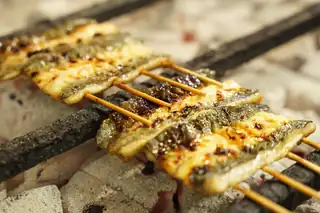
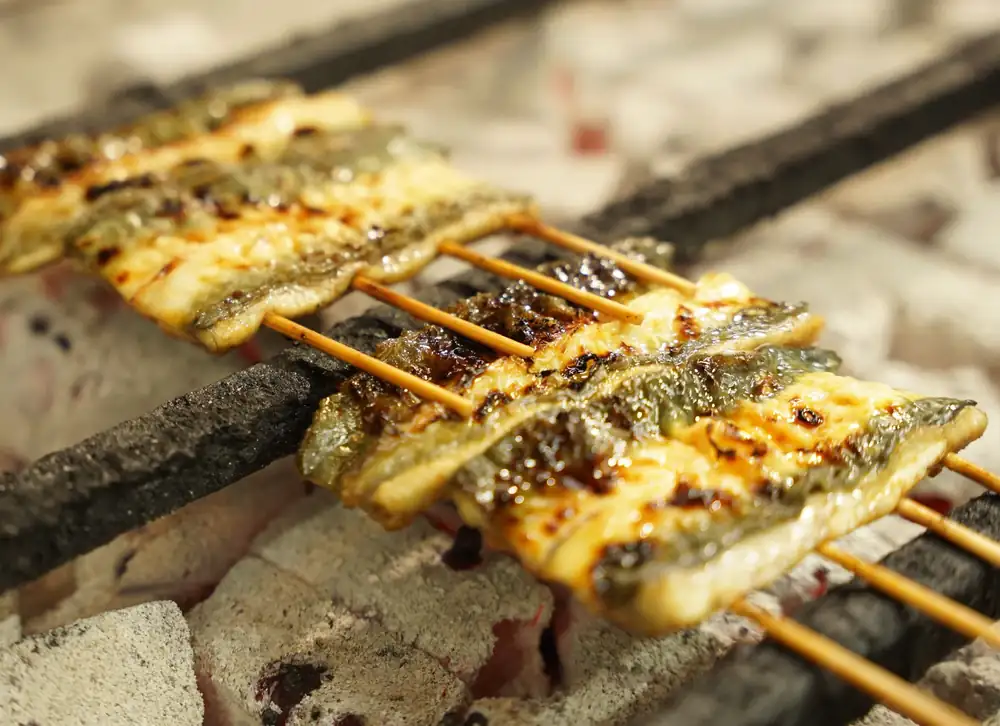
It would be more accurate to say that they select the finest 'kyushu' (small) eels, clean them with the utmost care, steam them, coat them in their secret sauce, grill them over hot coals, coat them again, and grill them once more until they reach the perfect point.
Single-product restaurants are common in Japan. If you want tempura, you go to the best fryer, and if you want eel (unagi in Japanese), you look for a place where years of experience and thousands of cooked specimens guarantee the best flavor and the most delicate texture, as is the case with Kinsan Ninonbashi.
Shinichiro, a sixth-generation eel farmer, is a sharp young man and is pleased to have an unusual table at the restaurant. He says, half-jokingly, half-seriously, that he only knows how to cook eels and that he aspires to see the world and learn other things. Masakazu, his father, watches him silently as he speaks with the visitors, thanks to Momoka, a longtime customer, who translates for them. At Kinsan, you don't see many Westerners, and there are no English translations. There's also no menu and not too many different dishes to order. Today is a special day, and our meal begins with raw eel usuzukuri, something very unusual even in restaurants specializing in unagi (seafood stew). They explain that it requires very precise control for its extreme cleaning and is only prepared on very special occasions. I had never eaten it before. It's beautiful and has a smooth texture, nothing like the texture of cooked eel. Its characteristic flavor is also absent. In that raw, very thin slice, it's much more neutral, giving way to the texture. The skin is served alongside in small pieces that curl up when steamed.
The next dish is a customer favorite. It's an umaki, a Japanese omelet, filled with eel in this case. The sweetness of the egg, mixed with dashi before cooking to make it silkier and more flavorful, contrasts beautifully with the eel. It's incredibly simple, yet addictive.
Alongside the meal, one of the traditional Japanese broths is served, made with another unfamiliar ingredient. It's a clarified, almost transparent dashi of eel liver and parsley. The unique organ floats in the bowl like a small clam, offering a slightly chewy texture and a delicate flavor.
The star dish of Kinsan Nihonbashi, the main course, arrives next. It's grilled eel served in a box on a bed of rice. Again, the apparent simplicity hides incredible refinement. The rice is cooked to perfection, both in texture and temperature. This is thanks to the quality of the grain, the Koshihikari variety, from Niigata Prefecture. In Japan, family-run artisan restaurants may have simple facilities, but if they practice washoku, or traditional Japanese cuisine, they place enormous importance on the quality and origin of the products they use. If you're interested in learning more, they might tell you that they buy this rice from Niigata because it's grown with water from the meltwater of Mount Amakazari, one of Japan's 100 most famous mountains. The green pepper they use to flavor their dishes is 'Budo Sansho' or grape pepper, and they bring it from Wakayama because after more than a century of flavoring their eels with sanso they know which one works best.
The only thing they don't reveal is the ingredients of the sauce they use to coat the unagi after steaming the eels on bamboo skewers and before placing the skewers on the charcoal grill, where they'll be grilled four times, each time alternating with a dip in the sauce. This dark marinade is one of the Matsuki family's secrets. It contains soy sauce and mirin, but they won't disclose what kind, how much, or what other ingredients. They've kept the same marinade alive for a century. They add fresh sauce to keep it from running out, but they don't change it. Its most valuable components are the juices and fat released by the thousands of steaming eels that have been marinated, releasing their essences.
The family is unaware of the controversy surrounding elvers in Spain. No Japanese person understands why people would prefer to eat a few hundred elvers at once instead of raising them to grow into adult eels, which are much tastier and more nutritious.
I'm salivating with anticipation of returning and I think that restaurants like Kinsan Nihonbashi and families like the Matsuki should be as protected as eels.