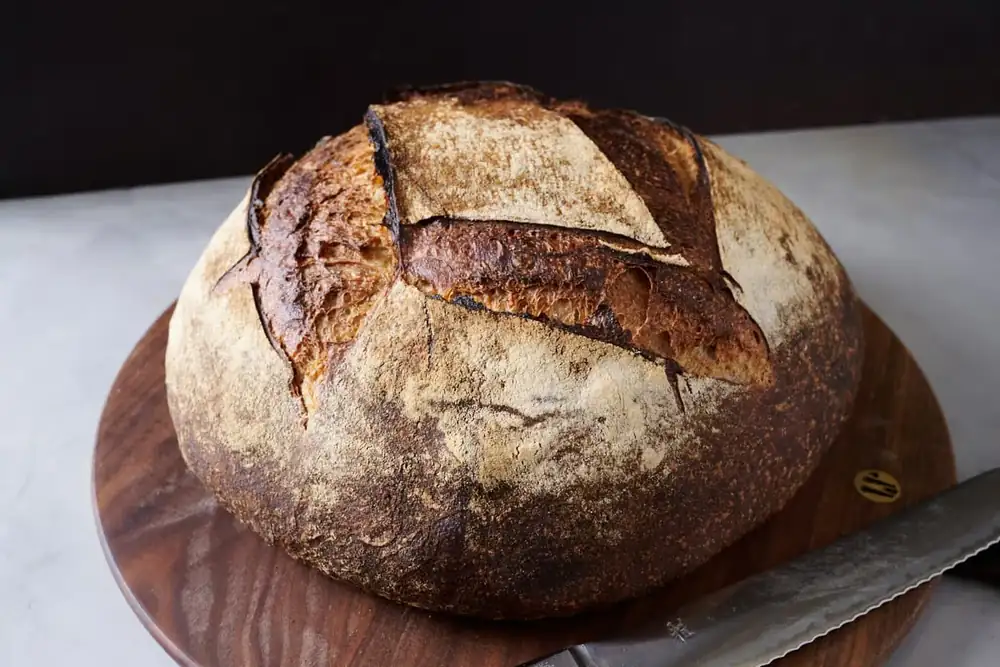
Hop Miche (Sourdough Beer Bread)
This is the kind of bread you want on your next family dinner (Thanksgiving! Christmas! Any meal!). With large loaves like this, it never ceases to amaze me how simply scaling up the size of a loaf transforms it so profoundly, but that’s precisely what happens, especially with this beer bread.
- 71g whole wheat flour
- 71g water
- 36g ripe sourdough starter
- 79g whole rye flour
- 197g stout beer
- 542g medium-protein white bread flour
- 293g whole wheat flour
- 569g water
- All of the tangzhong
- 118g water
- 20g fine sea salt
- 179g ripe levain
- Prepare the levain — 9:00 a.m.Mix the levain in your favorite jar and leave them covered at a warm temperature, 74-76°F (23-24°C), to ripen for 5 hours.
- Prepare the tangzhong — 9:10 a.m.Add the tangzhong ingredients to a medium saucepan set over medium-low heat. Cook, whisking continuously, until the mixture thickens and becomes a paste, 5 to 8 minutes. The beer will initially begin to foam, so keep an eye out that it does not spill over the pan. Whisk vigorously to break up any flour clumps, and continue to whisk well to avoid burning. Remove the pan from the heat and spread the tangzhong on a small plate to cool. Set aside.
- Autolyse — 1:00 p.m.Warm or cool the autolyse water so that the temperature of the mixed dough meets the final dough temperature of 78°F (26°C) for this recipe. Place the autolyse ingredients and the tangzhong in a large bowl. Use wet hands to mix until no dry bits remain. Cover the bowl and place it near your levain for 1 hour.
- Mix — 2:00 p.m.Add salt and levain to the autolysed dough, moistening with a splash of water. Mix thoroughly with wet hands or dough whisk, then knead for about 5 minutes using slap and fold technique or bowl folds until dough becomes smoother. Rest covered for 10 minutes. If dough feels dry and shaggy, mix in remaining water – if very wet, skip this. Knead again for 3-5 minutes until cohesive, then transfer to bulk fermentation container and cover.
- Bulk Fermentation — 2:15 p.m. to 5:45 p.m.Bulk ferment for about 3.5 hours at 74-76°F (23-24°C), performing 4 sets of stretches and folds at 30-minute intervals. For each set, grab the dough from each of 4 sides, stretching and folding over the center, rotating the bowl 90° between each fold. Cover between sets. After the final set, let dough rest covered until bulk fermentation completes.
- Shape — 5:45 p.m.After 3.5 hours, when dough is puffy with bubbles at edges, gently turn it onto a floured surface. For a single large loaf, skip preshaping but ensure sufficient tension when shaping into a boule. Transfer seam-side up to a heavily floured 10″ proofing basket.
- Proof — 6:00 p.m. to 9:00 a.m. (next day)Cover the basket with a large, reusable plastic bag and seal it shut. Place the basket in the refrigerator to proof overnight.
- Bake — 9:00 a.m.For this large miche, bake on a baking surface with steam or use a Brød and Taylor Baking Shell. Preheat oven to 450°F (230°C) for 30 minutes with baking surface in bottom third. Turn dough onto parchment-lined peel, score, and slide onto hot surface. Bake covered/with steam for 20 minutes, then uncovered for 45 minutes more until internal temperature reaches 204°F (95°C) and crust is dark, crunchy, and sounds hollow. Cool at least 3-4 hours, preferably overnight, before slicing.
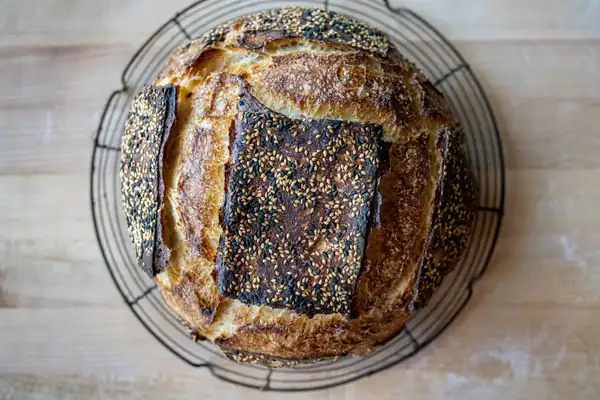
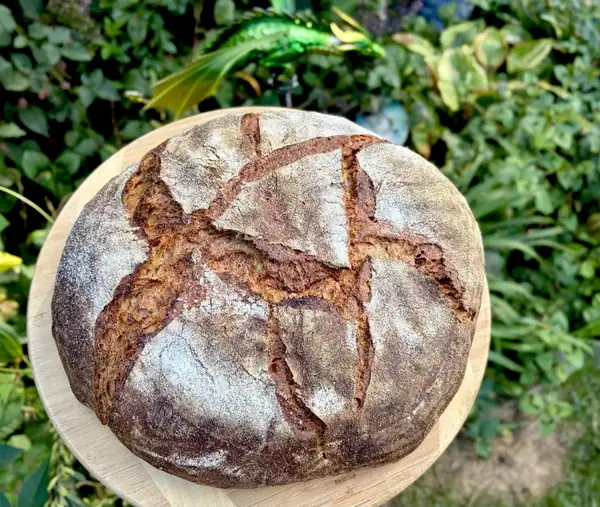
Instead of adding the malty beer alongside the water in the recipe, I use it in a tangzhong with whole rye flour. Essentially, I’m pre-cooking the flour with the beer, which amplifies the beer and grain flavor and aroma. It also brings softness to the crumb with a long-keeping quality (as tangzhong does). The crumb almost becomes iridescent and glossy, with dark overtones and a caramelized crust that’s a deep and brooding mahogany color.
To match its gorgeous outer appearance, this beer bread has an intense and rich flavor, thanks to the long fermentation time and the beer and whole grain flours. It’s malty, a little hoppy, and surprisingly, a little chocolatey. Now, this is what I call a miche.
Real Quick: Why This Hop Miche Good For A Large Gathering
I’m no stranger to baking bread with beer. In the past, I’ve made a stout sourdough and even worked in spent beer grains into a loaf (talk about fiber!). There’s a reason why they call beer “liquid bread.” In the end, they’re essentially the same product.
Let’s look at the flour blend I used for this miche.
Flour Selection
I love using specialty grains in large loaves like this beer bread miche because it’s a way to highlight an exceptionally flavorful flour in a large percentage. Plus, the high hydration of these miche and their large size mean the loaf lasts for a long time on the counter, letting me enjoy after slice after slice of the flavorful bread.
In this case, I used a hefty portion of hard red wheat from Camas Country Mill in the Pacific Northwest. Their freshly milled hard red is Yecora Rojo and makes for a strong dough that can take quite a bit of water. It’s also incredibly aromatic and stirs the senses right when mixing. In place of this flour, you can use any hard red wheat (typically any “whole wheat” you’d find at the market).
I paired this with stone-ground rye for the tangzhong, which added flavor and color to the crust. If you don’t have any rye on hand, swap this out for whole wheat.
Baking Schedule
I like to make this sourdough miche over two days for maximum flavor (and it makes for a slightly easier baking schedule, splitting the process over two days).
If you’re making this for a large gathering, bake this bread the day before the meal (this is what I do for Thanksgiving). This way, the bread has an entire night to set, allowing the complex flavor to develop fully.
Vitals
This recipe makes for a single large miche, but if you’d rather have two smaller loaves, divide the dough in half and make two round or oval loaves.
As always.
With this beer bread, I shoot for a typical final dough temperature of 78°F (26°C). See my post on the importance of dough temperature for a discussion on this and other temperature-related topics.
1. Prepare the levain – 9:00 a.m.
Mix the ingredients in the chart above in your favorite jar and leave them covered at a warm temperature, 74-76°F (23-24°C), to ripen for 5 hours.
2. Prepare the tangzhong – 9:10 a.m.
In a medium saucepan set over medium-low heat, add the 79g tangzhong rye flour and 197g tangzhong stout beer. Cook, whisking continuously, until the mixture thickens and becomes a paste, 5 to 8 minutes. The beer will initially begin to foam, so keep an eye out that it does not spill over the pan. Initially, whisk vigorously to break up any flour clumps, and continue to whisk well to avoid burning.
Remove the pan from the heat and spread the tangzhong on a small plate to cool. Set aside.
3. Autolyse – 1:00 p.m.
Since this recipe is this extra “soaking” time helps the whole grains fully hydrate.
Warm or cool the autolyse water so that the temperature of the mixed dough meets the final dough temperature (FDT) of 78°F (25°C) for this recipe. Place the flour, water 1 (autolyse), and tangzhong mixture in a large bowl. Use wet hands to mix until no dry bits remain; the dough will be quite shaggy and loose. Use a bowl scraper to scrape down the sides of the bowl to keep all the dough in one area at the bottom. Cover the bowl and place it near your levain for 1 hour.
4. Mix – 2:00 p.m.
Note that this recipe has a very high hydration; hold back Water 2 and only add it if the dough feels like it can handle it. Using the bassinage technique like this helps ensure we don’t overhydrate the dough.
This beer bread miche dough benefits from extra strengthening during mixing. Below, I’ll discuss mixing this dough by hand, but it’s also possible to use a mechanical dough mixer (like a Famag). In this case, mix the dough until it smooths and holds itself together, about 5 to 6 minutes on speed 2 in total.
To mix by hand, add the salt and levain to the top of the dough in autolyse. Use a splash of water 2 to moisten. Mix thoroughly with wet hands or a dough whisk.
Next, knead the dough for a few minutes using either the slap and fold technique or folds in the bowl. For this dough, I kneaded for about 5 minutes until the dough smoothed and became less shaggy and a little smoother. Transfer the dough back into the bowl, cover, and let rest for 10 minutes.
Don’t add any remaining water if the dough feels very wet and soupy. If it seems cohesive but still shaggy, add the remaining water 2, mixing it in until absorbed. Once again, scrape the dough out to the counter and use wet hands to slap and fold it for 3-5 minutes, making it smoother and more cohesive. Or, to keep things cleaner, do a series of folds in the bowl.
Transfer the dough to a bulk fermentation container and cover.
5. Bulk Fermentation – 2:15 p.m. to 5:45 p.m. (3 hours 30 minutes)
At a warm room temperature, 74-76°F (23-24°C), bulk fermentation should take about 3 hours and 30 minutes and need 4 sets of stretches and folds at 30-minute intervals.
After the first 30 minutes of bulk fermentation have elapsed, give your dough its first set of stretches and folds. Grab one side of the dough and stretch it up and over the dough to the other side. Rotate the bowl 180° and perform another stretch and fold. Then rotate the bowl 90° and do another stretch and fold. Finally, turn the bowl 180° and do one last stretch and fold. Cover the dough.
Perform 3 more sets of stretches and folds at 30-minute intervals. After the fourth set, let the dough rest, covered, for the remainder of bulk fermentation.
6. Shape – 5:45 p.m.
After 3 hours and 30 minutes, the dough should have risen in the container and be puffy with some scattered bubbles around the edges, indicating it’s ready to be divided.
Since I’m making a single large loaf, I tend to skip the preshaping step for this dough. It also helps create a more open interior, but it is essential to shape the dough with sufficient tension.
If you want to make shaping easier or if you’d like to make two 1,000 g loaves instead, preshaping can help organize the two pieces of dough, but it’s optional. If you preshape, do so lightly and let the dough rest for 15 to 20 minutes before continuing.
If you’re making one single large loaf like I do, use one 10″ diameter proofing basket. If you split the dough into two, use 8″ diameter baskets. Regardless, heavily dust the proofing basket(s) with white flour to prevent sticking.
Flour your work surface and the top of the dough in the container. Gently scrape the dough onto the floured work surface. Using floured hands, shape the dough into a large boule. Transfer the shaped dough, seam-side up, to the proofing basket.
7. Proof – 6:00 p.m. to 9:00 a.m.
Cover the basket with a large, reusable plastic bag and seal it shut. Place the basket in the refrigerator to proof overnight. to refrigerator temperatures.
8. Bake – 9:00 a.m.
Due to the large size of this miche, it will not fit in a 3.2-quart Dutch oven. or use a Brød and Taylor Baking Shell (the boule version).
Place an oven rack with a baking surface in the bottom third of the oven. Preheat the oven to 450°F (230°C) for 30 minutes.
Uncover the proofing basket from the fridge and put a piece of parchment paper over the top. Place a pizza peel or inverted baking sheet on top of the parchment, and using both hands, flip everything over. Gently remove the basket and score the dough.
Slide the parchment onto the preheated baking surface, cover the dough if using the Baking Shell or steam the oven if not, and bake for 20 minutes. Vent the oven of steam (uncover the dough or remove the steaming pans) and continue to bake for 45 minutes more. When done, the loaf should have an internal temperature of around 204°F (95°C), and the crust should be deeply colored and crusty. Tap a few times on the bottom of the loaf. It should feel sturdy and sound a bit hollow.
(If you decide to split this recipe into two loaves, reduce the baking time to about 10 minutes in total.)
Since this loaf has a prolonged bake time, expect it’ll have a thicker crust (as opposed to shorter bake times for a thinner crust). This thicker crust is precisely what we want with a large miche; it helps keep the bread fresh for even longer by locking in moisture naturally.
Due to the large size of this beer bread miche, it’s best to let it cool for at least 3 to 4 hours, preferably overnight, before slicing.
Description
A large French-style loaf with a deeply colored crust thanks to the bold bake and added dark stout beer and whole grain flours. The flavor is intense, rich, and with a hint of chocolate—this is one for the holidays!