Freshly Milled Whole Wheat Sourdough
Fall is coming. Actually, it already arrived at the doorstep and asked to come inside. It doesn’t quite feel like it yet, but I see the signs: long and brooding shadows, squash and apples at the market, trees changing from dark green to slightly orange and red, and of course that innate desire to make food with a hearty slant to it. Making food like whole wheat sourdough bread, butternut squash ri
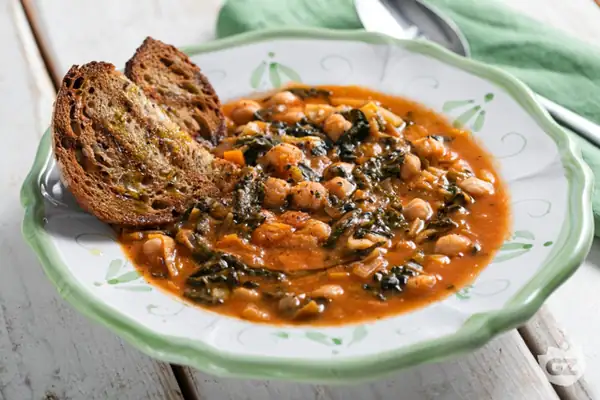
Whole grains always bring an extra level of flavor and heartiness to food, and bread is no exception. Whole grain bread begs for more savory food, and it’s a perfect match for soup, minestrone being my all-time favorite. I still remember my grandma (nonna to us) cooking minestrone for my brother and me when we were young. Our kitchen may not have the “perfect” set of ingredients on hand, but she was an incredibly gifted cook, one of those cooks who can make pretty much anything from a pantry of scattered bits and pieces. She would always make minestrone when the weather started to turn cool, and in preparation, I remember her saving up all the “heels” (the crunchy ends) of the baguettes and batards we would get each week as accompaniment. The perfect crunchy part of a loaf to dip. Back then we didn’t have much whole wheat bread, but I know she would have picked that above all else.
In my last entry, I dug deep into my new flour mill and my experience with freshly milled flour. For this bake, I decided to go at it with 50% fresh milled flour. I know many are not able to get hours-old fresh milled flour, and that’s ok, this recipe will work out smashingly with aged whole wheat.
Be sure to see my guide to working with freshly milled flour for more information on how to work with fresh flour in your baking.
Flour Selection
Lately, I’ve been gobbling up every single book by Alice Waters. It started with a recommendation for her, The Art of Simple Food (which I wholeheartedly recommend for beginners and professional cooks alike), a gateway to her approach to simple yet delicious food.
These books have me completely transfixed. While reading another of her books, My Pantry, I stumbled on the quote at right just as I was working on what to bake next, and it fit perfectly. She hails the use of whole grains as a revelation and talks about how whole grain bread brings with it this connotation of a dense, dry, and heavy brick.
But we, astute sourdough enthusiasts, know it doesn’t have to be this way.
I tried to find that balance between flavor and loft. The whole grains in this recipe bring just the right amount of that gratifying hearty flavor without compromising loaf volume.
The flour selected for this entry was 50% fresh milled Great River Organic Whole Wheat and 50% Central Milling Organic Artisan Baker’s Craft (“ABC,” a medium-protein white flour). I’m still working my way through the two sacks of Great River raw wheat berries I purchased a while back, but I’ve found the wheat to have an excellent flavor regardless.
The choice to use Central Milling ABC was easy: I wanted an organic low-protein complement to the whole wheat flour with a delicate flavor that would ride backseat to the show’s real star.
After you mill your own flour, flour to keep it fresh for longer.
Levain Build
Note that this bread has a low pre-fermented flour percentage and may require you to increase your bulk and or proof times to ensure the dough is fully proofed.
Dough Formula
final dough ingredients and do not take into account the levain.
The target final dough temperature (FDT) is 75°F (23°C). I target this temperature to help slow the fermentation down just a little bit (my typical FDT is 78°F/25°C) so my bulk finishes in about 4 hours. See my post on the importance of dough temperature for more information.
1. Levain – 8:00 a.m.
Use your ripe sourdough starter to create the stiff levain in the morning after milling fresh flour. Store somewhere warm around 78°F (25°C).
2. Autolyse – 1:30 p.m.
For the autolyse, mix the flour and water (reserve 50g water for the mix, later) very well in a bowl and cover. Ensure all dry flour is hydrated. Store near levain.
3. Mix – 3:00 p.m.
Using about 30g of the reserved water, incorporate levain build into autolyse and hand-mix thoroughly. Slap and fold for 5 minutes until dough holds shape well. Place the dough back into the bowl and let rest for about 4 minutes. Use remaining water, if necessary/desired, to incorporate salt into the mixture. The dough will initially break apart and then come back together. Slap and fold an additional 3 to 4 minutes until the dough starts to catch air and strength is built enough to keep dough relatively in shape on the counter. Transfer dough to a tub or thick-walled bowl for bulk fermentation.
See my guide to mixing bread dough for more tips on handmixing and using a mechanical mixer.
4. Bulk Fermentation – 3:15 p.m.
At the FDT listed above and at 78°F (25°C) ambient temperature, bulk fermentation should go for about 4 hours. Perform 5 sets of stretch and folds (each set is a stretch and fold at North, South, East & West), one every 30 minutes.
5. Divide & Preshape – 7:15 p.m.
Divide the dough evenly in half. Lightly shape each mass into a round, cover with an inverted bowl or moist towel, and let rest for 25 minutes.
6. Shape – 7:40 p.m.
Shape each into a boule or batard, whatever your preference may be. Place into a banneton lightly dusted with white rice flour.
For instruction on how to shape this dough as an oblong loaf, see my post on how to shape a batard (with video!).
7. Proof – 7:40 p.m.
Retard immediately into the refrigerator 39°F (3°C) for 12 hours.
8. Bake – Next Morning: Preheat oven at 7:00 a.m., Bake at 7:30 a.m.
In the morning, preheat your oven at 450°F (232°C). I baked this recipe using my method for steaming a home oven. Bake for 20 minutes at 450°F (232°C) with steam, vent the oven of steam, and then an additional 25-30 minutes until done to your liking.
Conclusion
I love this bread. If I were to pick a “daily bread” to always have on hand, it would be this recipe. The fresh milled whole wheat adds so much flavor, and the whole grain, in general, brings a delightfully hearty bias. Not only does it taste delicious, but it is also a very versatile bread. You can pair this with just about anything, and it won’t overpower.
Crust
Notice the stunning golden hue to the crust, it sings in the sunlight. Freshly milled flour imparts softness to the crust that isn’t immediately apparent, but not so soft as to collapse in your hand. Aged whole wheat tends to be a bit more crunchy, but that is not a bad thing, just different.
After slicing into this loaf, I found the crust to be exceptionally thin, in part due to the high heat of the oven when baking but also further reinforcing the fact that my method for steaming my home oven works very well.
Crumb
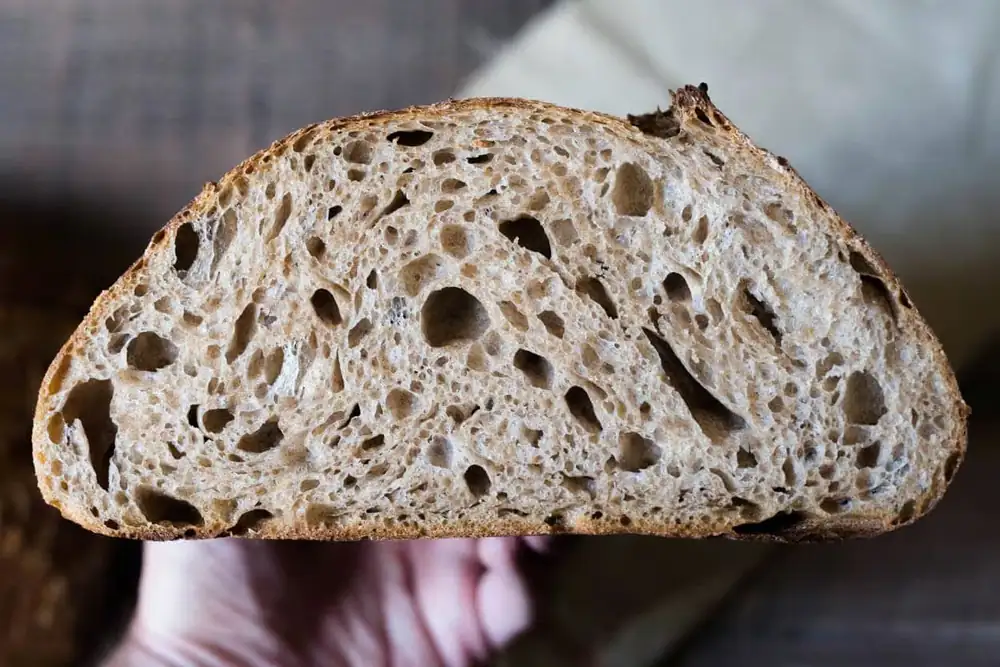
Quite open for so much whole wheat. It has a gloss and shines to it with translucent webbing throughout. The interior is incredibly soft and toothsome; you have to be very careful to eat one slice as it invariably leads to four or five. I love how light the loaf is in hand when you pick it up you know the interior is open and airy, it’s one of my favorite things about baking bread at home.
Taste
Interestingly enough, I almost prefer this bread a day or two after it’s been baked. The wheat flavor seems to come into its own and settle into a very mild and delicate flavor. When toasted heavily (as you can see above), the entire interior becomes a sort of soft crust that crackles away, and you chew. And when you have wonderfully crunchy sourdough, you can’t possibly deny yourself some bruschetta. I used some olive oil from my Dad’s restaurant, a mosto from Puglia that is just supernaturally good.
Mosto is derived from hand-picked “coratina” olives harvested whole and fresh at maturation. The olives are immediately transferred to the millstone, ground, and slowly cold-pressed. After settlement, maturation, and refinement, the extra virgin olive oil “Mosto” is born.
My favorite treat, especially when tomatoes are in season, of course.
With this bread, I think we can safely let Fall in the house and welcome its chilly attitude and strange colors. Plus, it motivates me to start planning my following market list: everything needed for my nonna’s minestrone, the perfect complement to go with the heels of these two whole wheat loaves.
If you want more recipes with freshly milled flour, check out my sourdough bread with freshly milled Yecora Rojo, a loaf with incredible fermentation flavors and malty notes.
If you use this recipe, tag @maurizio on Instagram so I can take a look!