11 Essential Ingredients You Need For Great Cuban Food
Cuban cuisine is bold and hearty, and its fundamental ingredients reflect its many roots. The names of the dishes, along with many of the ingredients, reveal the influence of Spanish colonization. For instance, Cuban cooks have happily adopted Spanish flan and tangy, garlicky meat marinades and made them their own.
“The idea being primarily to keep it sour while balancing it with a hint of sweetness. An even ratio of the three usually does the trick. I sometimes add a little extra lemon.”
As a California School of Culinary Arts alum, former professional baker, and a longtime Floridian who's enjoyed many Cuban meals, I can confirm you won't come away from a Cuban meal hungry. Want to try your hand at Cuban cuisine yourself? With the help of New Jersey-based Cuban chef Kassandra Gutierrez, I'm here to guide you through the essential ingredients you need to get started.
Garlic
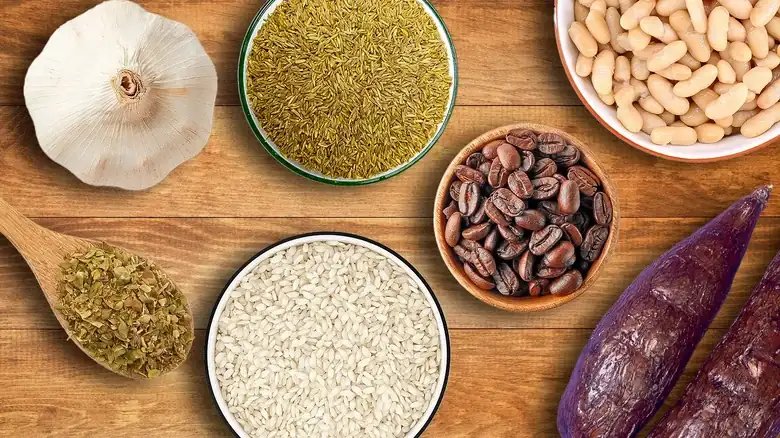
If you enjoy garlic, you'll love Cuban cuisine. While many dishes are mild and gently savory, some of the most popular dishes — those you're likely to encounter on the menu of a Cuban restaurant — pack an impressive garlic punch. Among these are Cuban-style roast chicken and pork, which get their garlicky flavor from mojo sauce, a signature Cuban preparation containing citrus juice, oregano, cumin, olive oil, and a generous amount of finely minced garlic. The tangy, punchy mixture plays several roles in Cuban cuisine. Besides serving as a marinade for meats (where it serves to tenderize as well as flavor the meat), it's also used as a finishing sauce to liven up mildly flavored foods such as boiled yuca. It can also work as a salad dressing, and is often served as a table condiment at Cuban restaurants for diners to add to sandwiches and other dishes at will.
Sour orange
Mojo sauce gives many classic Cuban dishes their garlicky zing, and traditionally, the tangy snap of the sauce came from the juice of sour Seville oranges. Like lemons, these fruits are too tart for most people to enjoy eating out of hand, but their aroma and mouth-puckering tang make them an indispensable ingredient in marinades. Sour oranges, or naranja agria in Spanish, have a long history in Cuban cooking and are another Spanish contribution to the cuisine. While they originated in China, they've been cultivated in Spain since the 12 th century and traveled with Spanish colonists to the lands they later settled in, including Cuba. Modern Cubans continue to grow the fruit on the island, as do expatriate Cubans in the sunny parts of the U.S. If you don't have access to fresh sour oranges, bottled juice is available in specialty stores or the Latin section of some supe
Oregano
Oregano is another flavoring that makes frequent appearances in Cuban cooking. The pungent, flavorful herb is not only a standard ingredient in the classic Cuban mojo sauce, it's also a key ingredient in sofrito. The mixture of oregano, chopped onions, green pepper, garlic, and black pepper is fried together until soft and used as a flavoring base for stews and other cooked dishes, such as stewed black beans. While oregano makes regular appearances in the Cuban kitchen, it's rarely the dominant flavoring, as it is in some Greek and Italian preparations. Rather, it plays an important supporting role, helping to balance out the other flavors in hearty dishes. While most Cuban recipes in the U.S. call for regular dried oregano, cooks who enjoy gardening or have access to a well-stocked farmer's market can experiment with Cuban oregano, which is nativ
Cumin
Among the ingredients that reveal the Spanish influence on Cuban cookery is cumin. The warm, earthy spice, native to western Asia, is a favorite of cooks around the world, who use it to add a savory depth to cooked dishes. Cumin is a relative of parsley, despite having a quite different flavor profile. And while whole cumin comes labeled as cumin seed, it's not actually a seed at all, but the dried whole fruit of the plant. The spice also comes as a ground powder. In Cuban cooking, cumin has a subtle but pervasive influence. For instance, it's among the seasonings in ropa vieja, a must-try Cuban dish featuring long-simmered shredded lean beef in a cumin-scented tomato-and-pepper sauce. It also makes an appearance in picadillo, a sweet-savory Spanish-inspired dish of ground beef simmered with tomatoes, olives, raisins, and spices. In neither case does the flavo
Yuca
Fresh yuca doesn't look very appetizing — it's a long root vegetable with a thick, textured brown skin covering a dense white interior. But it's a workhorse of the Cuban kitchen and the base for several much-loved side dishes. Hearty, starchy, and mild when cooked, it often appears as a bowl of boiled chunks slathered with garlicky mojo sauce or cut into batons and fried up to make a tropical variation of crispy French fries. While yuca cooks up much like a potato, it takes a bit more care to prepare. Critically, it's toxic when raw, so must be peeled and thoroughly cooked before it's safe to eat. Also, the skin is too tough to remove with a standard vegetable peeler and is usually coated with a layer of wax to keep the roots fresh, so the easiest and best way to remove it is with a sturdy knife. When shopping for fresh yuca, look for firm roots free of
Plantains
If you order a meal in a Cuban restaurant, you're likely to see plantains among the options for your side dishes. The bigger, starchier relatives of bananas, plantains are among the must-haves in the Cuban kitchen. Unlike bananas, they're always eaten cooked, rather than raw. And just as experienced American home cooks know to use just-ripened bananas for salads and blackened, mushy ones for banana bread, Cuban cooks have mastered the art of extracting maximum flavor from plantains at every stage of ripeness. Green plantains have very little sweetness, so cooks prepare them as a savory side dish. A classic preparation is tostones, green plantain slices that are fried until soft, flattened, then fried again until crisp and served with mojo or other savory sauces; think of them as a Cuban equivalent of cottage fries. In contrast, if you allow plantains to ripen
Rice
While rice is now a staple of Cuban cuisine — and a perfect foil to the country's rich, saucy stews and meat dishes — it was once considered an exotic rarity. It was introduced into Cuba by Chinese immigrants, and over time, the locals became just as fond of it as the homesick immigrants who brought it. Plain white rice (often boiled with a touch of salt and oil) is a favorite accompaniment to meals. Upgraded rice side dishes include arroz amarillo, or yellow rice (cooked with diced vegetables including onions and bell pepper and tinted yellow with achiote powder), and moros y cristianos, a mixture of stewed, seasoned black beans, and white rice. Rice can also be a star attraction in main dishes, such as arroz con pollo, a pilaf of seasoned rice cooked with chicken and vegetables. And finally, lovers of Cuban food can enjoy rice for dessert as arroz con leche, the crea
Beans
Black beans are another of the side dishes you're almost certain to see at Cuban restaurants. A ladleful of black, glossy beans not only offers a striking visual contrast to the paler food on the plate, but a rich and comforting flavor to complement the rest of the meal. They're typically simmered for hours with classic Cuban aromatics including onions, garlic, minced bell pepper, and spices such as oregano and bay leaves, and are tasty and substantial enough to serve as a meal by themselves. But while black beans are the first (and maybe only) legumes most people associate with Cuban food, Cuban cooks in the eastern part of the country use red beans as well. A signature dish of the region, for example, is congri. The dish features cooked red beans sauteed with ham, bacon, and savory aromatics including habanero chilis and the standard sofrito of onion, g
Guava
Cooks and eaters everywhere learn to celebrate the foods that grow naturally in their area, so in Cuba, food lovers take the island's tropical fruit seriously. Pineapple, sapote, soursop, and other fruits are enjoyed fresh or in juices and smoothies. And while these fruits are sweet and juicy enough not to need any embellishment, some of them — especially guavas — make their way into sweet treats such as pastries and other desserts. It's nearly impossible to step into a Cuban bakery in Florida (or even the bakery section of Publix, the dominant supermarket chain in the state) without encountering guava-filled pastries, often with a touch of cream cheese for richness and contrast. They're a refreshing change-up from the predictable apple and cherry fillings. If you're a serious guava fan and lucky enough to have a productive tree (or access to affordable fresh gu
Coffee
Coffee is certainly not unique to Cuban cuisine, but the Cuban spin on coffee-making and coffee culture is. If you order a café Cubano (sometimes called a cafecito) at a restaurant or coffee stand, you'll get a tiny cup of intense, pre-sweetened espresso. To make it, cooks start to brew the coffee in an espresso maker and vigorously whip the first drops that appear with a few spoonsful of sugar until it forms a thick foam. After the brewing is complete, cooks pour the hot coffee over the foam, which floats to the top. Besides the standard café Cubano, you may see several other unfamiliar terms on a Cuban coffee menu. A cortadito is a shot of unsweetened espresso topped with a touch of milk; drinkers can sweeten it to taste. Café con leche, or coffee with milk, is also unsweetened and contains a larger proportion of hot, steamed milk; it's popular at breakfast. Cuba
Culantro
No, this is not the same thing as cilantro. It's actually a unique herb that's central to authentic Cuban cooking. "I would say one ingredient that is not commonly found and is a staple of almost every dish is culantro, not to be confused with cilantro," Kassandra Gutierrez said. "It has a much more bitter flavor than the brightness found in cilantro." Gutierrez uses culantro in her sofrito — the savory vegetable-heavy flavor base that forms the foundation for most cooked dishes. Unless you live in an area with a big Cuban community, you may have to do some hunting to procure culantro. "Culantro is rarely found in big box groceries," Gutierrez said." You'll likely need to find a Hispanic or Asian foods grocer." When you find fresh culantro, you'll see that it's clearly different from cilantro as it has long, serrated leaves that are larger and thicker than