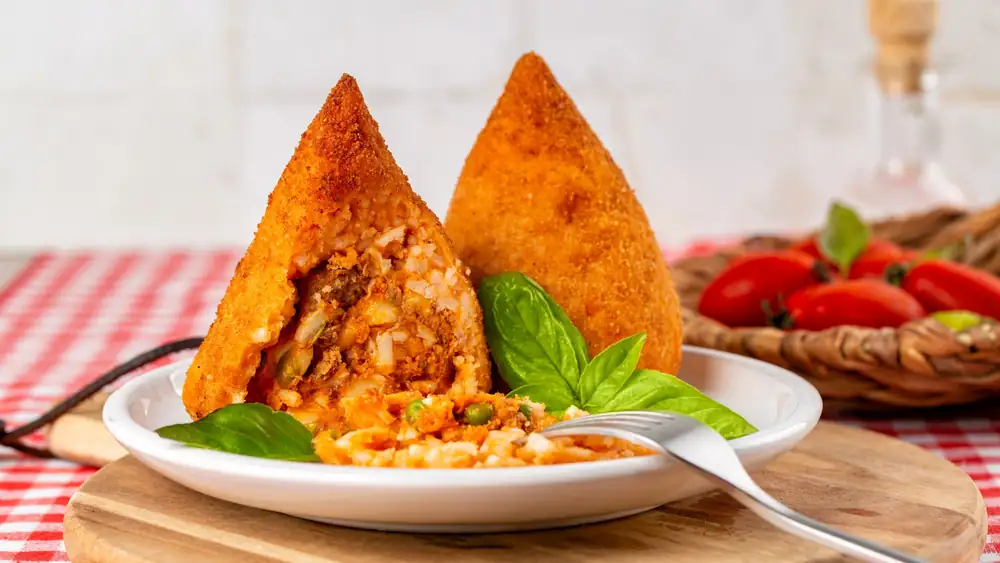
Arancini or arancine: how to make them at home, just like in Sicily
Crispy on the outside, soft and chewy on the inside: arancini, or arancine, are one of the most delicious symbols of Sicilian street food.
A symbol of Sicilian cuisine and a staple of the island's street food scene, arancini are crispy on the outside and soft on the inside, with a filling that varies depending on the recipe. The ragù version is one of the most classic, but there are countless fillings and shapes, from round to pear-shaped. Making them at home requires a bit of patience and skill, but by following a few steps, you can achieve a golden, crispy coating and a filling that's well-encased in the rice.
Are they called arancini or arancine?
Let's get one thing straight: are they called arancini or arancine? The name varies depending on the area: in western Sicily, namely Palermo, Trapani, Agrigento, and their respective provinces, they're called arancine, while in the areas of Catania, Messina, Enna, Caltanissetta, and most of the eastern and central regions, they're called arancini.
The Accademia della Crusca recommends the feminine form of the term "by analogy with the round, golden orange fruit, that is, the orange."
Let's leave aside linguistic arguments and focus on Sicilian street food par excellence, so beloved because it's ideal at any time of day: it can be a single dish for a quick lunch, a hearty snack, or a casual dinner.
What are the types of arancini fillings?
Ragù with peas and caciocavallo cheese is one of the most classic fillings, but arancini lend themselves to countless interpretations. In Sicily, you'll find versions with ham and cheese, spinach and mozzarella, eggplant and tomato, or seafood, such as fish, shrimp, and salmon. There's also no shortage of "butter" arancini, especially typical of the Palermo tradition, made with béchamel sauce, ham, and cheese. The shape and toppings may vary, but the principle remains the same: a rice shell encloses a soft and flavorful filling, which is then coated in crispy breadcrumbs and fried until golden brown.
Are arancini pear-shaped or round?
The shape of arancini can vary depending on the area of Sicily. The pointed version, reminiscent of a pear, is particularly common in eastern Sicily, while the round shape is more common in the Palermo area. For this recipe, we chose the characteristic pear shape: the rice is shaped in the palm of the hand, leaving room in the center for the ragù and caciocavallo cheese. Once the filling is added, it is covered with more rice and gently shaped to form a pointed shape.
How are arancini (or arancine) prepared?
So why not try making them at home? It's not that difficult—they're ready in an hour, and the half hour it takes to let them rest can be used to set the table or prepare a delicious dessert. Below are the ingredients and instructions, while the photo gallery below features the complete tutorial with our very own Joëlle Néderlants's steps for shaping them and coating them with that crispy crust, which should be neither too thick nor too thin.
Here's our step-by-step preparation for a truly perfect recipe.
Arancini or arancine with ragù: the recipe
- 500 g of Vialone Nano rice
- 200 g of 00 flour
- 170 g of caciocavallo cheese
- 100 g minced beef pulp
- 100 g minced pork pulp
- 80 g of shelled peas
- 30 g of butter
- 3-4 tablespoons of tomato paste
- 2 sachets of saffron
- 1 celery stalk
- 1 carrot
- 1 onion
- breadcrumbs to taste
- extra virgin olive oil to taste
- peanut oil to taste
- sale q.b.
- pepe q.b.
- Cook the rice. Toast the rice in a saucepan, without adding any fat. Pour in 1 liter of boiling salted water and cook for 15 minutes. Halfway through cooking, add the saffron dissolved in a little hot water.
- Stir in the rice. Once cooked, stir in the butter and 100g of grated caciocavallo cheese. Transfer the rice to a tray and let it cool.
- Prepare the ragù. Finely chop the celery, carrot, and onion and sauté them in a drizzle of extra virgin olive oil. Add the minced beef and pork and cook for 3-4 minutes.
- Add the tomato. Add the tomato paste and 250 g of water. Season with salt and pepper and cook for 15 minutes.
- Add the peas and continue cooking for another 5 minutes. Let the ragù cool.
- Prepare the batter. Mix the flour with 300 ml of water and a pinch of salt. Also prepare a generous amount of breadcrumbs in a dish.
- Prepare the filling. Dice the remaining 70g of caciocavallo cheese.
- Shape the arancini. Take a handful of rice and shape it in the palm of your hand, creating a hollow in the center. Fill it with 2 tablespoons of ragù and a few cubes of caciocavallo cheese. Cover with more rice and seal well, shaping the arancini between your hands until they achieve their characteristic pear shape.
- Coat. Pour the batter over the arancini, holding them in the palm of your hand so they're evenly coated. Gently roll them in the breadcrumbs, ensuring they adhere well, then arrange them on a serving platter.
- Fry. Heat plenty of peanut oil until it reaches 170-175°C. Fry the arancini, two or three at a time, for about 4 minutes.
- Drain and serve. Drain the arancini and transfer them to paper towels to remove excess oil.
How to get a crispy breading for arancini or arancine
A good coating is essential for successful arancini or arancine: it must be uniform, adhere well to the rice, and become crispy during frying without becoming too thick. In this recipe, the arancini are first coated in a flour and water batter and then coated in breadcrumbs. For frying, the peanut oil must reach 170-175°C: the arancini are dipped in a few at a time and fried until golden brown.