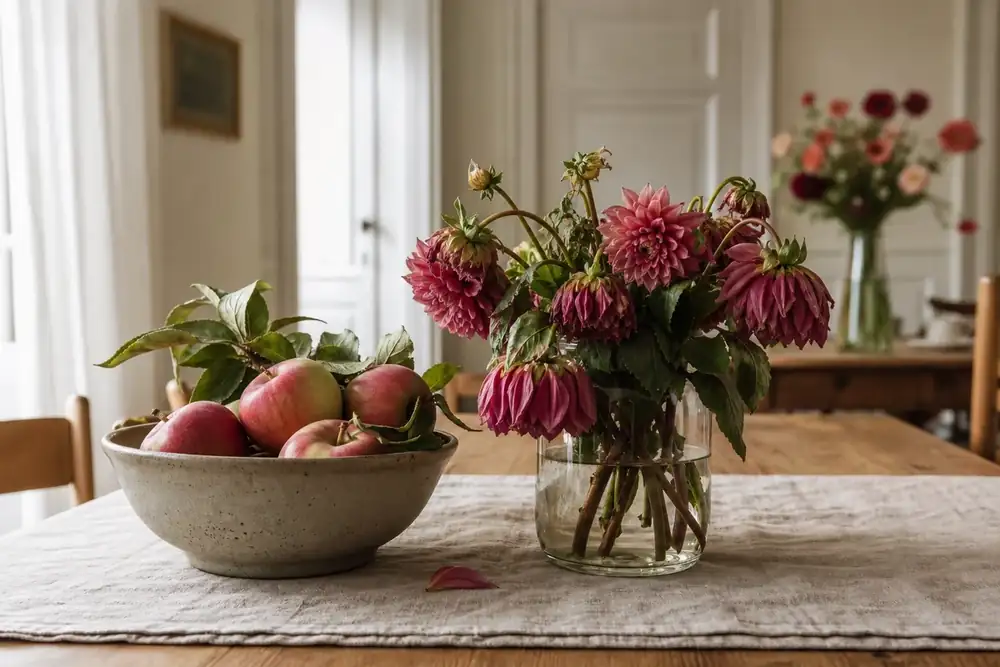
Do apples cause the flowers next to them to wilt? Yes
Why the bouquet topples over next to the apple peel and which decorative fruits are unproblematic.
The images in the article are photorealistic and generated with AI models.
Yes, apples cause flowers to wilt: The culprit is the gaseous ripening hormone ethylene, which ripe fruit continuously releases into the air and which acts like an aging accelerator on blossoms. Anyone who places the first autumn apples, such as Elstar, next to a dahlia vase now will lose several days of blooming time for the bouquet.
Update, September 21, 2026: The autumn apples are here: According to Plantura, the Elstar apple reaches picking ripeness from mid-September and eating ripeness from the end of September, so precisely these days. Freshly picked apples continue to ripen and release a particularly high amount of ethylene during this time. Anyone who has the first autumn bouquet of dahlias, asters, or chrysanthemums on their table should consistently place the apple bowl on a different piece of furniture this week and store any stored apples in the refrigerator. For the Thanksgiving table on October 4th, where fruit and flowers are traditionally displayed together, grapes, pomegranate, and lemon should be placed directly next to the vase, and the apples on the sideboard (source).
Ethylene acts on flowers like an aging hormone.
Ethylene is a gaseous plant hormone. Because it's gaseous, its effects aren't limited to the fruit that produces it: The gas spreads throughout the surrounding area and triggers a chain reaction in all nearby plants, further stimulating their own ethylene production. This makes climacteric fruits like apples softer and sweeter. Everything else within range simply ages faster. Apples are the clear leader in this regard; their ethylene release significantly exceeds that of pears, avocados, and bananas.
Carnations are the most severely affected cut flowers: bud drop, color loss, and premature wilting. Florists are familiar with this problem from autumn arrangements with real fruit and therefore keep fruit and bouquets strictly separate in their shops. This applies to purchased bouquets as well as to hand-tied floral arrangements for the table.
The distancing rule: How to keep the bouquet and the apple peel friends
The good news: ethylene dissipates rapidly. With every meter of distance and every cubic meter of room air, the concentration reaching the blossoms decreases. If the apple peel is placed on the sideboard or in an adjacent room, hardly any effective gas reaches the flower receptors. The effect is immediate, and the bouquet typically lasts several days longer. The dining table can then be reserved for flowers, perhaps as a table decoration with a bouquet and a lantern.
Two limitations. In a small, rarely ventilated room, the low air volume partially compensates for the distance. And overripe or rotting apples release such high quantities of pollen that even distance within the same room is of little help. Therefore, bruised apples should be discarded immediately, not placed in a decorative bowl. Daily airing replaces the pollen-laden air, but does not replace the need for separation as long as the source continues to produce pollen.
If you don't want to decorate the apples but want to eat them, put them in the refrigerator: Ethylene production is highly temperature-dependent and almost completely stops in cold temperatures.
Unproblematic decorative fruit: These fruits can be placed directly next to the vase.
Those who have planned to use fruit as edible table decorations for their autumn table don't have to forgo it entirely, they just need to choose differently. Non-ripening varieties produce little to no ethylene: According to the Federal Centre for Nutrition, these include grapes, lemons, oranges, pomegranates, cherries, and berries. A dark bunch of grapes, two pomegranates, and a lemon next to a vase evoke autumn and prevent any blossoms from aging. Just be consistent: A single apple in the grape-citrus bowl will negate the entire effect.
The ranking is clear. The most effective solution is to place non-toxic decorative fruit directly next to the flowers, because this completely eliminates the ethylene source instead of just diluting it. The quickest solution is simply to change the location: an apple peel on the sideboard, done. Robust varieties like chrysanthemums only postpone the problem for a few days. Ventilation alone is the least reliable option, because as long as ripe apples are next to the vase, the ethylene source continues to produce.
The fact check concludes with a resounding yes and a simple solution for autumn decorations: a piece of furniture to keep them apart or the right fruit – and this applies to the Thanksgiving table on October 4th just as much as to the autumn bouquet on the dresser. More inspiration for the season can be found in modern table decoration ideas for autumn. And those who continue their outdoor decorating will find a wealth of options in autumnal arrangements in the garden, where no bouquet is at risk.