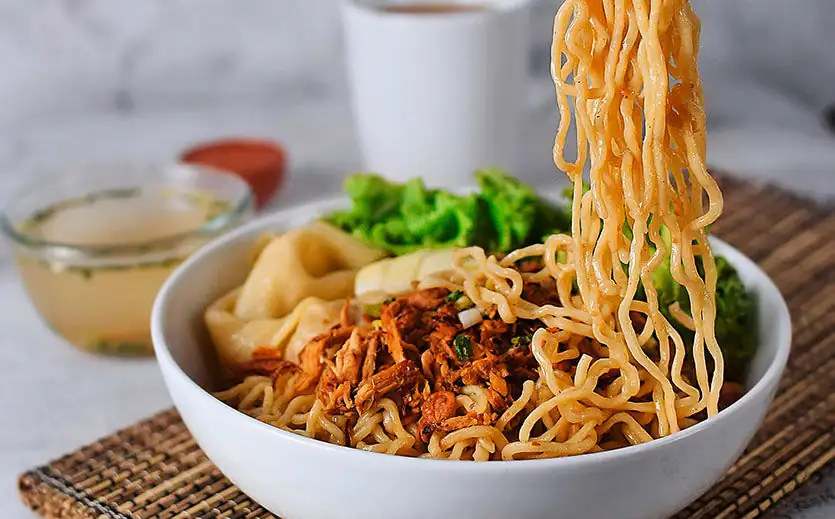
Product knowledge: Mie, Udon or Soba – how the most important Asian noodle varieties differ
They are familiar yet exotic, sometimes translucent, sometimes dark, thin or thick as a finger: Asian noodles are as diverse as the cuisines from which they originate.
Inventor of instant noodles
Noodles have a long tradition in Asia. The first evidence of grain-based noodles comes from China. Archaeological finds document millet noodles from pre-Christian times. Noodles spread to Japan, Korea, and Southeast Asia via trade routes, where distinct traditions and noodle varieties developed. A decisive turning point was the invention of instant noodles: in 1958, Japanese entrepreneur Momofuku Ando launched "Chikin Ramen," the first commercially available noodle with a shortened cooking time. His method of pre-cooking the noodles and preserving them through deep-frying solved the problem of long preparation times.
Today, various types of Asian noodles are available pre-cooked and portioned. Their advantages: long shelf life, low price, and easy preparation. They simply need a few minutes in hot water or directly in the sauce. The basis of every noodle is a basic grain or starch source. Most Asian noodles are made from wheat flour (mie, udon, ramen), some are buckwheat-based (soba), rice noodles are made from rice flour, while glass noodles are made from pure starch, such as mung bean starch. Varieties based on sweet potato starch also round out the selection.
Gluten-free options
The raw material determines the consistency, nutritional value, and target audience: Wheat noodles like mie and udon are firm to the bite and versatile, while soba noodles score points with their nutty flavor and are reduced in gluten if manufacturers use a high proportion of buckwheat (please note: Pure buckwheat noodles are rare; wheat flour is usually added). Rice noodles and glass noodles are naturally gluten-free and therefore attractive to a growing target group. Whether instant noodles are fried or air-dried affects the cooking time and fat content. Therefore, it's worth checking the label when advising health-conscious customers. Gentler, non-fried versions have also recently become established on the market. These are available as vacuum-packed, pasteurized pre-cooked products and only require two minutes in hot water or in the microwave.
Production
Mie noodles are the instant noodles of Asian cuisine. They form the basis of noodle snacks and are popular as a convenient ingredient. Here's how they are made.
- Mixing the dough: A mixer in the mixing trough processes wheat flour, some durum wheat semolina, and water into pasta dough. The production process adds only enough water to just combine the flour. The mie pasta dough is initially crumbly. A kneading machine then processes it into a uniform strand.
- Rolling until waves form: After the mie noodle dough has unfolded on a resting belt for some time, several rollers process it into a thin sheet of dough. In the next step, knives cut the sheet into small strands. The cut strands run over a belt that rotates more slowly than the cutting unit. This causes the strands to bunch up slightly and lie on top of each other in even waves. This step creates the characteristic crimp of mie noodles.
- Steaming or frying: Hot steam briefly pre-cooks the wavy strands. This causes the starch to gel, fixing the wave shape. Furthermore, this method means that mie noodles require only a very short cooking time in a pot at home. It replaces traditional deep-frying and results in a reduced fat content in the final product.
- Drying the noodle nests: The dough strands are portioned. In a final step, these so-called noodle cakes are dried for several hours before they are finally packaged.