What's your cooking personality?
We recently published our 13th annual Good Food Nation Survey, drawing on a YouGov poll of 2,000 UK adults.
That said, 87% of you enjoy cooking, yet 70% feel uninspired by your main meals. This is where planning, batch-cooking or prepping can all be helpful – the defining features of three types of ‘cooking personality’ outlined here. Figure out yours and you might keep the panic at bay as dinnertime looms.
Define your focus, then decide your approach from the following three types:
- Enabling individual household members to assemble their own meals to suit their own preferences.
- Preparing and storing individual components of meals that can be quickly assembled later.
You’re the optimistic organiser who takes comfort in knowing that their efforts will pay off all week. Proteins are portioned, grains and carbs cooked, salads chopped, oats soaked – and all these are stacked neatly in the fridge.
The point is that on Wednesday night, if you’re tired and your resistance to bad decisions (the ease of a takeaway or six slices of toast and jam) is low, the good decision made several days ago is sitting in the fridge.
To be a prepper, you need comfort with systems that other people find restrictive. Your motivation could be time or money, but it isn’t variety. Eating the same (or same-ish) lunch five days running is a feature, but you might already do this if you make or buy a sandwich every lunchtime.
It tends to suit a life with reasonably predictable rhythms – a spontaneous night out means a meal not eaten.
Pros: dramatically reduces weeknight decision fatigue, supports consistent nutrition and saves significant time.
Cons: requires repetition, has limited flexibility when plans change and might become boring.
- Time, and needing a variety of complete meals ready to go so they only need reheating.
You might say your organisational ability is something you’ve learned rather than decided to do: a parent, a period of not being flush with cash, the reality of feeding more than one or two people or because working hours mean coming home too exhausted to cook.
A batch of bolognese means enough for eight; half goes in the freezer before anyone can ask for seconds.
Batch cooks are not necessarily optimising nutrition; you’re solving the problem of putting something on the table on a Tuesday when there’s no time. Soups, stews, casseroles, chilli, dhals and curries are easily doubled, portion well and forgive reheating.
To be a batch cook, you need infrastructure – a decent freezer, enough containers, the presence of mind to label things and enough time at the weekend to cook.
Pros: a high return on effort, reduced food waste, suits larger households, freezer stock provides fallback on difficult days Cons: needs space, time, forward thinking, labelling and rotation discipline or food still gets wasted.
- Budgeting and efficiency
Shopping is your superpower; you know that most of the week’s food problems are shopping problems in disguise.
On Sunday, you spend 20 minutes with your phone and your head in the fridge to see what’s left, along with a mental list of everyone’s preferences.
You work out what needs using up, then dovetail it into what to eat. Meal-planning means almost nothing goes off. You’re likely great at making lunch from leftovers. All you need is time to think, look up recipes, gather ideas and dream a little.
Pros: low waste, reduced spend, flexibility to cook fresh daily, no essential skills or equipment.
Cons: requires weekly time investment and mental discipline, and there’s no buffer on weeknights when exhaustion hits.
Tools to make life easier
Freezer containers are the bane of many lives – lids escape and they never stack well. Instead, try a freezer ‘pod’ – freeze your food in blocks, then pop them out and stack in a bag. Don’t forget to label and date.
Glass stacking containers mean you can easily see what’s in them. The IKEA ones can be bought separately from the lids, so if you break or lose one part, you can replace it. They’re also handily ovenproof.
A mini chopper makes light work of herbs, while a food processor with grating and slicing blades will sort out carrots, cabbage and onions. Unless you like meditative slicing and chopping, make your prep quicker and easier.
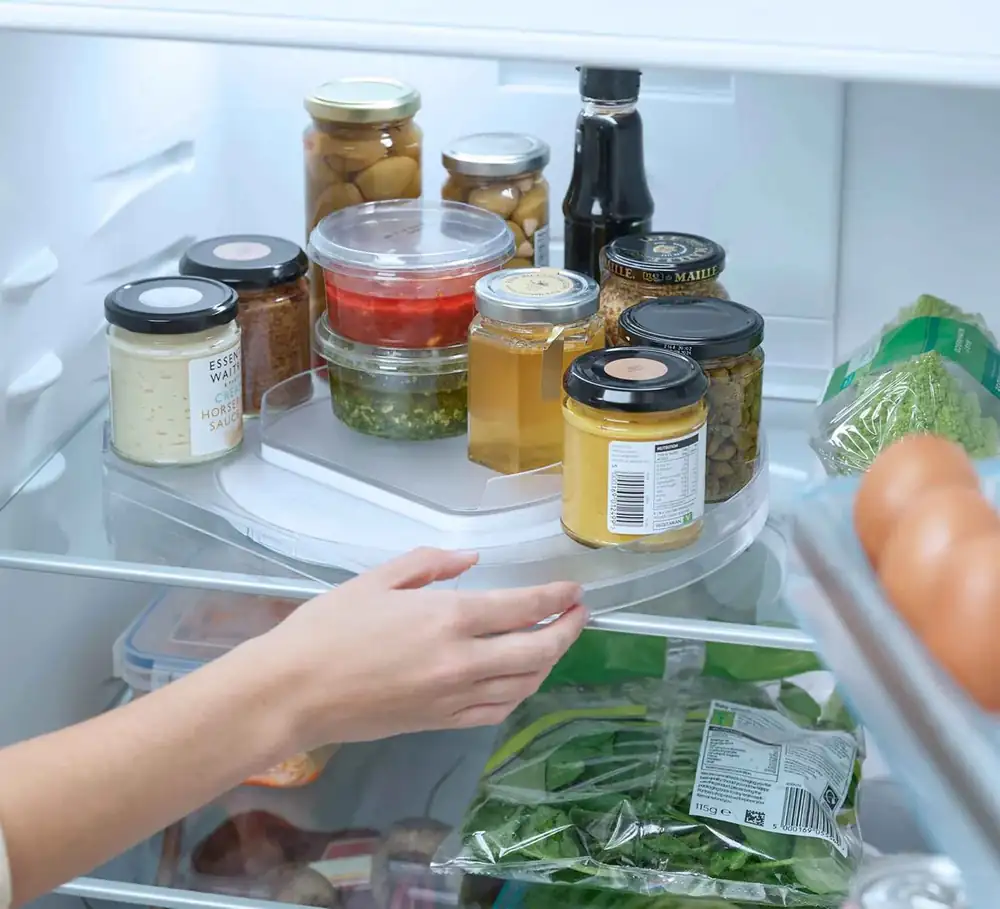
A fridge or storecupboard carousel helps you store and reach for the exciting condiments and flavourings that pep up your meals. It’s an old-school solution that still completely works.