White bread, dark bread. What flour tells us about the Salzburg region
Traditional breads are almost never included as part of cultural heritage, as if there were a certain disdain for this essential food.
Flour and salt
Salzburg is the 'Rome of the North'. Located in the heart of Europe, enriched by the salt that flowed through the river that bears its name and protected by the power of the Church, this beautiful baroque city of palaces, fortresses and monasteries has one of the richest bread-making traditions in the world.
The prestige and fame of Viennese bakeries, declared the best in the world at the 1867 Universal Exposition in Paris, extends to this beautiful Mozartian city, albeit with its own local varieties. While most tourists come in search of the internationally renowned Sacher torte, the jewel proudly displayed in every café and pastry shop in the city and which has even lent its name to a luxury hotel, the aroma of traditional bread wafts through the breweries, artisan bakeries, and the Saturday market, where all the cheese and charcuterie specialties are accompanied by some of the beautiful loaves with suggestive shapes: pristine white milk and butter loaves, or dark, spiced, and nutty loaves, somewhere between bread and pastry.
Bread and faith
There's no better place in this city to discover local specialties than the Augustinian monks' tavern. Since 1548, the Augustiner Bräustübl has been a veritable institution where you can sample cured meats, beef stew with onion sauce, venison ragout, Viennese escalope, Wiener Schnitzel, or a good goulash, an emblematic dish of the old Austro-Hungarian Empire. Amidst this carnivorous feast—pure dietary logic in a region surrounded by forests and abundant pastures—bread occupies a less prominent position, disguised with monastic simplicity, but its role is essential. No soup or broth is complete without Kaspressknödel (bread dumplings made with cheese, egg, and onion), and the menus rarely lack the simple and comforting spinach Semmelknödel, which Salzburgers associate with the dishes of their childhood.
Wheat bread pervades everything with the humility of one who knows himself to be victorious over hunger. Its function is always to unite the community of the faithful around a food that Christianity transformed into the body of Christ, a symbol of a Catholic faith that throughout Austria was threatened countless times by the power of Islam or imminently fractured by the Lutheran ideas sweeping through Renaissance Europe. As always, these golden-crusted bread knots sprinkled with grains of salt remind us that white bread is a powerful social marker, uniting souls against the enemies of the faith. These delicious pretzels, arriving at the table warm and wrapped in cotton napkins, originated in the monasteries that dominated Christian Europe, where each loaf was revered by the believer who recognized in it a message of loyalty, an embrace of the faith. The immigration to American lands of many German-speaking communities in the 18th and 19th centuries made it one of the most valued breads by millions of people who today enjoy it in sweet versions.
The black bread of the mountains
In the late seventies, a little Swiss girl with Japanese features brought tears to the eyes of half of Spain with a simple bread roll. Few of us knew then that Vienna bread was called Kaisermmel, or Emperor's bread, in Austria; few of us were aware then, even though our parents had eaten more dark bread than they would have liked, that bread is a dividing line between social classes. Rye bread or wholemeal breads, which we now appreciate so much, were nothing more than synonyms for poverty, a lack of wheat, and poor milling. Central Europe has a long tradition of dark breads for obvious reasons. The cold northern territories weren't always able to cultivate wheat, so oats or rye gave rise to breads so highly valued by today's nutritional approaches, much richer in fiber, such as rye pumpernickel or Ner bread from the Italian Aosta Valley. This was probably the type of black bread that Heidi's blind and toothless grandmother ate, like almost all shepherds in the Alps.
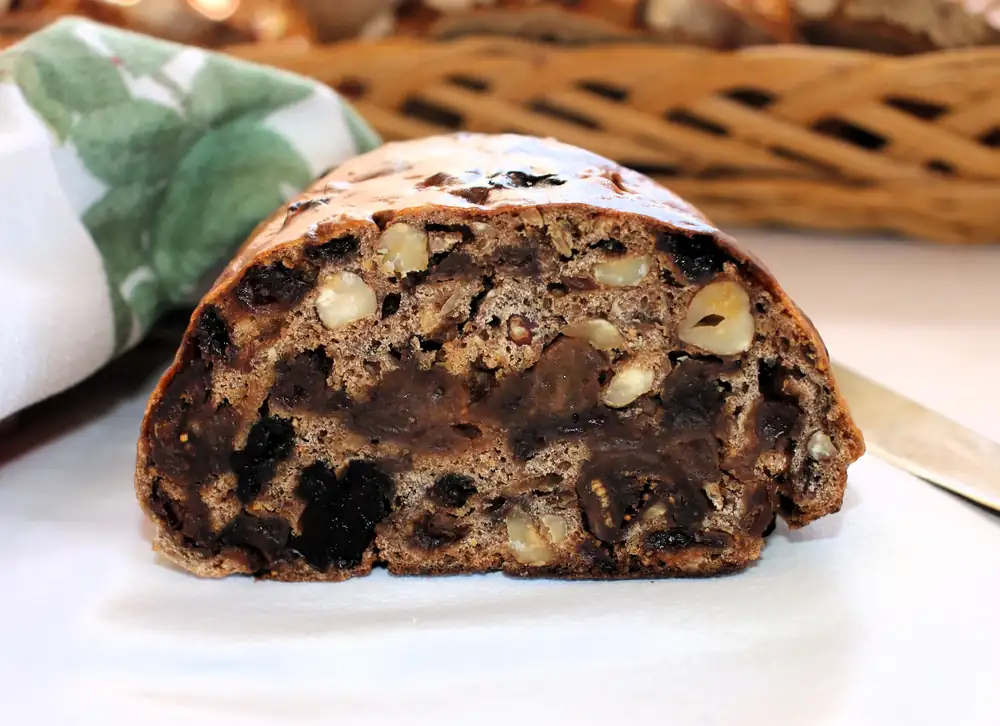
Sometimes, these dense loaves, which kept for a long time, were enriched with sugar or syrups, honey, local nuts such as walnuts or chestnuts, and, when one could afford it, spices and candied citrus fruits. These loaves are more akin to Christmas breads—with panettone being the most famous example—so prized by the European nobility who celebrated the most important festival of the Catholic liturgical year in this way. It's worth remembering that these baked goods were essential for regaining energy after the fasts imposed by Advent. At the Saturday market, they can still be found under the name Kletzenbrot. Their flavor pairs well with cheeses, ham, or venison jerky, another of Salzburg's most local products.
Bread, empire, and the steam oven: the viennoiserie
In any case, access to good bread was always reserved for the elite, so in the Austrian Empire, a soft bread specially made for Emperor Franz Joseph I was a must. The Kaiser was certainly fortunate to be born during the Industrial Revolution, which allowed his rolls to be more airy and brioche-like, since his ovens were already steam-powered. August Zang, the Austrian responsible for bringing viennoiserie to Paris, discovered steam for the initial stages of bread baking. The Austrians, who did so much for the fame of this bread, also brought the kifli or kipferl, the ancestor of the croissant, to Paris. The rest is history.
But as with everything in cooking, it's a constant evolution, a process of exchange and discovery. One of Salzburg's finest desserts is simply a thick crêpe batter, torn into pieces and served with apples, raisins, and cranberry jam, all dusted with powdered sugar while still warm. A comforting delight born of ingenuity and flour.