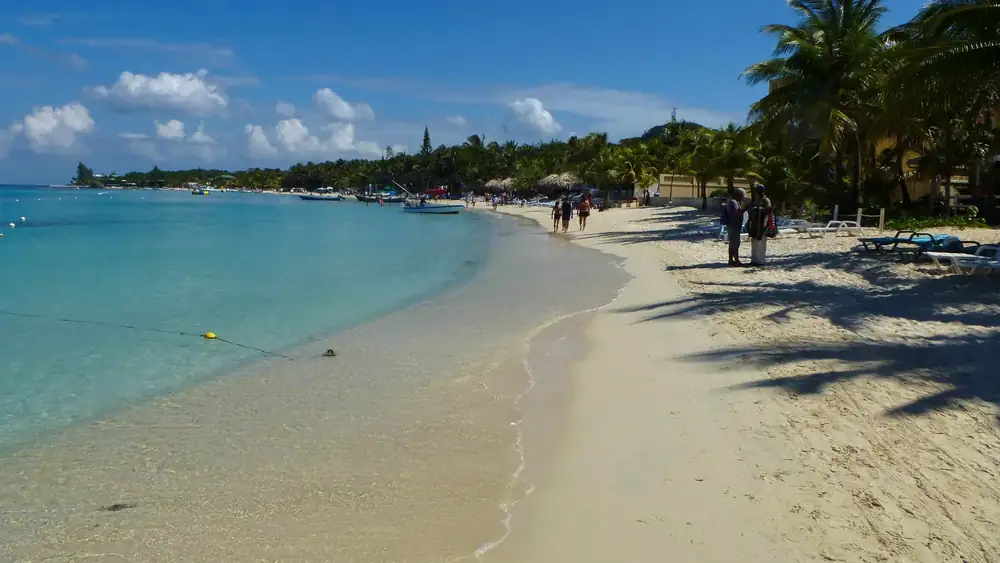
Roatán with C: coconut, snail, cacao and coffee
Watanegui consup / Iupipati iupipati / Wuli wani wanaga If you want to dance / Conch soup! (hey).
I had to travel all the way to Roatán, Honduras (anyone reading this would say it was quite a sacrifice) to learn that conch soup is one of their traditional dishes. And to understand that the song I've been listening to since my teens is actually about it. Some claim that this tongue twister hides the expression "what a very good soup," which isn't entirely true.
Actually, "Sopa de Caracol" is written in Garifuna, the language of the descendants of African slaves mixed with the Amerindian population of the Caribbean islands. What the lyrics really say is, "I want to eat soup, I want to keep enjoying it. A little for you, a little for me." And after having tried the popular conch soup, I wholeheartedly agree with the chorus.
Many of Roatán's dishes are unique to the Garifuna people, who were brought from the island of St. Vincent by the British army in the 18th century. Some historians believe they landed at the Roatán port of Camp Bay, northeast of the community of Punta Gorda, where most of their descendants live today and which is the best place on the island to enjoy their cuisine.
In culinary terms, islands present both an opportunity and a risk. Isolated territories with harsh climates where the land and sea yield products that may be limited, yet unique. In this sense, these resources can be used creatively, or they can be a limitation that leads to seeking imported packaged foods and preparations that stray from local traditions.
Sidney Boddin, a Roatán native responsible for preparing the conch soup at the Kimpton Grand Roatán Resort and Spa, explains that the island has always respected natural ingredients. “Coconuts, fish, chickens, conch, blue crabs, and lobster are products that have been used in the island's cuisine for generations. We also grow mangoes, papayas, pineapples, herbs, and of course, we have plenty of coconuts and plantains.”
Although he himself is not a member of the Garifuna community, he has always eaten their dishes. He proudly recounts that today his almost sole responsibility at the hotel is preparing the conch soup, a process that takes at least four hours. His version contains shrimp, conch, plantain, fish, coconut milk, and a generous amount of garlic, onion, and chili peppers. A hearty stew, “good for the brain and a real pick-me-up,” he continues.
There isn't just one single Garifuna soup; they vary according to the bounty of the beautiful Roate sea, and in many cases, they are accompanied by machucas, balls of mashed green plantain. Sundays are ideal for visiting Punta Gorda and trying Garifuna dishes, which also include fried fish, baked or flatbread-like cassava bread, coconut bread, and coconut tablets. While you're there, you can learn about some of the botanicals used to prepare gifiti or guiffity, a Garifuna herbal liqueur.
Made from rum or aguardiente with a mixture of at least seven herbs, roots, leaves, and flowers—though it can contain up to 38—gifiti is characterized by its bitter flavor. Its composition varies, but it typically includes anise, chamomile, Mexican tarragon, allspice, and cloves. It is left to steep for weeks or months in wooden or clay containers. It is believed to have medicinal and aphrodisiac properties, and an alcohol-free version exists. Besides Honduras, gifiti is also made on the Caribbean coast of Guatemala, Nicaragua, and Belize.
Hotel cuisine with a local touch
Approaching his second year at the helm of the Grand Roatán Resort and Spa kitchen, Guido Ojeda's assessment is positive. One of the biggest challenges for the Argentinian chef, who has worked in kitchens in Spain, Dubai, and Iceland, was "finding an identity for the restaurant. Knowing that we're in a hotel and that, in addition to establishing a vision for the restaurant, we have to feed guests who are looking for more than just rice and beans, coconut milk, and conch. The challenge is making the customer feel comfortable while also allowing us to showcase the local culture."
For the rest of the day's menu, the restaurant sources its ingredients from Roata's abundant seafood, something Guido understood immediately upon arrival when some of the local cooks took him to the Coxen Haul market on the other side of the island, right where the Garifuna people live. “We went to buy something very early; I hadn't had breakfast. Many women come out to their front doors, put up a small awning, set up a table with three or four pots of food, and sell it. There was a man who had conch, oxtail, iguana, shrimp, lobster—it was incredible.”
She began discovering that island flavor: coconut, coconut oil, cumin, ginger, cinnamon, star anise, and those slow-cooked stocks they make to achieve their unique tastes. “I started to understand what we could take from that culture and incorporate into what we were doing at the restaurant. It was a process of months until we felt comfortable with the relationships we began to build with producers, which helped us discover that here, even though many ingredients come from elsewhere, there is a whole world to discover with suppliers, both from the island and the mainland.”
The result is a menu featuring dishes like the Captain's Ceviche, made with thinly sliced grouper and conch, nance or loquat tiger's milk, orange, grapes, and red onion, served with plantain chips; the tuna crudo with tahini emulsion, pear and sumac relish; or the flavorful fried fish fins with sour cream tartar. The Garifuna ravioli, filled with lobster, crab, coconut sauce, and conch and garlic prawns, is memorable. Lobster is also on the menu, and of course, there's conch soup.
As they continue to strengthen this relationship, they began hosting dinners with chefs from diverse backgrounds, their Guest Chef Series, with the dual purpose of promoting the hotel's and the island's cuisine, and learning from their guests. “This exposure connects us with chefs and producers from the mainland who seek us out, but also from other countries. We've had guests from Panama, Guatemala, Argentina, Chile, and Brazil.”
We visited the hotel during one of these dinners, this time featuring chefs Danilo Ferraz from Argentina, Darío Costa from Brazil, and Pablo Cáceres from Chile. In addition to creating their collaborative menu, the chefs participated in the second edition of the Food & Wine Festival, which took place over two nights around the pool. There were more than 45 food and beverage stands and around a thousand attendees over the two days.
One of the festival's highlights was a Honduran coffee omakase experience led by Kathya Irias, creator of Spirit Origin, a local brand. It began with a passion fruit cordial and coffee foam, accompanied by a fried sweetcorn bite with fresh cheese. Next came a smoky nance (or loquat) cordial with coffee caviar, paired with a pork tamale and a chicken terrine. The meal concluded with a cold brew of catuai and bourbon with clarified milk for dipping meringues, orange and lemon gel, and a touch of mango.
Outside the hall, the music grew louder, conch soup was served, the Argentine barbecue that Guido Ojeda had prepared for the festival continued, and Spirit coffees and Mayak chocolates were being sold, representing other emblematic Honduran products. A delightful destination that begs for more time to be explored, both in the depths of its turquoise sea and coral reef, and in the land of lush greenery and flavors that linger in the mind again and again.