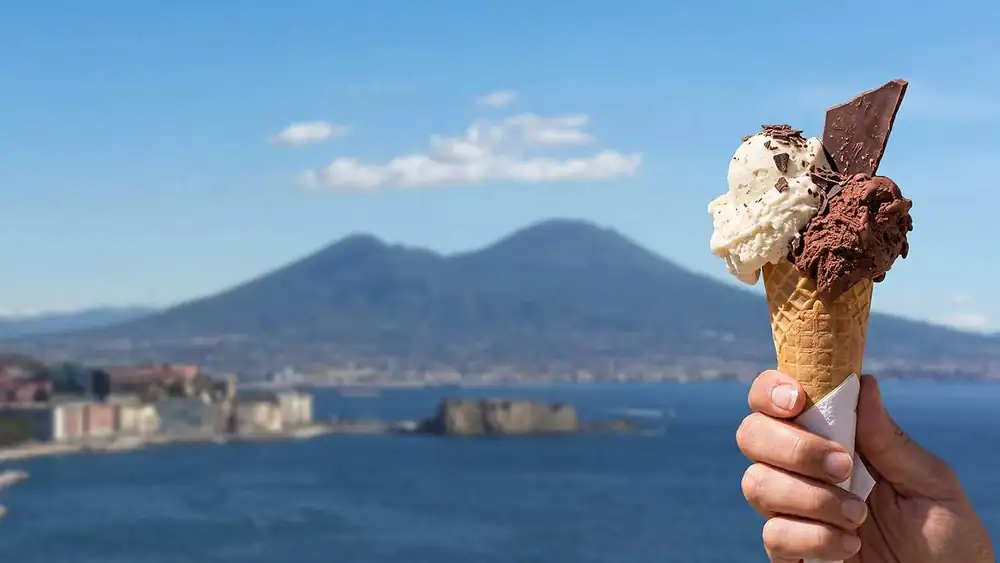
Artisanal ice cream doesn't exist in Naples
When you decide to descend into the heart of Naples, whether by kissing the humidity enveloping the tuff or listening to the bottom of a cistern, the city always finds a way to reward you.
Let's put it this way, without diplomacy or local marketing: in Naples, the culture of artisanal gelato, understood as a clean and sincere food, the fruit of an artisan's recipe and his careful selection of ingredients, is a veritable utopia. A disconcerting void, especially in a metropolis capable of elevating any carbohydrate to a global cult object. It's the gastronomic equivalent of having Jannik Sinner on the pitch and having him pick up the balls.
The golden age of the ice cream genius
The paradox becomes even more evident if we delve into the past. In 1694, Antonio Latini, a master chef in the service of the Spanish Viceroyalty, wrote in Lo Scalco alla Moderna: "Here in Naples, it seems everyone is born with the genius and instinct to make sorbets." It wasn't flattery, it was a statement.
Snowmen collected snow on Mount Faito and Vesuvius, stored it in pits dug among the beech trees, and transported it on donkeys to the central laboratories, where it became the sorbet that the Duke of Guise, Henry II of Lorraine, considered the best on the continent. In 1775, the physician Filippo Baldini published the world's first monographic treatise on sorbet. Three years later, Vincenzo Corrado, a Neapolitan intellectual and gastronome, codified over 30 recipes and invented cuviglie: small metal glasses (from the Spanish cubillo) filled with a frothy semifreddo, halfway between mousse and ice cream, whose thermal conductivity was integral to the dessert's success.
Matilde Serao celebrated it in Il Paese di Cuccagna, but today the coviglia has become a rarity. It's still found at Gran Caffè Gambrinus (on Via Chiaia), which has had it on its menu since its founding and offers a violet version, dedicated to Princess Sissi. They make it (now poorly) at Scaturchio in Piazza San Domenico Maggiore 19 (since 1903) and at the century-old Vincenzo Bellavia pastry shop, in cassata, hazelnut, and chocolate flavors. Served in little plastic or glass cups, sometimes made from semi-finished products, in some pastry shops only by order. And that seems to matter to me.
Leopardi and his obsession with Neapolitan sorbet
The most avid consumer of these wonders was Giacomo Leopardi. He arrived in Naples in 1833 with his friend Antonio Ranieri and never left, thanks in part to an ice cream maker. Vito Pinto ran the Bottega del Caffè on Largo della Carità, and was so good that with his earnings he even bought a barony, even earning a satirical verse from the poet in I nuovi credere ("and art where Vito is a baron").
It is Ranieri, in the memoirs published in 1880 under the title Seven Years of Partnership with Giacomo Leopardi, who gives us the picture: the poet ordered ice creams at the Caffè delle Due Sicilie one after the other, piling them up on the table until he attracted crowds of onlookers around him.
On June 14, 1837, a few hours before his death, Leopardi asked the nun who cared for him for a "double frozen lemonade" and drank it with what Ranieri described as "his usual greed." Cholera, not sorbet, took him. But the gastronomic legend has endured for two centuries because Neapolitans prefer to believe that in their city, one can die of pleasure rather than of disease.
Flavors inspired by Neapolitan sweets and the ever-present Lotus biscuits
What happened in the meantime? Neapolitan gelato makers stopped thinking of gelato as a cold-weather discipline and reduced it to a subcontract to pastry and snacks. Unable to master a milk base, unwilling to compete with the seasonality that Vincenzo Corrado preached in 1778, the average gelato maker clung to already-known desserts and brands. Gelato has become frozen pastry, and palates accustomed to sugary flavors don't even notice. These are its manifesto flavors.
- The Babbaiola tart. Philological clarification: it has nothing to do with babà. The nickname is that of a certain Mrs. Rosa di Marechiaro, known in Posillipo for her babà, whose fame is linked to this cult tart, made with crumbly shortcrust pastry, lemon cream, and firm ricotta. Transforming it into gelato means reducing those contrasts to a blurry sweetness where the lemon becomes a faint memory.
- Franui. This is the end of the Roman Empire. Frozen chocolate-covered raspberries are an industrial product that's a hit on social media and ends up in tubs as is.
- Lotus. The Belgian speculoos biscuit is now a fixture on stalls throughout Naples. It's caramelized, it's spiced, it's identical in Milan, Berlin, and at a service station on the A1. If the unwritten pact of artisanal gelato is to tell the story of a region, the Lotus flavor merely expresses a barcode.
The chocolatiers' paradox: those who know how to temper also know how to churn.
The twist? The most balanced and technically sound gelato in Naples doesn't come from ice cream parlors, but from chocolatiers' workshops.
Gay Odin, a chocolate factory since 1894, launched its cold-serve line in 2003 almost out of necessity: to keep the cocoa from surviving the August heat. Today, it operates six ice cream counters, free of semi-finished products and artificial colorings. Foresta chocolate becomes the flagship flavor, dark chocolate is flavored with ginger, cinnamon, or rum, hazelnuts are from Giffoni, pistachios are Sicilian, and lemons come from the gardens surrounding the factory on Via Vetriera. Whether you eat Ghianda or Cremino freddo, you'll experience the same aromatic definition of the respective chocolates.
Gennaro Bottone, a sumptuous master chocolatier since 1979, doesn't simply toss a bit of dark chocolate into a white base. His production is focused, available in both couch-sized and portable formats. Perfectly calibrated jars, camillini (the classic ice cream biscuit), glazed cones, and his famous truffles. Those who spend decades tempering chocolate learn to tame fats with absolute severity, because cocoa butter is unforgiving to amateurs.
Bottone's gelatos, whether made with single-origin cocoa or pure gianduja, display a structure that stands on its own. There's no need to mask the flaws in the churning process by burying the product under layers of industrial sauces or crumbled biscuits. It's a pure gelato, centered, and without shortcuts: a lesson in pure technique taught, with sublime irony, by someone whose profession is entirely different.
The Mennella Case: Craftsmanship Becomes Industry
The Mennella family began in 1969 in Torre del Greco with an artisanal workshop and rigorous principles. No hydrogenated fats, seasonal sorbets, and carob seed gum as the only thickener. Today, the brand, now known as Gusto Srl, has 18 stores throughout Naples and the surrounding province. The increase in production volumes has created numerous problems, including a general decline in quality, the standardization of flavors, and the offering of increasingly sweet and complex flavors. Mennella has industrialized nostalgia, and in Naples, between the excellent but rare product and the standardized, abundant, and reassuring one, reassurance always wins.
The only ice cream worthy of the name in the city is made by those for whom ice cream is merely a seasonal diversion from chocolate.
In The New Believers, Leopardi, after celebrating the art of Vito Pinto, concluded with a jab at the satiated and unambitious Neapolitans: "They satisfy your every appetite, / and your heart, which never dreamed of anything noble, nor rare, / nor beautiful, nor infinite." Nearly two centuries later, the appetite has remained the same. Only the sorbet has worsened.