Now that everyone is grilling, does it still make sense to grill?
Grilling has certainly been one of this year's trends.
Grilling has certainly been one of this year's trends. Numerous new themed restaurants have opened, and many cuisines have embraced (no, the missing "c" isn't a typo) this cooking technique, transforming their offerings to give more prominence to smoking and the like. This movement has its roots far away, and specifically in the Basque Country, home of chef Victor Arguinzoniz of Asador Etxebarri (ranked second in The World's 50 Best Restaurants 2025).
He is the absolute master, the precursor and founder of a movement that has revolved around the grill and led to all kinds of variations, transforming it from an ancestral cooking method into a trendy technique, thanks above all to figures like Salt Bae (real name Nusret Gökçe), who has become an internet star with his picturesquely salted grilled meat.
In Italy, the absolute benchmark for grilled food is Errico Recanati, chef at the Andreina restaurant in Loreto. He's one of those who took the family restaurant and turned it into something else, a gourmet destination, pioneering a cooking technique that no one else had brought to this level in our country. He took it, the most basic cooking technique in the world, and experimented with it day after day, creating gourmet creations and pop-culture innovations (his cacio e sette pepi is one of the main reasons people dine at his restaurant), demonstrating how versatile and interesting it can be, if mastered, yet also instantly understandable to everyone.
We asked him, who would even cook his arm over the embers to experience the fire's yield on a different type of raw material: now that everyone is making embers, does it still make sense to make embers?
Sharing the embers
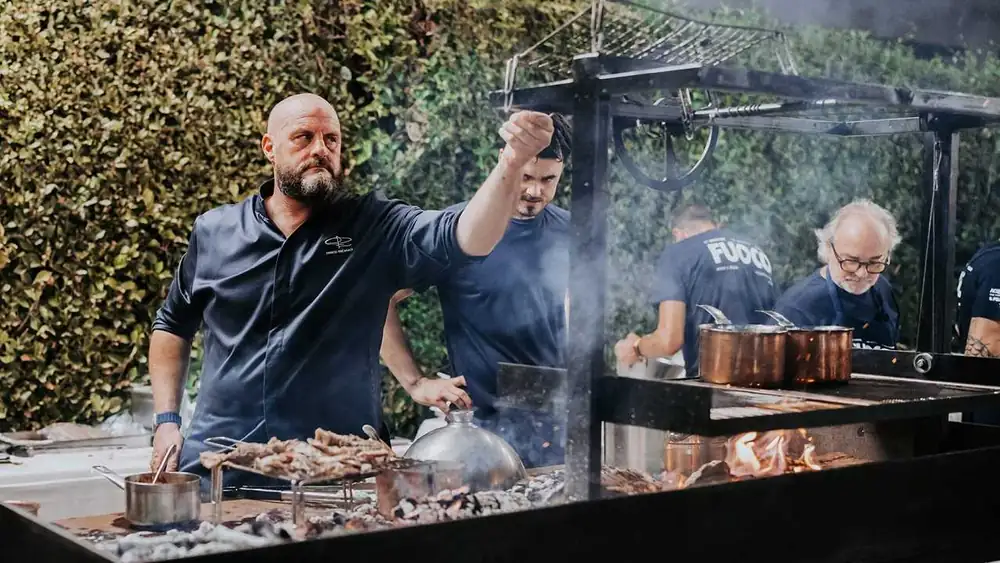
Some of his colleagues—starred chefs and emerging talents alike—who want to try their hand at grilling, learning from the best in the field, are currently joining Errico Recanati at his home in the garden of Ristorante Andreina. On September 13th, he's hosting FUOCO, a grand end-of-summer celebration where each chef offers their own gastronomic microcosm to the smoke, embers, and flames, sharing an ingredient, a technique, a story, or a region. "At the end of an intense season, when we're all tired after months of work, we feel the need to stop and reconnect. To celebrate together what has happened, before starting again." This is how, in Errico Recanati's mind, FUOCO was born, a moment in which "around the fire, people who know each other, respect each other, and often love each other gather. Chefs, producers, friends: people who share a common passion and the pleasure of being together."
The grill trend: Pros and cons
Errico Recanati, in a way, takes credit for starting what's more of a school than a fad. A trend, it's true, but above all, the spread of a complex technique. "Yes, I think I did my part to help embers spread," he says. "Ten years ago, no one was talking about it; it was very rare. Over the years, I've worked to develop my own identity, but also to popularize this cooking technique."
This is because, for Recanati, grilling isn't just a method; it's the very essence of cooking. "In fire, I find freedom, simplicity, something a pan can't provide." "So, I'm glad there are more people doing it," he says. "As long as it's real grilling, done properly." "We're talking about direct cooking," he warns.
“If we take a piece of meat, cook it at a low temperature and then grill it again, we can't really talk about grilling it; we're getting off topic, right?”
The most common mistakes
Everyone grills, but not everyone knows how. "It's not an easy way to cook," Recanati warns. "I have greater exposure and attention to the product, because as we know, grilling can also take away just as it gives."
So, the first mistake people make is not mastering an ancestral cooking method, as widespread as it is undervalued. Mastery of the medium is necessary, and often it isn't there, or isn't there at all. "And then we never forget the quality of the wood, the quality of the charcoal, as well as the quality of the raw material, otherwise how can we even talk about well-made embers?" says Recanati, addressing not only the risk that the products used to fuel the fire contain contaminating chemical elements, but also the sustainability of the materials used, from which forest they come, how they were recovered. "If you want to be sure of what you're eating, the embers must be made well."
And by "good," of course, we also mean flavor, because that's ultimately what we're talking about. "Even in this case, you have to be able to manage it," explains Andreina's chef. "In my cooking, there's the smokiness, but then it disappears, and the acidity and freshness that balance the smoke come through. Instead, I often see excessive smoking and little respect for the raw material, in terms of flavor and cooking, which is never just right: I always look for a perfect Maillard, the one I can't find any other way."
The future of embers
And then, when you think about grilling, you think more about the past than the future. As an ancestral cooking method, it harks back to ancient times, when cooking over an open fire was the only way to prepare food. The oldest cooking method in the world. Now everyone has rediscovered it, and it will presumably be used forever, regardless of trends. Recanati is also convinced of this. "Only the best will survive. It's not a passing fad; if it were up to me, it wouldn't even be a fad," he says. "It's a great cooking technique, and I'd like it to be perceived that way: at least, that's the goal of my work."
But—the chef continues—"we need to step back for a moment and focus on the raw ingredients." Which ones? "Right now, I'm focusing a lot on fruit: for example, we've just made peaches hung over embers, tied like scamorza cheese, which ultimately take on a very particular consistency, like grandma's compote. For me, fire is a constant discovery, really."