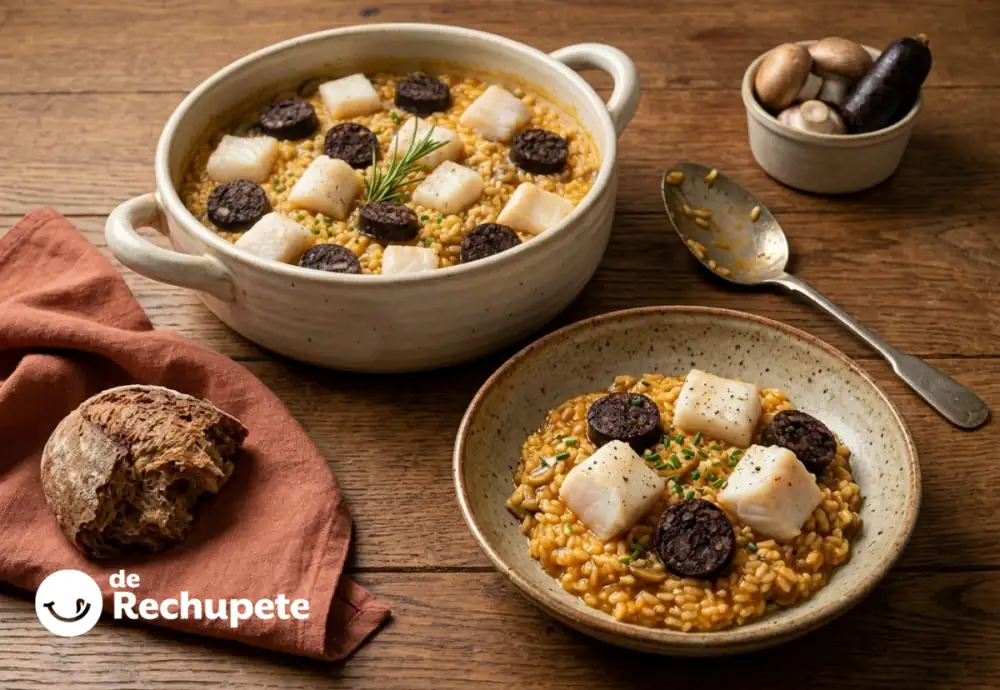
Catalonia's Arròs del Paraigüer Pairs Salt Cod and Black Sausage in a Forest Cazuela
A rice from the woodlands of Girona, built on preserved proteins and seasonal foraging, reveals how Catalan mountain workers turned a sparse larder into a complete meal.
- 320 g de arroz de grano redondo, preferiblemente bomba o arroz de Pals
- 300 g de bacalao desalado, mejor de una pieza gruesa, limpio de piel y espinas
- 180 g de butifarra negra o butifarra del perol
- 1 cebolla mediana, unos 150 g
- 1 manojo de ajos tiernos, 6-8 unidades
- 2 tomates maduros, unos 250 g
- 150 g de setas de temporada o 180 g de espárragos trigueros
- 1,2 litros de caldo suave de pescado o agua, más un poco extra por si hiciera falta
- 50 ml de aceite de oliva virgen extra
- 1 ramita pequeña de romero o unas hojas de tomillo
- Pimienta negra recién molida
- Sal, solo si hace falta
- Si hemos comprado bacalao ya desalado, lo secamos y lo cortamos en trozos de 3-4 cm. Si partimos de una pieza salada, tendremos que desalar el bacalao con antelación. Una pieza gruesa puede necesitar entre 36 y 48 horas en agua fría, dentro de la nevera y con varios cambios de agua.
- Calentamos el caldo en un cazo y lo mantenemos a fuego suave. Podemos usar agua, como en las versiones más sencillas, pero un fumet o caldo de pescado casero poco concentrado da más fondo sin tapar la butifarra. El líquido debe entrar bien caliente en la cazuela.
- Picamos la cebolla y los ajos tiernos. Rallamos los tomates. En una cazuela ancha calentamos el aceite y pochamos la cebolla 8-10 minutos a fuego medio-bajo. Añadimos los ajos tiernos, cocinamos 2 minutos e incorporamos el tomate. Seguimos hasta tener un sofrito bien concentrado, sin agua visible.
- Añadimos las setas limpias y troceadas, o los espárragos cortados en piezas de 2-3 cm. Rehogamos 3-4 minutos. No buscamos cocinarlos del todo, solo que pierdan parte del agua y se impregnen del sofrito.
- Echamos el arroz y mezclamos durante un minuto. Vertemos unos 1,1 litros del caldo caliente y reservamos el resto. Llevamos a ebullición y cocemos a fuego medio unos 14-15 minutos, moviendo la cazuela de vez en cuando pero sin remover continuamente el arroz.
- Probamos el caldo antes de salar. El bacalao y la butifarra todavía van a aportar sabor. Si el arroz se queda demasiado seco, añadimos parte del caldo reservado, siempre caliente. Debe mantenerse jugoso durante la cocción.
- Cortamos la butifarra en rodajas gruesas y la incorporamos junto con el bacalao. Cocemos 3-4 minutos más, lo justo para que el pescado quede jugoso y la butifarra se caliente sin deshacerse. Añadimos pimienta y un poco de romero o tomillo.
- Apagamos cuando el grano esté hecho pero todavía quede caldo alrededor. Probamos y corregimos de sal solo al final. Dejamos reposar 2-3 minutos y servimos. Durante ese descanso el arroz seguirá absorbiendo líquido, así que lo retiramos del fuego algo más caldoso de lo que queremos encontrar en el plato.
The arròs del paraigüer belongs to the forested comarques of Girona — La Selva and the Empordà above all — where it fed men who spent days or whole seasons working in the woods. It is a cazuela rice, neither dry nor soupy, landing at the point Catalan cooks call jugoso: the grain done but still swimming in a lightly bound broth. The name resists a clean origin. One account ties it to paraigüers, craftsmen who carved umbrella ribs and walking sticks from forest timber. But the same pot is claimed for charcoal burners, woodcutters, cork strippers and hunters. What unites them is not a trade but a condition: cooking far from a market, with only what could be carried and kept. That constraint shaped the recipe's spine. Salt cod, soaked for 36 to 48 hours in cold water with regular changes, provides the deep savour that fresh fish cannot replicate. Butifarra negra — a Catalan blood sausage seasoned with pepper and warm spices — brings fat and iron. Together they form a protein pairing rare in Mediterranean rice cookery, where surf and turf usually stay on separate plates. The technique is a study in sequencing. A wide cazuela takes olive oil, diced onion cooked low for eight to ten minutes, spring garlic for two more, then grated tomato reduced until no free water remains. This sofrito, the Catalan foundation, must be concentrated before anything else enters. Seasonal mushrooms or wild asparagus go in next, sautéed just long enough to shed their moisture and take on the base. Round-grain rice — bomba or the local Pals variety — toasts for a minute before hot fish stock floods the pan, roughly 1.1 litres for 320 grams of grain, with more held back. The rice cooks at a steady medium heat for 14 to 15 minutes, the cazuela shaken now and then but never stirred. Only in the final three or four minutes do the cod, cut into thick chunks, and the sliced butifarra join the pot, heating through without breaking down. Salt discipline matters more here than in most rice dishes. Both the cod and the sausage carry their own seasoning, and a stock reduced over the cooking will concentrate further. The rule is to taste before adding anything and to correct only at the end. The dish does not travel well through time. Reheated, the rice drinks the remaining broth and the cod tightens into chalk. It must be cooked and served in one motion, rested off the heat for no more than two or three minutes while the grain finishes absorbing. What the arròs del paraigüer demonstrates, more clearly than most regional recipes, is that Catalan mountain cooking was never about scarcity for its own sake. The workers chose salt cod over fresh not because they lacked options but because preservation was a technology that let flavour travel uphill. The dish still works on that logic: a sofrito built with patience, a grain chosen for its thirst, and two proteins added at the last possible moment so that each keeps its character. That is not poverty cooking. That is engineering. I prefer this response Response 2 Crafting a precise, evocative headline that captures the dish’s essence without overloading it with SEO elements. Skip I prefer this response