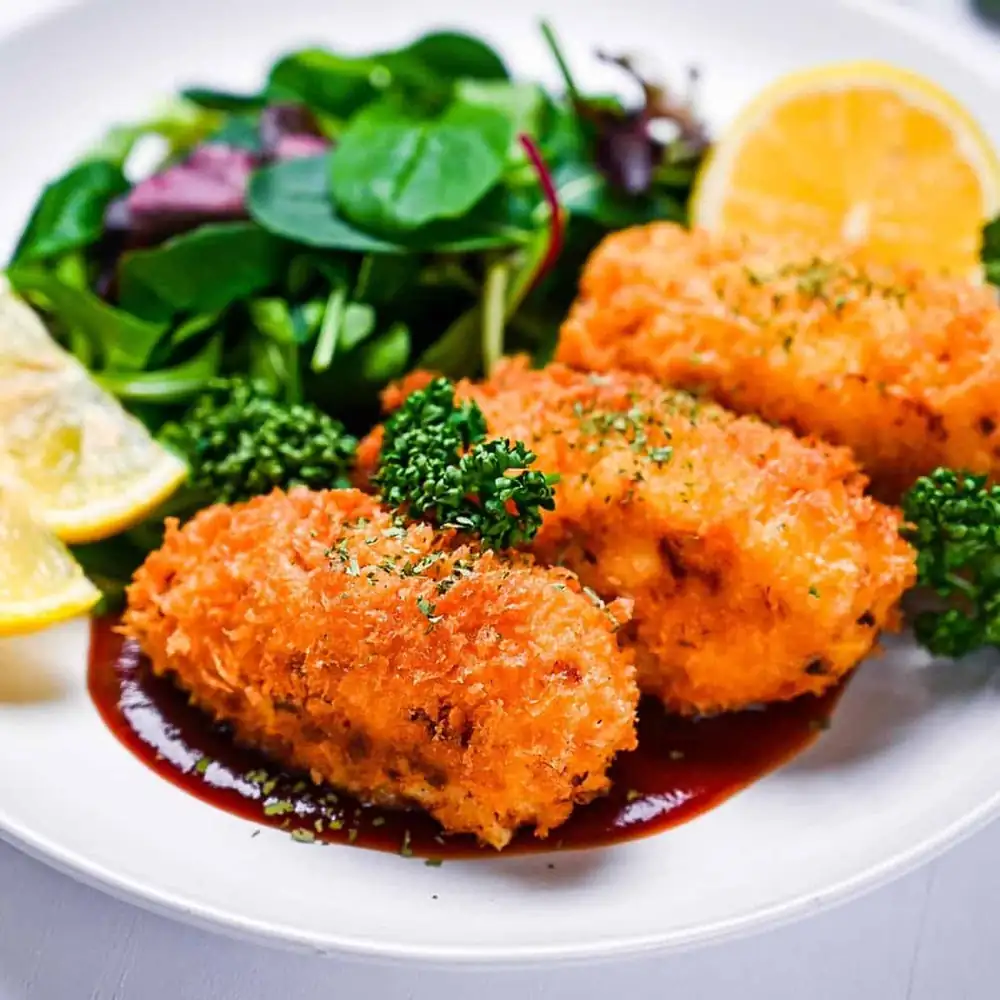
Crab Cream Croquette (Kani Kurimu Korokke)
There is something almost mischievous about crab cream croquettes.
- 30 g unsalted butter
- 170 g onion (finely diced)
- 110 g crab meat (canned)
- 1 tsp tomato ketchup
- 4 tbsp all-purpose flour
- 200 ml whole milk
- ¼ tsp salt
- 1 pinch ground black pepper
- 1 pinch nutmeg powder
- 2 tbsp preferred shredded melting cheese (grated cheddar or similar)
- 50 ml cold water
- 1 egg
- 5 tbsp all-purpose flour (plus extra for dusting)
- 75 g panko breadcrumbs
- cooking oil (for deep frying)
- 2 tbsp tomato ketchup
- 1 tbsp Worcestershire sauce
- Take a medium saucepan and melt 30 g unsalted butter over a medium-low heat. Add 170 g onion (diced) and sauté until soft and translucent (don't let it brown).
- Once the onion is soft, add 110 g crab meat and 1 tsp tomato ketchup. Mix until well combined.
- Sift in 4 tbsp all-purpose flour and mix thoroughly.
- Add 200 ml whole milk one-third at a time while whisking continuously.
- Add ¼ tsp salt, 1 pinch ground black pepper, 1 pinch nutmeg powder and 2 tbsp preferred shredded melting cheese.
- Switch to a spatula and keep mixing until the filling is thickened to the consistency of mashed potato.
- Transfer to a wide container and leave to cool. Once cool enough to touch, place in the freezer for 30 minutes or until firm enough to shape.
- Preheat your cooking oil to 170 °C (338 °F) to 180 °C (356 °F). While you wait for it to heat up, take a bowl and add 50 ml cold water, 1 egg and 5 tbsp all-purpose flour. Whisk together until a smooth batter is formed.
- Prepare two plates, one with flour for dusting and one with 75 g panko breadcrumbs.
- Remove the crab filling from the freezer and cut into 8 equal pieces.
- Roll each piece into a barrel shape.
- Once the oil is hot, coat the barrels in plain flour, then egg batter, then a generous coating of panko breadcrumbs.
- Once coated, immediately place each croquette straight into the hot oil, I recommend cooking them in batches. (Place the uncoated croquettes in the freezer while you're waiting for the others to cook.)
- Fry the korokke until crispy and golden, then transfer to a wire rack to drain any excess oil.
- While they rest, mix 2 tbsp tomato ketchup and 1 tbsp Worcestershire sauce to make your easy korokke sauce.
- Serve and enjoy!
They look like innocent potato korokke, but the moment they hit hot oil they bare their teeth. The filling is essentially a thick sauce, and sauce fights back. Most people think they are too tricky for home.
I will not pretend they are effortless, but their weak points are known. Cook it stiff, chill it firm and coat it with no gaps. Do those 3 things and the fangs disappear.
Let us tackle the usual pitfalls together tonight.
Crab cream croquettes
- What is it? A yoshoku (Japanese Western-style) croquette built on crab folded into a white sauce instead of potato, breaded in panko and fried, crisp outside with a molten cream center.
- Flavor profile: Rich and creamy filling carries a gentle but clear sweet crab aroma, while a quick ketchup and Worcestershire sauce backs it with tang and a little sweetness.
- Why this recipe works: It is built foolproof. You cook the sauce firm to drive off water, chill it solid, and coat it with no gaps, heading off every common failure early.
- How to make it: Cook the bechamel, fold in crab, chill it firm, and shape into logs. Coat with batter and panko leaving no gaps, then fry at 170-180°C (338-356°F) untouched.
- What to expect: Makes 8. The work itself is not hard, but the sauce needs time to chill firm before you shape it.
Summarize & Save this content on:
Crab cream croquette is basically a fried sauce. The filling is not potato. It is a thick white sauce of butter, flour, and milk cooked into a stiff béchamel, then mixed with crab meat.
You coat it in breadcrumbs and deep-fry it. The word cream refers only to that rich, creamy texture inside, not to any cream poured in or over it. English speakers often confuse it with a crab cake.
Those are packed solidly with crab as the star, but here the sauce is the star and the crab is a fragrant, sweet accent that is only a small part by weight. Both are called croquettes, yet this one has a different origin and mouthfeel from the potato version.
For me, crab cream croquette is that classic dish from old-school Japanese Western restaurants. The outside is crisp, and the moment your fork breaks in, the center flows out in a thick, creamy rush.
It is rich and smooth, yet the crab flavor comes through. My recipe goes all in on that troublesome filling and crushes every bit of it.
- Crab: Crab is not the star here, it is an aroma accent, and that faint line is exactly the face of the dish. Canned is fine, but use real crab if you can. Imitation crab (surimi) works and tastes good in its own way, though that sweet hit of crab the moment it lands on your tongue only comes from the real thing.
- Panko: In a crab cream croquette the panko is both texture and a pressure vessel. As the croquette fries, it is the wall that takes the steam building up inside, and a coat that covers evenly with no gaps keeps it from bursting. Thin or patchy spots are the weak points where it blows out, so coat it evenly and generously.
- Flour: Flour pulls double duty. First, it is the body of the sauce. Its starch gelatinizes in the milk and firms it up, and that firmness pulls the croquette together so it holds a shape. Second, it is the dusting flour for the coating. Cooking abroad, the all-purpose (plain flour) in your cupboard is all you need.
The spine you cannot move is the bechamel and the panko coat, but the crab that looks like the star is actually the most flexible part, so here is how I lean toward what I have on hand without breaking that spine. Substitutions:
- Crab → Imitation crab (surimi): The best-known swap, and the pros use it too. The crab flavor here is delicate and the texture comes from the sauce, so surimi still gives you a crab-like taste and flake. The cost drops a lot. It goes by surimi in Europe and imitation crab in the US, and you can find it anywhere.
- Crab → Shrimp, scallop, cod, or lobster: I make this with seafood other than crab all the time. They all sit well with bechamel and give you a sweet, flaky bite. Peeled frozen shrimp and scallops are easy to find and easy to handle.
- Cake flour → All-purpose or bread flour: Any flour thickens the sauce just fine. Bread flour actually helps the binding, so it is a good pick when you want a croquette that resists splitting.
Have trouble finding Japanese ingredients? Check out my ultimate guide to Japanese ingredient substitutes! Variations:
- Corn: Adds sweetness and it is the crowd-pleasing twist for kids. Fold it in along with the crab.
- Cheese or parmesan: Bump up the melting cheese or add parmesan and the richness and depth climb another notch.
- Mushrooms: Chop them and cook them down with the onion for extra savor and texture.
- A different finishing sauce: Beyond the classic ketchup and Worcestershire, demi-glace or tartar sauce works on the side as well.
If you prefer to watch the process in action, check out my YouTube video of this creamy crab croquettes recipe! i. Melt the butter in a pot over medium-low heat.
Add the onion and cook until soft and translucent. Do not let it brown.
Color turns your white sauce into a brown one. ii.
Once the onion is soft, add the crab and the ketchup and stir to combine. iii.
Sift in the flour and mix it in well. Sifting keeps lumps from forming.
iv. Add the milk in 3 additions, whisking each one in completely before the next. Pouring it in all at once is what makes lumps.
Tip: Keep the milk cold and add it a little at a time. It sounds trivial but it matters, cold milk holds the lumps back.
v. Add the salt, black pepper, nutmeg, and melting cheese.
Switch to a spatula and work it until it is as firm as mashed potato. vi.
Transfer it to a wide, shallow container to cool. Once it is cool enough to touch, move it to the freezer and chill it until it is firm enough to shape, but don’t let it freeze solid! (about 30 minutes)
Bechamel flows while it is hot and sets as it cools. The 2 most common failures with this dish, bursting in the oil and being too soft to shape, both come from underchilling.
Chilling firms the starch in the sauce and drops the surface moisture. Never skip it.
i. Preheat the cooking oil with high smoke point to 170-180°C (338-356°F). While you wait, make the batter.
Whisk cold water, egg, and flour together until smooth. Tip: A batter, rather than egg alone, is what keeps things from failing in the oil. A thicker batter builds a wall that stops the sauce from leaking out.
ii. Set out 2 plates, dusting flour on the first and panko on the second.
iii. Take the chilled filling out of the freezer and divide it into 8.
Shape each into a log, working quickly. iv.
Once the oil is hot, dust a log with flour, dip it through the batter, and coat it heavily in panko. Tip: Coat evenly and heavily.
Thin or patchy spots are the doorway a burst comes through. The inside of a cream croquette is soft, and a flat oval patty cannot hold it. A log has no corners, so you can roll it in the oil and set the whole surface evenly, which leaves fewer weak spots that break.
The heat of your hands melts the sauce fast, so shape quickly. If it turns sticky, chill it again.
i. As soon as a log is coated, get it straight into the hot oil.
Fry a few at a time depending on the size of your pot. Keep the uncoated logs in the freezer while you wait so they hold their shape.
ii. Fry until crisp and golden brown, then lift onto a rack to drain the excess oil. In a shallow fry, the part sitting above the oil never sets, it stays unstable, and it collapses and leaks when you turn it, so use enough oil to submerge them fully.
Hold 170-180°C (338-356°F). Too low and the inside warms and leaks before the coat sets, too high and the panko burns while the center stays cold.
Once a log is in, do not touch it until the coat is set. Poking or moving it tears that spot and it blows out. Crowding the pot drops the oil temperature and invites sogginess and bursting, so do not overload it.
- NEVER skip the chill, no matter what. Most people who give up on this dish rush this step. Hot sauce will not shape no matter how good it tastes, and an underchilled filling turns its leftover water into steam all at once in the oil and bursts. The freezer sets it in about 30 minutes. If you have the time, let it firm up slowly in the fridge instead.
- Whoever controls the moisture controls this dish. The wildest variable is the liquid from the can. When you use canned crab, separate the meat from the canning liquid and resist adding that liquid back for the sake of its flavor. If the sauce feels loose, work it a little longer to cook off the water before you chill it, and both shaping and frying get much steadier.
- Coat evenly and heavily, then leave it alone in the oil. Thin or patchy spots become the doorway a burst comes through. A batter helps the coat go on evenly. Poke or nudge a croquette while it fries and that spot tears and the filling shoots out, so do not touch it until the coat has set.
Crisp outside, molten within. That contrast only shows up when a firmly chilled filling meets a coat sealed with no gaps, and once you nail that, the plate from the yoshoku diner counter becomes a dish in your own kitchen. Fridge: Skip refrigerating fried croquettes.
The coat turns soggy and will not re-crisp, so fry to order. Freezer: The make-ahead is to freeze them raw, shaped and coated.
Freeze spaced apart on a metal tray, then bag. Fry from frozen, seeing as the filling is already cooked.
Meal prep: Prep to the raw, coated stage a day ahead. Fresh out the fryer tastes best, so fry right before eating.
My croquettes burst and leak while frying
The cause is almost always the same, trapped moisture turning to steam in the oil and punching through a weak spot in the coat.
Next time, cook the sauce firmer to drive off water (do not add too much canning liquid), then chill it solid before you shape it. Coat evenly and heavily so there are no thin spots.
Hold 170-180°C (338-356°F), do not crowd the pot, and do not touch them until the coat sets. A sealed coat that holds will not burst.
The filling is too soft to hold a log shape
This is just the nature of a cream croquette, it is meant to be much softer than a potato one.
First, it is underchilled, so put it back in the freezer until firm, about 30 minutes. If you have the time, an hour to 3 hours in the fridge works too.
If it is still loose, return the sauce to the heat, work it a little to cook off the water, and let it set. When you shape it, wet or lightly oil your hands and move quickly, and if it melts from the heat of your hands, chill it again.
How firm should the sauce be, and can I shape it without chilling I aim for the firmness of mashed potato.
Cook off the water until you can drag a spatula across the bottom and glimpse the pan for a second, and it will hold up in the oil. And no matter how firm you cook it, you cannot skip the chill.
You can never shape it while it is hot, and chilling both firms it further and drops the surface moisture. The freezer sets it in about 30 minutes, so always chill it once.
The ingredient brands and tools I trust are in my Japanese pantry guide and my cooking tools guide. Can’t find certain Japanese ingredients?
See my substitution guide here.
Filling
- Melt 30 g unsalted butter in a frying pan over a medium-low heat. Sauté 170 g onion (diced) until soft and translucent, without letting it brown.
- Stir in 110 g crab meat and 1 tsp tomato ketchup.
- Sift in 4 tbsp all-purpose flour and mix until evenly distributed.
- Switch to a spatula and keep mixing until the filling has thickened to the consistency of mashed potato.
Shaping and frying
- Preheat your cooking oil to 170 °C (338 °F) to 180 °C (356 °F). While you wait, make a batter by mixing 50 ml cold water, 1 egg and 5 tbsp all-purpose flour together in a bowl until smooth.
- Take the crab filling from the freezer and divide into equal portions (the base recipe makes 8).
- When the oil is ready, coat each barrel in plain flour, then batter, then a generous coating of panko breadcrumbs. Once coated, place immediately into the hot oil.
- Fry them in batches to avoid overcrowding and lowering the oil temperature. Keep uncoated croquettes in the freezer while you're waiting for the others to cook. Fry until golden all over.
- Rest on a wire rack to drain excess oil.
- Mix 2 tbsp tomato ketchup and 1 tbsp Worcestershire sauce together in a bowl to make the korokke sauce.