The Gourmet
The surprising story of the Pavlova (and the trick experts use to make sure it never fails)
Discover the story of the Pavlova, the famous dessert inspired by the ballerina Anna Pavlova. Learn about its origins, why Australia and New Zealand claim to have created it, and the trick to achieving the perfect texture at home.
Crispy on the outside, soft on the inside, and topped with fresh fruit, the Pavlova is one of the most famous desserts in the world. In this article, we'll tell you about the origin of the Pavlova, who Anna Pavlova was, and the secret to achieving its perfect texture.
Dear readers, allow us to transport you for a moment to the elegant theaters of the 1920s. Dresses brush the floor of the grand halls, fans flutter discreetly among the attendees, and all eyes are fixed on a single figure.
She is not a queen or a high society heiress.
This is Anna Pavlova, the legendary Russian ballerina whose grace, delicacy, and magnetism inspired one of the most famous desserts in history. The Pavlova, that irresistible meringue dessert that now graces tables around the world, was created in her honor during her tours of Australia and New Zealand.
And like any story worthy of a period drama, this one also has mystery, rivalry, and an unforgettable protagonist.
A dessert, a muse, and a dispute that has lasted for more than a century
The story of Pavlova begins with such deep admiration that it ended up becoming a recipe.
During her tours of Oceania in the 1920s, Anna Pavlova captivated audiences. Her ability to appear almost suspended in mid-air inspired chefs and pastry chefs who sought to capture that same sense of lightness in a dessert. Thus was born a creation as delicate as the artist who gave it her name.
What no one disputes is that the Pavlova became an absolute classic of world pastry and one of the most representative desserts of Oceania.
Australia and New Zealand still dispute the origin of the recipe. Both countries claim to have been the first to create this culinary tribute, and despite decades of research, the debate continues.
But here the gastronomic scandal appears.
What is Pavlova?
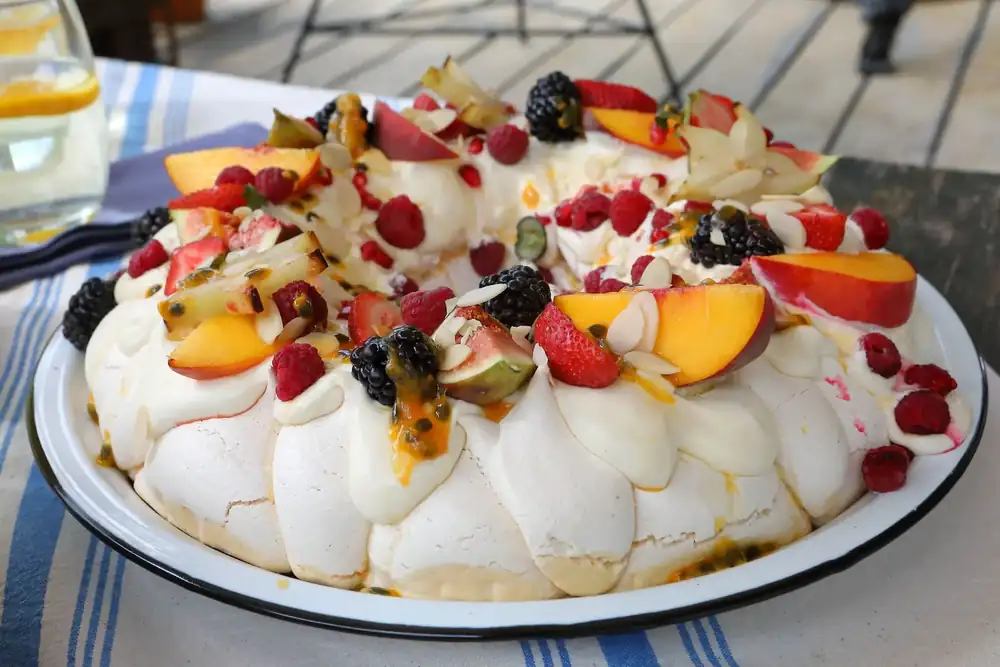
For those who have not yet succumbed to its charms, Pavlova is a dessert made from baked meringue that achieves an almost magical combination of textures.
Its exterior is delicately crispy, while the interior remains soft, moist, and light. It's traditionally topped with whipped cream and fresh fruit, a combination that brings balance and freshness to every bite.
Some food historians argue that its appearance is reminiscent of the flowing white tutus that Anna Pavlova wore in her performances, thus reinforcing the link between art and gastronomy.
The secret to a perfect Pavlova
As with the best recipes, success depends not on extravagant ingredients but on small details.
If you've ever wondered why some Pavlovas turn out dry while others achieve that characteristic soft center, the answer lies in three key factors:
- Incorporate an acidic ingredient, such as vinegar or lemon juice.
- Use cornstarch to help preserve the characteristic texture of the interior.
- Bake at a low temperature and let the dessert cool slowly inside the oven.
More than a difficult recipe, the Pavlova is an exercise in patience. And when these steps are followed, the result is as elegant as the ballerina who inspired it.
The version by Estefi Colombo that you have to try
The good news is that this story doesn't end in the salons of the 1920s.
And if you want to try an original version of this classic, you can't miss Estefi Colombo's Pavlova Muffins, a modern reinterpretation that preserves all the essence of the traditional recipe.