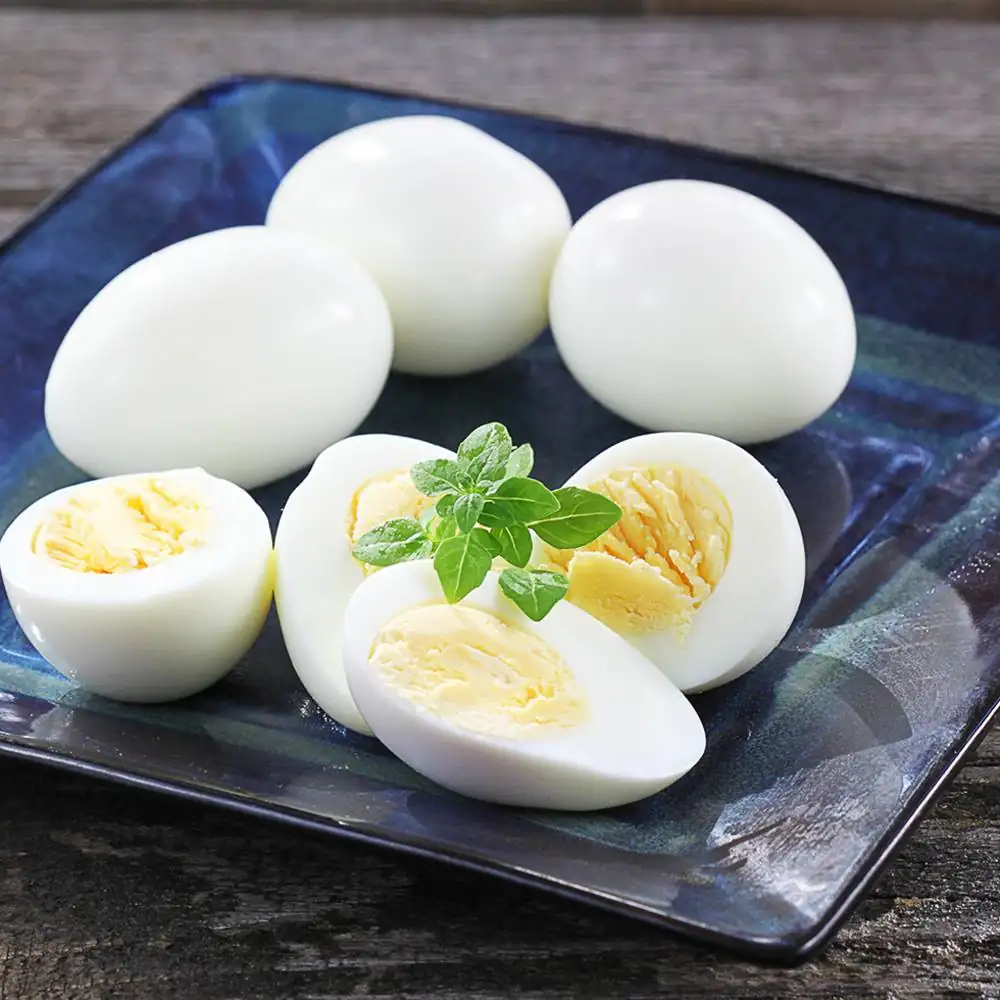
Hard-boiled eggs
Learn how to hard-boil eggs without overcooking them. Learn how to prevent eggs from cracking during cooking. Learn how to make sure the shell peels off easily without damaging the egg.
- simple tips - many uses in the kitchen - the perfect way to make hard-boiled eggs
- Preparation time: 5 minutes
- Cooking time: 9 minutes
- Number of servings: as many as eggs
- Energy value 155 kcal
- Carbohydrates 1 g
- Including sugars 1 g
- Protein 13 g
- Fat 11 g
- Diet: gluten-free, low-sugar, low-carbohydrate, vegetarian, high-protein.
- eggs
It is best to take the eggs out of the fridge in advance (if you keep them in the fridge) to allow them to reach room temperature.
Hard-boiled eggs are delicious not only on sandwiches, but also as a salad addition, egg spread, or even as a filling for meat. These are just a few ideas for using hard-boiled eggs. There are many more culinary variations with hard-boiled eggs!
How can you tell if an egg is fresh without cracking it? Simply immerse raw eggs in a bowl of cold water. Fresh eggs will sink to the bottom, while less fresh ones will float to the surface. I recommend using less fresh eggs for scrambled eggs or omelets as a last resort. However, if they're past their expiration date, I recommend throwing them away.
Hard-boiled eggs
Let me start by saying that egg size matters. Small "S" - up to 5 cm Medium "M" - about 6 cm Large "L" - about 7 cm.
* In centimeters - measuring, for example, with a caliper, from tip to tip. You can also measure the egg "by eye," placing it against a piece of graph paper or a ruler.
How long to boil hard-boiled eggs
Small - up to 8 minutes Medium - up to 9 minutes Large - up to 10 minutes.
Hard-boiled egg
The pot should be large enough to hold eggs placed side by side on the bottom. Fill the pot with water and add salt (if you're boiling a lot of eggs at once, you can even add a few tablespoons of salt). Place the eggs in the pot with cold water, using a spoon to lower them into the water. Set the heat to medium.
Once the water begins to boil, wait as many minutes as your eggs need, depending on their size. Never cook eggs for longer than 10 minutes. Try to set the heat so that the water is just flickering slightly but still simmering. The eggs shouldn't be bouncing around, as there's a risk of cracking. Once the cooking time has elapsed, transfer the pot of eggs to the sink. Drain off some of the water. Pour cold tap water over the eggs to stop the cooking process. After a moment, pour out all the water and fill the pot with cold tap water. Leave the eggs in the pot for a few minutes to cool.
To ensure the eggs peel perfectly and without any damage, it's a good idea to slightly damage each shell by tapping the egg against the sink. Place any eggs with slightly damaged shells back into the pot of cold water and wait a moment. Peel the eggs.
I don't recommend leaving unpeeled eggs in cold water for extended periods. This can cause the shell to peel poorly again. Perfectly peeled and undamaged eggs look beautiful when you plan to serve them on the table, including deviled eggs.
Why do we put salt in water?
I recommend adding a few tablespoons of salt to the water in which you boil the eggs. If I'm boiling 2-4 eggs, I add two full tablespoons of salt. For most eggs, I add 4-5 tablespoons. I don't measure the salt and rather eyeball it. However, I recommend adding salt to the water because it makes it much easier to peel the eggs. Even eggs that crack during cooking don't float into the water; they just bulge out slightly. This is because salt increases the density of the water. Adding salt slightly increases the boiling point.
Why do eggs sometimes crack while cooking?
Eggs can crack for several reasons. Most often, they crack when they're still cold (straight from the refrigerator) and placed in a pot of boiling water (including cold water). Eggs can also crack if you pack too many eggs into the pot and they're pressed together, knocking against each other, or if you set the burner too high and the water boils too rapidly.
How to keep the yolk in the center of the egg after cooking?
If I want to prevent the cooked yolk from getting closer to one of the edges of the shell, after about 2-3 minutes of cooking, I carefully and gently turn the eggs in a pot of boiling water. This way, as the white and yolk slowly coagulate, the yolk is more likely to stay closer to the side where it remains throughout the cooking process.
How do you know if eggs have been cooked too long?
When cut into pieces, the yellow is looser and darker. A gray-green rim forms around the yolk. These eggs are edible, but neither their appearance nor texture are as appetizing.
How long should you boil eggs that are to be dyed for Easter? Eggs for the basket are cooked the same way. Some people think that to make the eggs last longer in the basket or on the plate, they need to be boiled much longer. Of course, if you don't plan on eating them later, then by all means, go ahead.
I usually put hard-boiled eggs on sandwiches with ham and cheese, vegetables, and chives. I then cut them into thick slices. I often have this hard-boiled egg on a sandwich in the spring. I also add hard-boiled eggs to salads. Broccoli salad is great, too.
Egg paste. Hard-boiled eggs are, of course, a staple when preparing Easter dishes. Deviled eggs must look beautiful and taste wonderful.
Meatloaf with eggs is one of the most interesting Christmas Eve dishes using hard-boiled eggs.
What are your favorite hard-boiled egg dishes?
Enjoy your meal.
ps Check also my recipe for perfect scrambled eggs with bacon and chives.