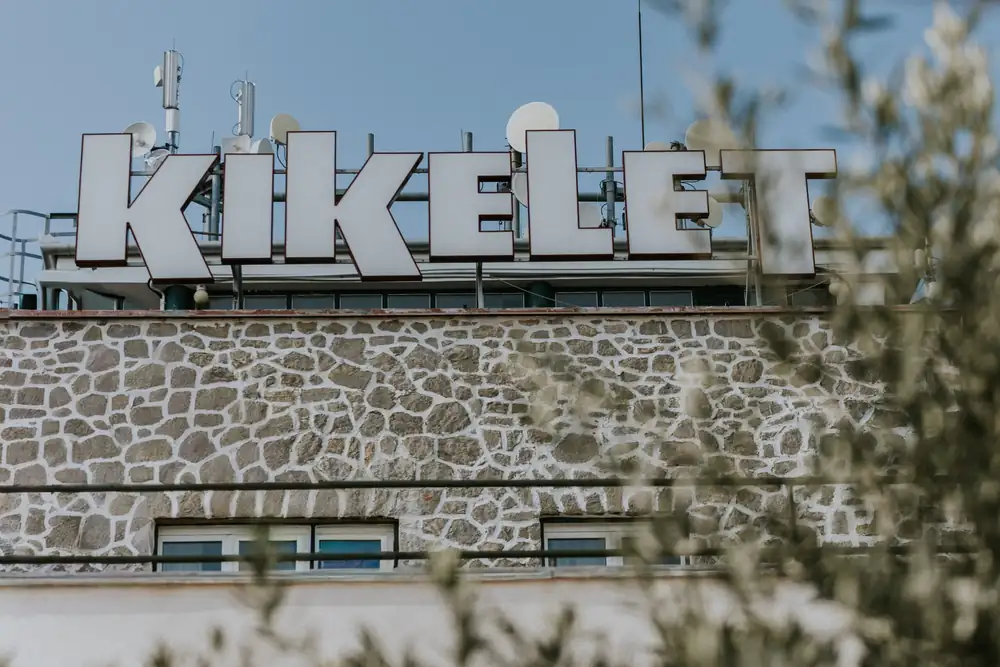
Grandma's reimagined pumpkin stew and Mecsek tartar – Zoltán Teleky talked about the first months of Kikelet
We talked to the professional manager of Kikelet about the new era of Kikelet, the boundaries of progressive Hungarian cuisine, the difficulties of rural hospitality, and why this project became more than just a simple restaurant opening for him.
You previously stated that you no longer wanted to operate an à la carte restaurant. What was it about Kikelet that made you willing to override this decision?
Kikelet has a history that gave me the motivation to prove to myself: I want to create one of the best, most demanding restaurants in the country on the Mecsek side. A modern, non-fine dining restaurant, with modern kitchen technology, quality ingredients, but in a way that everyone can find something to their liking. It's not about the meat hanging off the plate, but about creating hospitality that suits today's times.
You worked on the opening for a year and a half in a place that the people of Pécs already have strong memories of. To what extent was it possible to start with a clean slate here, and to what extent did you have to adapt to the location itself?
We actually started with a completely clean slate. The space was there and we transformed it as much as possible. I think we managed to create a modern, fashionable interior that matched the style of the house and didn't have to make any compromises. The implementation also took a while because we're talking about a heritage-protected building, where obviously everything isn't as smooth as when you build something completely new.
You said about Kikelet that you don't want to simply give Pécs another restaurant, but to create a hospitality experience. What does this mean in practice?
The location itself is part of this: we are on the Mecsek side, with perhaps the most beautiful panorama of the city. I could compare it to the Rege in Tihany: there you can see Lake Balaton, and from here you can see Pécs and a good part of the region. This is combined with the modern interior and an atmosphere in which everything is in harmony with each other: the quality and character of the food, the interior design, the music, but even the clothes of the waiters and chefs. I think we have worked out and coordinated every little detail.
Did you have to change anything after the opening due to the guests' reactions?
In the first round, we have achieved everything we wanted, but in the meantime we are groping for ways to reach a larger segment of the market. The hospitality industry is in a pretty difficult situation right now, so we have to be very smart about any bold idea so that it doesn't backfire. We have to constantly generate interest, we always need something to attract guests.
You say that the hospitality industry is in a difficult situation right now. What do you feel most strongly about this?
First of all, I would say that there is not enough money in the system at the moment, which is why hospitality is not moving properly. A place like Kikelet is perhaps at the end of its spending: going to a restaurant has become a bit of a luxury item that not everyone can afford.
But perhaps an even bigger problem is the lack of quality professionals. It is very difficult to find someone who can represent and carry forward the philosophy that we want. This is why it is very difficult to expand.
If we look at it from the perspective of price sensitivity: how is it possible to operate a higher quality, ambitious restaurant in Pécs today while still having the guests accept the prices?
I think we may not be the most expensive in town, while we pay close attention to quality. I also dared to take the plunge into Kikelet because it is such a large independent unit where we can hold events for up to eighty to a hundred people. I am confident that in time we will have events on a weekly basis. With these, we can keep the costs in balance, and thus the à la carte restaurant can also function well.
While you want to appeal to a wider audience, you define yourself as a progressive Hungarian bistro. What makes a dish truly progressive and not simply a modernized Hungarian dish?
I think it depends primarily on the food preparation technology and how much the chef can bring his creativity to it. A dish will not become progressive just because we put a little parsley oil on it or serve it differently. The preparation technology itself must also change. The point is that the guest gets back a familiar taste, while the food does not look exactly like what he is used to. Maybe comfort food is the right term for it: we want to evoke the feeling that a well-known dish gives.
A good example of this is our Gypsy roast, which is already the talk of the town. We confit the rib, so a thick, almost steak-like, yet tender piece of meat is on the plate. The Duck Trio is one such dish, which includes duck breast, duck leg and foie gras. We don't just add red cabbage, we add red cabbage cream, and we prepare the mashed potatoes in a different way.
But despite our progressive thinking, we also make sure that everyone can find their own dish: vegans can enjoy cauliflower steak with an Eastern-Mediterranean flavor, grandpas can enjoy gypsy roast, and foreign university students can even enjoy pumpkin stew.
If the familiar taste is the key: where is the line drawn between rethinking and when a dish loses the character for which we originally loved it?
I think it's very important to keep the original character of the food. What's interesting is how we can play and experiment within that. For example, if you eat a simple paprika fries that doesn't look like your mom's, but tastes exactly the same, and you can see the playfulness in it, then I think we've won.
We try to stay down to earth with the classics. We are basically a country restaurant where people come primarily to eat and live well. Hungarian guests have a very strong classic repertoire of twenty to twenty-five dishes, so we have to have a few dishes on the menu that everyone can find something to their liking.
For example, there is the aforementioned salmon trout fillet with cold pumpkin stew with dill. The pumpkin stew consists of roasted pumpkin and dill pumpkin velouté: it is like a pumpkin stew, but not quite, while it completely resembles grandma's pumpkin stew in taste.
In addition to Hungarian classics, how important is it that Kikelet also talks about Baranya?
We can show this mostly through the ingredients. We have been in this field for a long time, we know what is available in Baranya. Whenever possible, we buy from local producers and select the ingredients based on seasonality. The menu also reflects our connection to the region: for example, the Mecsek beef tartare, which is made with marinated forest mushrooms and pickled mustard seeds, made with high-quality, aged sirloin. Our guests love it!
To what extent do you determine the professional direction of the menu, and where does Chef László Kuzma's creative freedom begin? To what extent do you make decisions with a "chef's head" because of your experience?
We can have a very good dialogue. I have a direction about what I want, and he can relate to that very well. We usually discuss the menu together: he writes a draft, I tell him what I like, where it should go, or what I would change, and he is completely open to that. I also always have to look at what can be sold, what we can generate income from. It's not good if a group of eight people come in and end up getting up and leaving because they don't find a dish they like.
I basically think about the plate with a chef's and guest's mind. Since I'm a chef, I look at a business first and foremost from a chef's perspective, but as a manager I also have to pay close attention to the service side. For example, if the chef is writing a menu for an event, I often tell him to simplify it and not to overburden himself. I have many years of experience, and as a young chef he welcomes this with enthusiasm and motivation. I think we can work very well together.
You have opened several restaurants. How is your approach to Kikelet different from your previous projects?
I am present in this restaurant with a completely different maturity. When I opened Zsolnay Étterem fourteen years ago, I was thirty-two years old, and at Kiskastély I was around thirty-seven or thirty-eight. I have a completely different approach to this project now. It started very difficult, creating the background was also difficult, and in the meantime I am preparing for something big, because I want to make this the main work of my life. I want to realize my experiences so far, my knowledge, everything I have seen while traveling the world, in this unity.
This is a top-shelf restaurant, and I still have to grow up in some ways. But I think that by opening it, I've already taken it to a new level.
If in five years we ask a person from Pécs, “What is Kikelet?”, what would you like them to answer?
That it is one of the best restaurants in the country, and at the same time a well-functioning unit, where everyone can find what they need. It doesn't matter if you want to eat, have brunch, just have a coffee with your girlfriend on the terrace, or hold a wedding or a corporate event. I want it to be a unit that is constantly well-utilized, and that everyone thinks of with a good heart.
The latter part is already there. I never thought that the place would have such great power: almost everyone has a story about it. The first date was here, the proposal, the wedding, or they simply went up here. Kikelet has a past that is still very much alive in the people of Pécs today.