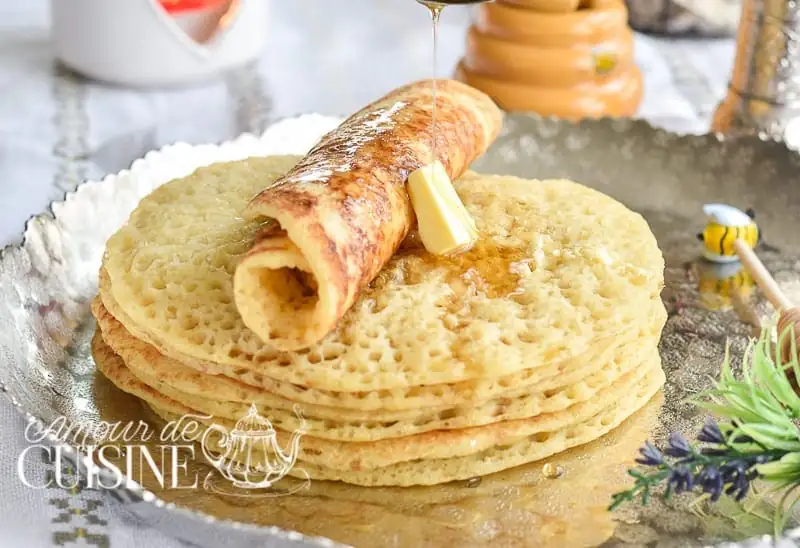
Thousand Hole Pancake (Baghrir): Easy & Fail-Proof Maghrebi Recipe
These baghrirs, or thick pancakes with a thousand holes, are light and melt in the mouth.
- 1 glass of fine semolina (200 ml glass)
- 1 glass minus two fingers of flour
- 1 tablespoon of sugar
- 1/2 tsp salt
- 1 tablespoon of baker's yeast
- 1 teaspoon of baking powder
- 450 ml of lukewarm water (+/- depending on the absorption of your semolina and flour)
- Mix the ingredients well in a large bowl using an immersion blender.
- Let it rise for about 30 minutes
- Mix again.
- Place a Tefal pan over medium heat, or use a crepe maker as I personally do.
- Cook your batter using a ladleful that you pour into the pan; the batter should spread well in the pan.
- Cook thoroughly before removing from the pan (only one side is cooked).
- When ready to serve, decorate to your liking with butter and granulated sugar.
With this recipe, you will have soft and airy baghrir.
In Algeria, they are often enjoyed with a little melted butter and a drizzle of honey, for a traditional brunch.
Thousand-hole pancakes: quick and easy baghrir made with a blender, fluffy and foolproof
Baghrir, also called ghrayef, corsa or thighrifine depending on the region, is a Maghrebi pancake made from semolina. Its thin batter cooks on one side only and forms a multitude of small air pockets capable of absorbing honey and melted butter.
This Algerian thousand-hole pancake recipe is my quick version using an immersion blender: 30 minutes of resting time is all it takes. The real secret isn't to aim for a thick batter, but rather a smooth, pouring consistency, and then a pan at the right temperature. For a more traditional preparation, you can also find my classic baghrir recipe without a food processor.
Ingredients for the express baghrir and the role of each
Use the same 200ml glass to measure both the semolina and the flour. The amount of water may vary slightly depending on their absorption capacity.
- 1 glass of fine wheat semolina: this is the base of baghrir. Choose fine semolina, not couscous grains, to obtain a homogeneous batter and a supple texture.
- 1 glass of flour minus two fingers: the flour helps the batter to bind, shortens the resting time and makes the pancakes easy to handle.
- 1 tablespoon of dried baker's yeast: it ferments the dough and helps form the holes. Check its expiration date.
- 1 teaspoon of baking powder: it acts during baking and complements the action of baker's yeast.
- 1 tablespoon of caster sugar: it supports fermentation and balances the taste without turning the dough into a very sweet dessert.
- 1/2 teaspoon of salt: it enhances the flavor. This quantity replaces the whole teaspoon mentioned earlier in the text and corresponds to the recipe card.
- Approximately 450 ml of lukewarm water: pour it in gradually. It should be lukewarm, never hot, so as not to weaken the yeast.
1. Prepare a smooth dough
- Sift the fine semolina and flour into a large bowl. This step reduces lumps even before you start mixing.
- Add the sugar, dried baker's yeast, baking powder and salt, then mix the powders.
- Pour about three-quarters of the lukewarm water and blend with an immersion blender. Then gradually add the rest until you obtain a smooth, fluid and slightly frothy paste.
- Cover and let rest for about 30 minutes away from drafts. The surface should have a fine foam: this is a sign that the yeast is working.
- After resting, stir gently with a ladle to homogenize the batter without whisking vigorously.
2. Check the consistency before cooking
The batter should flow from the ladle in a continuous ribbon and spread out on its own in the pan. Always do a test batch first: if it remains thick and forms few holes, stir in one or two tablespoons of warm water. If it spreads out like water and becomes very flat, the batter is too thin.
3. Cook the baghrirs on one side only
- Heat a flat, non-stick pan over medium heat. It should be hot, but not smoking.
- Pour a ladleful of batter into the center without spreading it. Holes should start to appear almost immediately, from the center outwards.
- Cook the baghrir without turning it over. Remove it when the entire surface is dry and there are no more shiny areas of batter.
- Place the baghrirs separately on a clean tea towel to cool slightly. You can then stack them cooked side to cooked side to prevent them from sticking.
My tips for making perfect baghrir every time
- Simply lukewarm water: water that is too hot can neutralize the yeast; cold water slows down fermentation.
- A batter that is thinner than pancake batter: it should spread easily on its own, but should not be as runny as French crepe batter.
- A dry pan: do not grease it before each use. Oil can hinder the even adhesion of the batter and the uniform formation of holes.
- A medium and steady heat: a hot pan will color the bottom before the top is cooked; a pan that is too cold will give a pale and pasty pancake.
- A little mixing between several cookings: if the dough separates, stir it gently to distribute the foam and the liquid part.
Why don't my thousand-hole pancakes make holes?
The problem usually stems from one of these four points. This quick check allows you to correct the batch without having to start the entire dough over.
- The dough is too thick: add a little warm water, one tablespoon at a time.
- The pan is not hot enough: let it heat up more before pouring the next ladleful.
- The yeast is no longer active: dough that does not foam after resting often indicates yeast that is too old or water that is too hot.
- The batter has separated: mix it gently before continuing, especially if the first baghrirs were successful and the following ones less holey.
How to serve baghrir
- Melted butter and honey: mix them together and then coat the still-warm baghrirs. The honeycomb surface absorbs the sauce without losing its softness.
- Melted butter and sugar: lightly drizzle each crepe with the melted butter before sprinkling it with sugar.
- Flavored syrup: add a little orange blossom, cinnamon or orange zest to a light syrup.
- Amlou: this paste made from almonds, honey and argan oil goes very well with the spongy texture of baghrir.
Serve them for breakfast, as an afternoon snack, or during Ramadan with mint tea or coffee. Baghrir is traditionally sweet, but a filling of fresh cheese and herbs makes a savory variation.
Storage, freezing and reheating
- At room temperature: keep them for a few hours under a clean cloth if you are serving them the same day.
- In the refrigerator: keep them for 2 to 3 days in an airtight container, separated if necessary by baking paper.
- To freeze: place baking paper between the baghrirs, then put them in a tightly sealed bag. This way you can take out only the amount you need.
- To reheat them: microwave them for a few seconds or briefly in a pan over low heat. Avoid prolonged cooking, which will dry them out.
What type of semolina should I choose for thousand-hole pancakes?
Use fine or extra-fine durum wheat semolina. Do not confuse it with couscous grains, which will not produce a smooth dough.
How long should the baghrir batter be left to rest?
This quick recipe takes about 30 minutes. Also, pay attention to the appearance of the dough: it should be foamy before baking.
Can these baghrir be prepared without baker's yeast?
Not by simply removing the yeast from this recipe: it contributes to the moist texture and the air pockets. A version using only baking powder requires different proportions and a different method.
Can this recipe be made without semolina?
It wouldn't be the same recipe anymore. Semolina gives baghrir its characteristic texture; a crepe made only with flour requires a different proportion.
Why don't we turn the baghrir over?
The steam passes through the holes and gradually cooks the top. Flipping it would flatten the holes and cause the pancake to lose its spongy surface.