Gastronomika crowns a grill chef for the first time
The final competition of this year's San Sebastián Gastronomika—which also included tripe, Russian salad, and fish soup—was the grilling contest. Storm Kirk forced a change of plans, moving the professional and public jury from the Kursaal terrace indoors, but neither the wind nor the rain dampened the excitement.
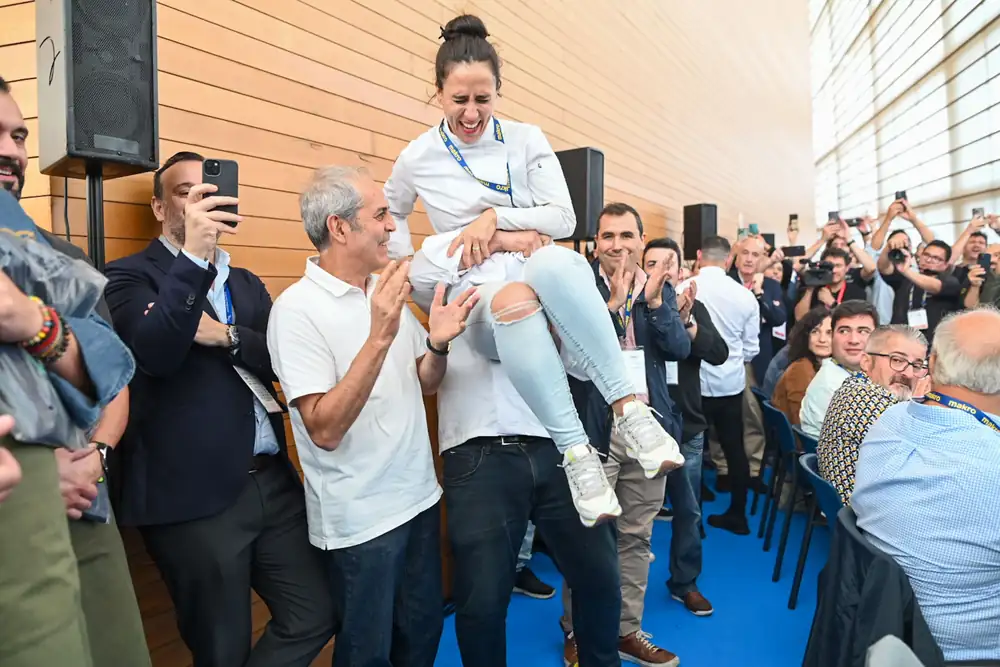
For the first time, a woman triumphed: Vanesa Martín, grill master from the El Alfoz de Burgos restaurant (Villagonzalo de Pedernales), with the collaboration of the Guikar meat company, which was named the best national meat for the fifth time.
The grill has been practically the exclusive domain of men and after fifteen editions in which the National Grill Championship has become one of the most popular events of San Sebastián Gastronomika, the woman from Burgos convinced the jury with a meat whose point she nailed despite the hurricane-force wind.
Vanesa Martín was thrilled: “I still haven’t come down to earth. Guikar has made an incredible effort; we’ve been working on this for months, and we’ve poured our heart and soul into it, and it shows.” For her, the key is “tempering the meat,” in this case Simmental, with 45 days of aging. “We chose it for its fat cover, its texture, the even marbling… That gave us a guarantee of flavor and texture, and we had no doubts,” explained Jesús Sainz of Guikar.
A very close competition
The final day also hosted the 21st edition of the International Extra Virgin Olive Oil Cooking Prize "Jaén, Paraíso Interior," with an exceptionally high level of competition among the eight finalists, making the jury's decision difficult. The winner was Alejandro Paz, from Fuentelgato, a restaurant he runs with his partner, Olga García, in a truly courageous venture for these young entrepreneurs in rural Spain, specifically in Huerta del Marquesado, in the Serranía de Cuenca mountain range.
He proposed a recipe with cod tripe, whey, lavender and EVOO in which he sought "lightness and to play with bitterness and sweetness."
The necessary revolution of the producers
Meanwhile, in the Kursaal auditorium, presentations were taking place one after another. One such presentation was by Pepe Solla, who predicted that in gastronomy, "the great revolution to come is that of the producers."
The Galician took to the stage at the Kursaal accompanied by Roberto Rodríguez (Artesans da Pesca), his fish supplier and trusted man - "I talk to him more than to my partner," Solla acknowledged - to talk about fish in particular, but about the role played by the choice and treatment of ingredients in general.
“Many young people come to my house more concerned with learning a technique than with the impressive product that comes into the pantry every morning. It can't be that they want to come in the afternoon to learn how to make a spherification, but complain when it's their turn to peel teardrop peas, which are the most perfect sphere that exists,” he lamented.
In that sense, he stated that "the kitchen has advanced a lot in recent years, but we have not put the same effort into helping producers advance."
It wasn't just empty talk. To support his arguments, he displayed two wild sea bass on stage, caught by hook and line in the same area of the Galician coast. One had been treated on the boat to ensure a quick death, efficient bleeding, and preservation in cold storage; the other had been left to die, thrashing and banging itself around, its blood seeping into the muscle until it turned pinkish and developed a strong odor.
“One smells clean, and the other smells like death,” said Solla, who served the attendees a sample of both. In his opinion, it is the responsibility of chefs to encourage more respectful practices toward the product they work with, even in a “selfish” way, since the restaurant is the one that benefits the most. The goal of this mutual collaboration between chefs and producers should be “that what reaches the plate is on par with what existed in nature, although that is a pipe dream.”
Thank you, Portugal
Portuguese chef Joao Rodrigues also spoke about his relationship with the local scene, recalling his time at Gastronomika as a student almost two decades ago and how the congress opened his eyes: “Obrigado!” When he settled in the Algarve to become head chef of the Vista restaurant, he started by cooking “foie gras and truffles, because I thought that was the best I could offer.”
It was while spending time in that privileged natural environment that he began to make contact with the local fishermen or a neighboring gardener, with whom he now builds a menu that consists only of vegetables and some marine protein.
He was the last of a long list of Portuguese chefs - Ana Moura, Joao Oliveira, Joao Sá, José Avillez, Marlene Vieira and Rodrigo Castelo - who have showcased the culinary awakening of the neighboring country throughout this edition of Gastronomika.
From Portugal to the Philippines, via Chicago, home to Kasama restaurant, which served another highlight of the closing day's festivities. The restaurant of Filipinos Tim Flores and Genie Kwon has recently gained popularity thanks to its consulting work on the series "The Bear," starring Jeremy Allen White, but its appeal extends far beyond its television acclaim.
By day, they're a bakery and pastry shop with a line that stretches for blocks and can last for more than three hours. By night, they transform into a fine-dining restaurant, serving a tasting menu inspired by the traditional cuisine of their homeland, which has earned them the first Michelin star ever awarded to a Filipino chef.
The program was rounded out by two of La Mancha's most promising restaurants: Toledo's two-Michelin-starred chef Iván Cerdeño and the very young Javier Sanz and Juan Sahuquillo, from Albacete's Cañitas Mayte and the Michelin-starred Oba. Both offered a glimpse into their creative processes, from Cerdeño's exploration of old recipes to red-legged partridge and eel, to Cañitas's thoughtful work of deconstruction and recomposition around colostrum. Protagonists of one of the most dazzling successes the profession has ever seen - they haven't been active for five years and already manage spaces in Madrid and Ibiza in addition to the original establishment in Casas Ibáñez - Sanz and Sahuquillo left an interesting reflection that connects with what has been seen these days at the congress: "It seems that chefs always have to be inventing things, but sometimes the important thing is to know ourselves and get together with professionals from other disciplines who help us get where we want to be."
And so ended another edition of San Sebastián Gastronomika, which has served to showcase the contrasts that the current culinary scene holds: haute cuisine restaurants versus humble taverns (protagonists of the 1st Forum of Taverns and Tavern Keepers, a resounding success with the public), historical recipes that coexist with futuristic techniques, young talents and established figures that join hands, all seasoned with a string of competitions that stimulate the competitiveness of the chefs and attract an audience eager for superlatives.
In addition, and as a new feature, the congress went out into the city to bring other cuisines to bars and taverns in San Sebastián and even took the congressmen to learn about the inner workings of the gastronomic societies.