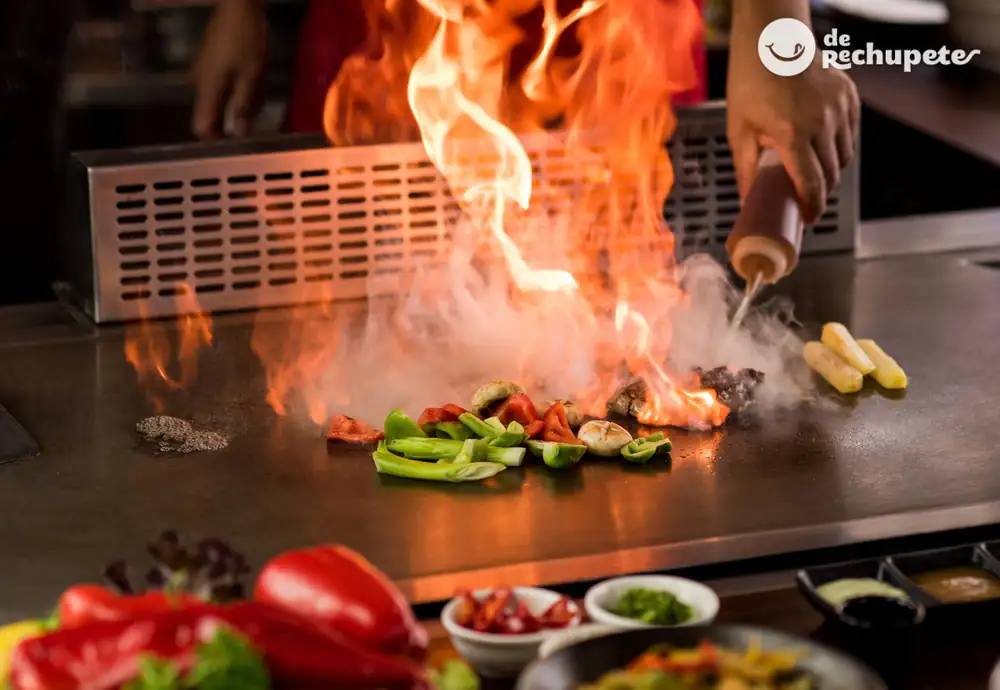
Flambéing and flambéing. Differences and what they are. Cooking techniques
Those darn culinary terms! There are some out there that you don't even know if they're spelled in your language, and then you stumble across them in a recipe and you're completely lost. Like we've all been there, today we're going to talk about two terms that cause a lot of controversy: flame and flambé.
Flamear
According to the RAE (Royal Spanish Academy), "flamear" means "to sprinkle food with alcohol and set it on fire" or "to pass plucked birds or the skin of an animal through a flame to remove the remains of feathers or hair."
Flambear
Flambear means "to sprinkle a food with liquor", which comes from the French flamber, whose translation would be to burn or pass through the fire.
As you can see, both concepts are similar and are used for almost the same purposes, with the difference that flaming is also valid for a deeper cleaning of hides and birds, although it must be done carefully as everything can be burned.
Origin and history of this cooking technique
The origin of this culinary technique dates back to Monte Carlo in 1895. There, a waiter named Henri Carpentier accidentally set fire to a pan where crepes were being prepared, resulting in a spectacular dish. Interestingly, those crepes were intended for Edward VII, the future King of the United Kingdom.
This cooking technique became very popular a few years ago in the world's finest restaurants, where waiters would flambé customers' food right in front of them, producing spectacular results. Unfortunately, this practice has largely fallen out of favor, likely due to the potential risks of lighting a fire in front of a customer.
In what recipes can they be used?
These cooking techniques can be applied to both sweet and savory dishes. Some dishes require flambéing during the cooking process, such as pâté or sirloin steak with whiskey sauce, while others require it at the end, such as crêpes Suzette, flambéed bananas, or Christmas pudding.
6 tricks and tips for better flambéing
- It's best to warm the liquor or alcohol slightly before adding it so it burns more easily. The most commonly used spirits for flambéing are rum, brandy or cognac, Cointreau or Grand Marnier orange liqueur, and whiskey.
- Do not pour the liquid directly from the bottle into the dish. Instead, place the required amount in a separate container, heat it, and then add it. Remove the pan or saucepan from the heat before adding the alcoholic beverage.
- The food to be flambéed must be hot, so as not to cool the alcoholic beverage and risk it not lighting.
- To light the fire I recommend a blowtorch, but you can also use a long match.
- We should use a saucepan with deep sides and a long handle to avoid burns. It should have a lid in case we need to smother the fire. Remember that you should never add water to put out a fire; the absence of oxygen (i.e., covering the pan) is the best option.
- Move the pan or saucepan back and forth until the flames die down on their own. The flambéing will stop when the alcohol evaporates. And very importantly, turn off the extractor fan when flambéing.
We hope you now have a clearer understanding of the difference between flambéing and flame-flaughtering, which, as you've seen, isn't much. Try flambéing one of your dishes and tell us how it turns out in the comments. We're sure it will be fantastic!