Artificial intelligence in the kitchen: ovens, hobs and robots that are starting to make decisions for us
For years, a "smart" appliance was little more than a device that could connect to your phone, notify you when it was finished, or pre-program a cycle. At IFA 2026, the conversation had shifted considerably.
Individually, each function might seem like just another technological innovation. Together, they paint a much more interesting picture: the appliance begins to make small decisions that, until now, were the responsibility of the cook. We're not talking about a kitchen that prepares dinner by itself while we watch, but rather systems that observe, compare what's happening with a model or program, and adjust temperature, time, power, or cycle without waiting for a new command.
This also necessitates clarifying the buzzword. Not everything automatic is artificial intelligence, nor does everything labeled "AI" actually do something radically new. What truly matters to the cook is something else entirely: whether the appliance better understands what's happening, avoids unnecessary monitoring, and, above all, improves the final result.
From programming a device to letting it interpret food
Kitchen automation didn't just appear yesterday. For years we've been living with microwaves that defrost by weight, rice cookers that change phases as they absorb water, slow cookers that maintain temperature, and air fryers with preset programs. They're useful, but they operate within a fairly limited range: we choose the program, and the appliance executes it.
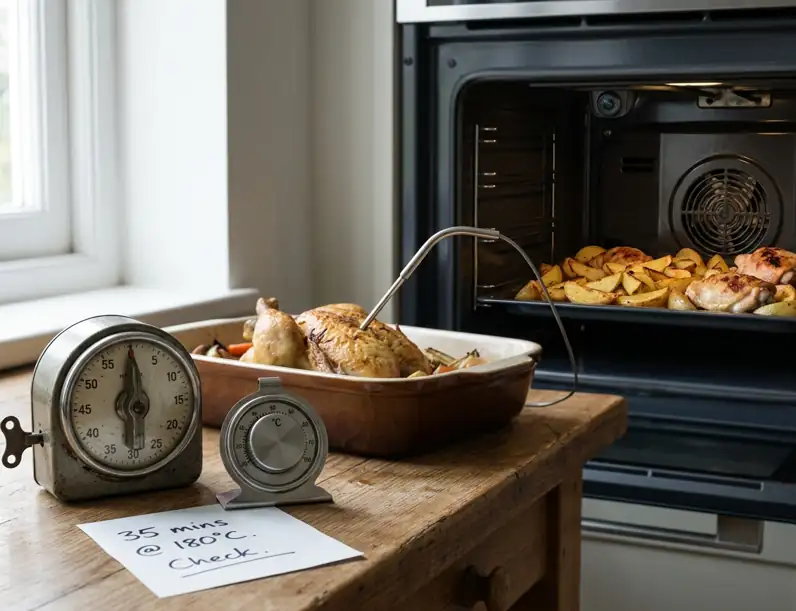
The smart kitchen being showcased at IFA 2026 adds another layer. Cameras, sensors, databases, and algorithms allow some appliances to gather information during the cooking process and adjust their settings accordingly. This subtle difference may seem small, but it changes our relationship with the appliance: we no longer simply tell it "bake for 25 minutes at 180°C," but in certain cases, it can recognize what we're baking, monitor the browning process, and decide when to stop.
It's an evolution of household appliances that make our lives easier, but it also raises a reasonable question: how much decision-making power do we want to give to a machine when we cook?
The oven no longer simply heats to the temperature we ask it to.
The oven is probably the clearest example of this leap forward. At IFA 2026, Siemens is presenting an iQ700 with dish recognition capable of automatically identifying over a hundred different dishes and suggesting the appropriate settings. The camera isn't just for viewing on your phone: it's part of the system that identifies the food and controls the cooking process. This year's innovation adds the ability to save favorite recipes so the oven remembers the correct program when you cook them again.
LG is following a similar path with its B900 Camera Oven. Its internal camera allows users to monitor cooking, receive alerts about browning, and get automatic recipe recommendations. Miele, for its part, is developing an ecosystem in which the oven can recognize when food has reached its desired doneness and combine that information with app functions.
Herein lies a key difference between a connected oven and an oven that interprets what's happening inside. Viewing an image on your phone might be convenient; recognizing the dish, monitoring its progress, and adjusting the cooking process represents a different level of automation.
That doesn't make the camera an infallible cook. The thickness of a piece of food, its initial temperature, the amount of water, its placement on the tray, or differences between ingredients still affect the result. Technology can reduce some of the monitoring, but real food still has variations that a cooking program must be able to tolerate.
The hob also wants to decide how much heat the recipe needs.
AEG's offering at IFA 2026 is particularly interesting because it brings automation to a task as commonplace as cooking pasta. Their new 7000 Series cooktop incorporates OnePot Pasta, a specific function where you select the number of servings, place the ingredients in the supplied pot, and the system manages the process. The brand estimates the cooking time to be around 15 minutes and aims to achieve al dente pasta with the sauce prepared in the same pot.
Anyone accustomed to cooking Italian pasta knows that we typically control the water, salt, cooking time, texture, and when the pasta mixes with the sauce. OnePot Pasta proposes a different method and automates some of these decisions. This doesn't mean it's "better" than traditional cooking or that it replaces all pasta preparation methods; it's simply a good example of how a cooktop is beginning to incorporate knowledge of a specific cooking process instead of simply offering power levels.
This also helps us understand where induction cooking is headed. Until now, we chose between gas, ceramic, or induction, and once we were in front of the stove, the decision was still ours. Sensors allow the cooktop to better understand what's happening in the pan, and some of the power adjustments are no longer done by guesswork.
When a recipe stops being just text and communicates with the device
One of the most interesting developments at IFA 2026 is not in a specific resistor, camera, or sensor, but in the connection between the recipe and the appliance.
Miele presents CulinaryCoach, an AI-powered assistant that combines its knowledge of recipes and appliances to answer questions about cooking and, when appropriate, apply the correct oven settings. The idea addresses a very common situation: we find recipes on websites, social media, in messages, or on apps, and then we have to translate "hot oven," "top and bottom heat," "until golden brown," or a specific temperature to our own oven.
The digital recipe is thus beginning to become a source of instructions for the machine as well. This change is significant for anyone who cooks following recipes: part of the interpretation we make between reading a step and pressing the controls can be automated.
But there's a clear limit. A recipe isn't just a combination of temperature and time. It also involves decisions about texture, size, ripeness, substitutions, salt level, amount of liquid, and final appearance. Translating a recipe into appliance parameters is relatively easy; understanding all its culinary exceptions is considerably more difficult.
Even the dishwasher starts checking what we've put inside.
The same logic applies outside of cooking. Miele's new G8 Diamond incorporates a camera and AI recognition to analyze the dishes and load, adapting the wash accordingly. LG's XG9S features an AI SenseClean system that uses a turbidity sensor to detect the level of soiling and adjust the program and wash time in several stages.
Here, the technology is less flashy than an oven that recognizes a pizza, but it probably explains the change better: sensor, interpretation, and automatic adjustment. The user no longer needs to choose so precisely between programs if the appliance itself can obtain real-time information about what's in front of it.
That doesn't eliminate basic maintenance tasks. Looking after the dishwasher, loading it correctly, and keeping filters and spray arms in good condition are still important. And it's also unwise to assume that any smart feature will always reduce consumption: energy savings in the kitchen depend on the appliance, the program, the duration, the temperature, and how we use it.
Kitchen robots: less science fiction and more practical tasks
This year, IFA has included a session in its program specifically dedicated to robots in the kitchen and home, ranging from tools designed for specific tasks to humanoid systems. The fact that the topic has made it onto the show's program doesn't mean we'll have a humanoid robot chopping onions in every home within two years.
In the short term, another approach seems far more realistic: specialized kitchen robots and highly controlled environments. Countertop units already exist that work with a defined container, pre-loaded ingredients, dosing systems, cameras, and stirring mechanisms. The more precisely defined the task, the easier it is to automate it reliably.
This evolution actually has very domestic roots. A rice cooker already frees us from monitoring a specific cooking process, a slow cooker maintains a long process with minimal intervention, and an air fryer automates temperature and time within a small space. The difference is that now some appliances can add vision, recognition, and the ability to adapt their operation while cooking.
The leap forward is not about a "robot chef" suddenly appearing, but about the increasing automation of micro-decisions.
Not everything that cooks automatically is artificial intelligence
With so much technological presentation, it's easy to lump together a camera, a timer, a thermal sensor, an automatic program, and an artificial intelligence model. They are not the same thing.
For the user, it's more useful to focus on what information the appliance actually gathers and what it does with it. If we simply select "pizza" and the oven always runs for 12 minutes at the same temperature, that's a program. But if a camera recognizes the food we've put in, compares its progress, and adjusts the cooking process accordingly, there's an additional layer of interpretation.
It's also important to distinguish between AI that generates recommendations and physical automation. An assistant can explain a recipe without controlling any stovetop. A sensor can perfectly regulate a temperature without needing generative AI. And a device can combine both.
That's why acronyms matter less than three fairly simple questions: what does it detect, what does it decide, and what does it modify without our intervention? If the answer is vague, there's probably more marketing than smart cooking.
Cooking well still requires things that a camera can't prove for us.
There's an easy temptation when these technologies appear: to think that learning to cook will become less necessary. For now, quite the opposite is true. The more we delegate a task, the more useful it is to understand what the appliance is trying to achieve, so we know when to accept it and when to correct it.
A camera can assess the surface color of a roast, but it can't taste the sauce. A sensor can detect temperature, but it can't decide if we want our onions more toasted. A program can repeat a recipe, but it won't know why we've swapped a very ripe tomato for a firmer one unless we provide that information.
Flavor, judgment, and preferences still belong to the cook. Learning to cook from scratch, recognizing textures, understanding the effects of heat, and knowing how to adjust dishes remain valuable, even if the oven can handle a good part of the process on its own.
Technology is especially useful when it eliminates repetitive work: monitoring to prevent overcooking, maintaining a temperature, adjusting a cycle, or remembering settings. It becomes less convincing when it tries to transform a variable cooking process into a rigid sequence that ignores what's actually happening in the pot.
Useful AI or Showcase AI: The Questions You Should Ask Before Buying
IFA itself has scheduled a panel for September 7th with a rather unpromotional question: whether AI in the kitchen is useful, just noise, or could even be harmful. The program explicitly mentions convenience, privacy, personalization, and consumer trust.
This debate is necessary because a connected appliance isn't bought solely for its flagship feature. It's important to know if it requires a constant connection, which functions depend on an app, how long it will receive updates, what information a camera processes, whether that processing happens on the device or externally, and what happens when the digital service becomes unavailable.
We also need to consider the less spectacular aspects: repairability, parts availability, compatibility with other systems, and price. A feature that saves us ten minutes of monitoring time can be fantastic; one that forces us to rely for years on an external service to do something that a physical remote control used to handle deserves a little more thought.
And there's another issue: automation must allow for adjustments to the appliance. If we want a different level of browning, want to change a recipe, or ignore a suggestion, the system should make it easy for us to do so. A smart kitchen that only works when we cook according to the manufacturer's instructions can end up being less flexible than a conventional kitchen.
What IFA 2026 makes clear about the future of cooking
The big sign of IFA 2026 isn't a specific oven, a pasta cooktop, or a dishwasher with a camera. It's that different manufacturers are arriving at the same place by different paths: home appliances are starting to observe, interpret, and decide.
The oven recognizes dishes and monitors browning. The hob executes a specific cooking process. The recipe can send parameters to the appliance. The dishwasher analyzes the load. Specialized robots are advancing within increasingly well-defined tasks. Everything points to a kitchen where we will give fewer small commands and reserve for ourselves the decisions that truly require taste, intention, or context.
That could be a significant improvement if the technology stays in place. Cooking isn't about constantly watching a timer, and no one loses any credit if an oven prevents a tray from burning. But the best smart kitchen will be the one that reduces our supervision without taking away our control.
The real competition, therefore, shouldn't be about who can put "AI" in the technical specifications the most times. It will be about who can demonstrate that their device makes the best decisions, at the right time, explains things sufficiently, and allows us to intervene when we know our meal needs something else.