A love story between a cookie and a city
It's everywhere you look.
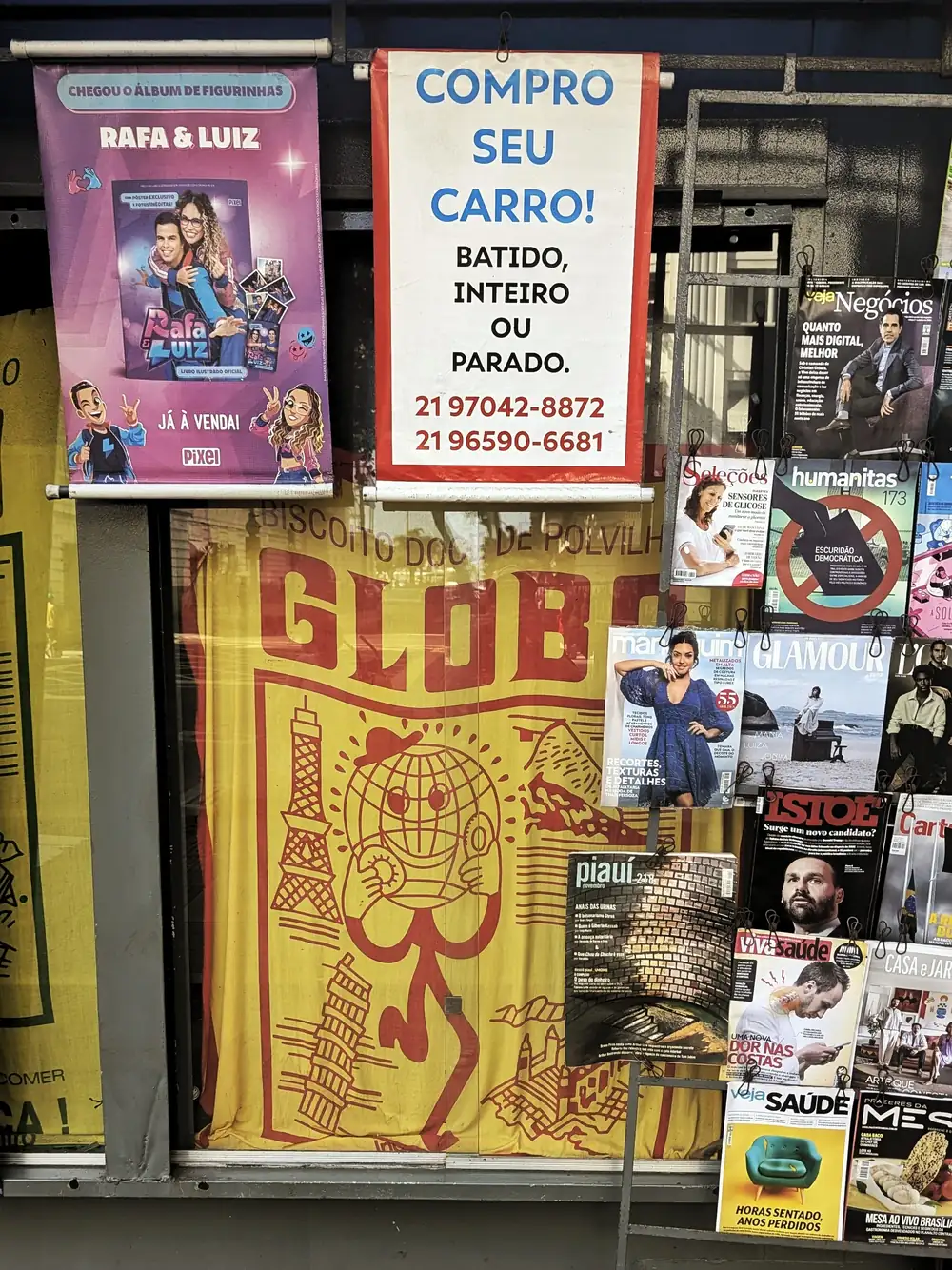
On the beaches, in the streets and in the businesses of Rio de Janeiro, a naive image is repeated, an almost childlike doodle: in the center, a human figure, with a globe for a head, holding two cookies; around it four silhouettes: Sugarloaf Mountain, the Eiffel Tower, the Leaning Tower of Pisa and the Belém Tower.
The color varies depending on the product it illustrates: t-shirts, sarongs, towels, flip-flops, shorts, bikinis, or tote bags. But in the original packaging, there are two options: yellow and red or yellow and green. The sweet or savory version of Globo, the crackers that set the rhythm and iconography of the streets of Rio de Janeiro.
When does a journey truly begin?
When do we choose a destination? When do we buy the tickets? When do we pack our suitcases?
These questions fuel the book Theory of Travel, by Michel Onfray.
For the Frenchman there is a “singular, perceptible moment, an evident date of birth, a gesture that marks the beginning: from the movement of the key in the lock of the door of our home, when we close and leave behind our house, our port of call. At that very moment the journey itself begins.”
But there is something earlier that is difficult to measure, a kind of prehistory of the journey.
The moment when a destination, or the idea of that destination, begins to take root within us.
From that prehistory of travel, Onfray highlights the importance of atlases and maps: how the musicality of a name or the power of geography can seep into our imagination and become a life goal. The beginning of a journey to the Amazon or the Himalayas can lie in the finger of a child tracing the blue line of rivers or the brown line of mountain ranges.
Then comes all the information that reaches us over the years in the form of photographs, songs, films, series, literature, and anecdotes. Few cities are as prolific in this regard as Rio de Janeiro. That's why it might seem strange that on my first visit to the Marvelous City, immersed in the picture-postcard landscape of Ipanema Beach, my eyes kept going back to the cookie vendors. In the epicenter of the caipirinha, samba, and football, I couldn't escape the magnetism of that childlike logo.
The cookies are shaped like donuts and have a light, crisp texture that doesn't translate into a memorable flavor. And yet, after the third or fourth one, you can't stop eating them. What matters is the lightness.
"They're called Globo because they're filled with air," my daughter told me after tasting them. I like that theory, but the name actually came from a bakery.
The great irony of this Rio icon is that it originated in São Paulo, the rival metropolis. Its creators soon realized that Rio de Janeiro, with its crowds, traffic jams, stadiums, and above all, its beaches, was its natural habitat. They moved the recipe and logistics to the Globo Bakery in the Botafogo neighborhood. Thus began the love story between a cookie and a city.
Its creators also did not invest in distribution: every day a battalion of street vendors collects the packages from the factory and spreads them around the city.
The division by color between sweet and savory was originally due to the fact that many of the vendors were illiterate.
“This flexible, autonomous retail network doesn’t cost the company a penny,” Becker writes.
“Street vendors and sunshine are—according to Becker—what Rio de Janeiro has in abundance. Globo cookies are anchored in an unbeatable partnership. It’s a more solid business model than that of many American financial institutions.”
Despite the business model, the global name and the international references of the label, Globo is a product that is practically not sold outside of Rio and is enjoyed mainly by the cariocas.
An icon behind closed doors. Quite the opposite of its main ingredient: cassava.
“The queen of Brazil,” as Luís da Câmara Cascudo called it, is not only the cornerstone of Brazilian cuisine: today it is a staple food for approximately one billion people. Also known as yuca or cassava, its versatility and resilience have made it a fundamental food for entire countries.
For Carlos Alberto Dória, cassava is the perfect example of how we cannot think of ingredients as something separate from culture: a poisonous root becomes suitable for consumption thanks to techniques that different indigenous peoples perfected over centuries.
The word comes from the Tupi language. The first written mentions are from the Portuguese, who were amazed by the laborious techniques the indigenous people used to remove its toxicity and, at the same time, by the incredible variety of preparations. By taking it to their colonies in Africa and Asia, they would change the global culinary map.
The base of Globo cookies is polvilho azedo, sour cassava flour.
In one passage of her chronicle, Clara Becker accompanies Roberto, a street vendor, along the beach, who tells her that on days when there are many tourists, sales are not as high: "The gringos don't eat Globo."
If I hadn't read that account back in the early stages of this trip, I might not have eaten them. Nor would I have noticed how light those biscuits were.