Gambero matures without losing his roguish edge
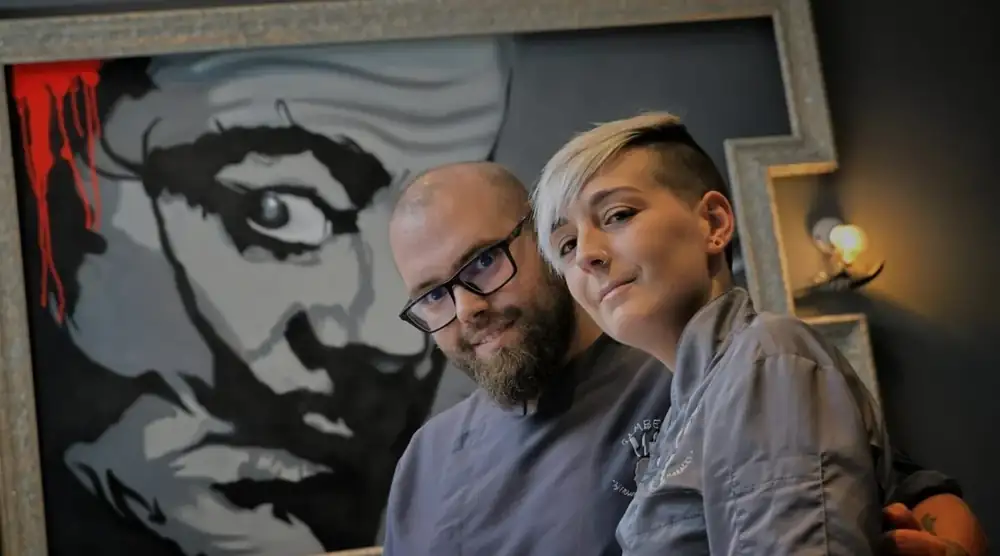
Franchesko Vera, in the kitchen, and Flor García, in the dining room, are the heart and soul of Gamberro restaurant, which boasts a Repsol Sun in Zaragoza (c/ Bolonia, 26. 696 932 781). They were practically children when they embarked on this adventure ten years ago.
Duck and cow tongues, rooster comb, and chicken heart. That's how they greeted customers at their first restaurant. Enough to make you run for the hills. Today, they still maintain that edgy touch, but it's more controlled. They're fun, because that's their essence, but the audacity in presenting ingredients has been toned down, aiming for a more coherent menu with a common thread.
Gamberro's cuisine knows no borders, no limits. Well, maybe a few. Don't expect to find blue lobster or Wagyu beef among its ingredients. If you add up the 70 euros the tasting menu costs across 17 courses, it's easy to understand. In any case, there's plenty of quality ingredients, lots of interesting ones. And technique. And concept. These are the three pillars upon which Fran's cuisine rests.
There are notable examples of the former. One of them is asparagus, a small green jewel bursting with flavor. Delicate, crisp, tender… They arrive in Zaragoza from Villena (Alicante). Further south, in Cádiz, farmer Rafa Monge, through his company Cultivo Desterrado, promotes the navazo of Sanlúcar de Barrameda, a cultivation system with 800 years of history.
Franchesko receives teardrop peas, fresh peanuts, pink turnips that look like watermelons, sunflower artichokes, and his latest discovery, tendrils—the more developed pea shoots—from this supplier. “I love them,” he confesses, “so I’ve asked Rafa to reserve the entire harvest of tendrils and sunflowers for me.” When in season, this supplier provides him with “the best tomatoes I’ve ever tasted,” which he uses in one of his recipes with green olive aguachile and smoked eel.
At Gamberro, the focus is increasingly on green. At least two courses are vegetable-based, and the side dishes are linked to the ingredients this chef receives weekly from the Sanlúcar de Barrameda market. There's also a concept behind it. For example, Frigopie ice cream is part of his culinary memory. Well, this chef has set out to create his own version in the shape of a finger. Furthermore, he likes to avoid preconceived notions, and that's where concept and technique intertwine.
The latest recipe he's added features chicken. Of course, it's from select poultry farms in Poleñino (Huesca). "Chicken is stigmatized and considered a second-rate product," he reflects. He wants to prove otherwise. With the combs, feathers, neck, and carcass, he makes a very reduced jus; with the collagen, a pil-pil base for a tartar sauce; with the giblets, a pâté; and with the prime cuts, he fills a dumpling. Many preparations, all with chicken.
But perhaps the best example of how product, technique, and concept come together is in Air Pizza, a bite that explodes in your mouth and mind. Franchesko worked for a time in Italy, and it was there that he found the inspiration to update this fast-food classic. It's a panipuri, the Indian fried bread, puffed up and toasted with a blowtorch. He fills it with classic tomato sauce and a burrata stracciatella with a 24-month aged Parmesan cheese cream. It's topped with a slice of porchetta and a basil leaf. It's like tasting the air of a pizza dough.
The classics
These and other dishes come and go from the menu, which, however, maintains some constants. They are its hallmarks. You try them and in one or two bites they show you where you are. Almost all of them appear at the beginning of the tasting: the olive with pickled mussels, the toasted brioche bread with beef tenderloin that has just been transformed/improved into a tartlet with a brioche bread cream and beef tartare with XO sauce, the Thai garlic prawn croquette, or the popular version of the "Civil Guard" accompanied by a refreshing green tomato and jalapeño gazpacho.
After these initial passes, the first thought is: “You’ve won me over. From here on out, do whatever you want. Play.” And that’s precisely what Franchesko, Flor, and their team do. In short, the idea of playing, experimenting, and trying to surprise is ever-present, and if it ever disappears, Gamberro will surely become something else entirely. Of course, this approach is perfectly compatible with the presentation of a refined cuisine, meticulous in its cooking and timing.
The Iberian pork shoulder with pickled and roasted vegetables is a good example. The shoulder is cured in lard, adding those southern touches. It's served simply with a tripe sauce, cooked like a Chinese soup. It's placed on the side so the customer can decide whether to use it or not. Fran isn't one for masking ingredients, especially meats and fish.
Further explanations
In the dining room, Flor directs the show with the indispensable support of Julio Canales, a young talent who has arrived with force to take the reins of the winery. In these ten years, he has grown and evolved considerably, and will continue to do so in the future, focusing on small projects within the region.
At the new Gamberro, there's also been an interesting change: Franchesko is spending more time in the dining room, leaving the kitchen. Well, he's actually been doing it for two or three years, but now with greater intensity. He never imagined that social interaction and face-to-face contact with customers would be part of the package for being a chef with his own restaurant, but that's the way it is. Fran is shy and reserved, but his explanations are very insightful for understanding his world.
In short, Gamberro's 10-year journey could be summarized as follows: a journey from playful gastronomy taken to the extreme, through intense learning in search of consolidation, to reach the current destination station, maturity.