Xavier Pellicer's restorative cuisine
I had already visited Xavier Pellicer's restaurant once, and one dish was etched in my memory: potatoes with beans. It was the only thing I remembered more vividly than the rest of the dishes, and although the visit was after summer and I clearly recall the bounty typical of that season (garlic soup, tomatoes, etc.), it was the textures I remembered more than other dishes.
Soft, surprising, light, and creamy. Beyond his story, his journey, his book, his technique, and his maturity, that was the memory I had of him. Memory, that great driving force, has brought me back to Healthy Kitchen after two years, to relive the potato and bean dish and discover—in the explanation of the dish—the power of evocation.
And indeed, memory is the argument of the potato and bean dish, the only possible way to explain it, its reason for being.
When serving this course, Xavier, recent recipient of a gastronomy award from the Catalan Academy of Gastronomy and Nutrition for his signature cuisine, presents it exactly like this: a dish that works on the memory of taste, based primarily on childhood memories—the everyday dinner of potatoes and boiled beans with olive oil—in a format with different textures that also appeals to olfactory memory, thanks to a crunchy bite of the blanched bean, which in turn evokes the smell of the first steam from the pot when the beans are added.
In the library of memories, the window to that aroma opens. In the mental palate, all the boiled vegetables from home are remembered, the common gestures (mashing the potato, adding oil and salt, and making a puree with the water released by the beans on the plate), and in the mouth, the texture of a gnocchi made with potato puree and oil, thickened with Kuzu (Pueraria lobata, a vegetable texturizer that he discovered long ago and has been mastering and integrating), and steamed to obtain a pure gnocchi, without egg or flour, is surprising.
Add and multiply all of the above. In the most technical and studied way, we find ourselves in simplicity. With a complex dish, we're at home.
Here, technique serves memory, and in other dishes on the menu, the avant-garde is in pursuit of the product, as is the case with asparagus, cooked for three and a half minutes at high pressure to offer the crispiest and juiciest bite that an asparagus can aspire to after being cooked: watery, not watery, due to the use of pressurized steam (an autoclave, where the steam is generated at 116ºC thanks to the vacuum).
Advanced culinary technology enhances the chlorophyll, textures, nutrients, and—thanks to cooking without added water—the flavor. This superb asparagus—with its subtle hint of sweet bitterness—forms the heart of the dish, accompanied by other ingredients that complement its flavor, such as orange and radish leaf, and rounded out with chanterelle mushrooms.
And although the use of technique is strategic to enhance the product, there are certain dishes that do not depend on technique but on the product itself, and that Xavier's team does not explain without mentioning their producers.
Products and producers
This is the case with Joan Salicrú's broad beans - a reference point for Biodynamics for years -, Xavier Carbó's tomatoes - with more than 50 types of tomatoes in Palafolls - or Antonio's peaches - a 75-year-old farmer who continues to select his products one by one - which supply him with ingredients that need nothing to be excellent, and in which, as Xavier himself explains, the kitchen is a mere transformer, and the weight of the cooking has been carried out by the Sun, during the ripening of the fruit on the plant.
In the case of Healthy Kitchen, the set menu format is the perfect structure to showcase the product, with enough flexibility to change week by week depending on what's available in the fields. Therefore, they offer two set menus (a short one with 5 courses and a longer one with 8), with three options (vegan, vegetarian, and omnivorous).
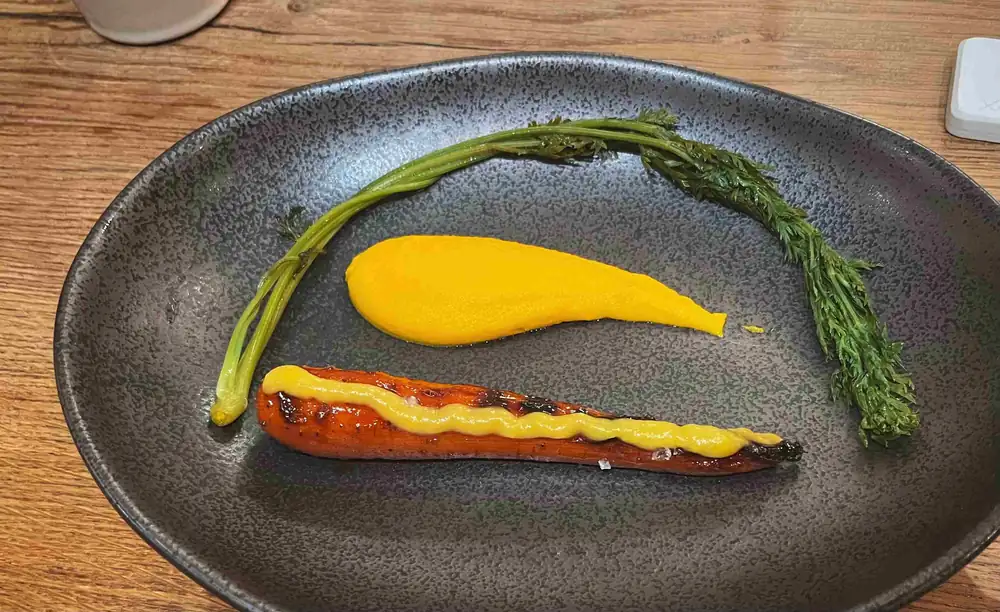
As I finished, while the omnivorous option includes the classic fish and meat – with an exceptional chicken that allows us to talk about Marta's work and emphasize the importance of her suppliers and the relationship of trust she establishes with them – I like to focus on the last course of the vegetarian menu: the carrot, which has nothing to envy in any piece of meat for its treatment, in which the texture is firm and the flavor is complete and resounding thanks to its cooking on the grill and a glaze that enhances the aroma.
Professional maturity
Awarded two Repsol Suns and hailed as the world's best vegetable restaurant by the We're Smart guide, Xavier's approach stands out for its well-roundedness and coherence, the result of two key factors in this chef's career: his extensive experience in restaurants that made history (the return of two Michelin stars to Barcelona at Àbac and the canonical cuisine of Santi Santamaria) and a kind of catharsis in his professional maturity; in which all his knowledge and technique are organized around a clear concept in his restaurant, from the name to the overall experience. Healthy Kitchen, literally.
While it's not an innovative concept in 2024, if we look back to the year of its opening (2018) or to 2015 with the opening of Céleri (his previous restaurant, the seed of the current one), Xavier is a pioneer, a forerunner of the focus on vegetables, the value of organic products, the vegan and vegetarian alternative (offered together with the omnivorous option) and of seasonality and proximity in a gastronomic restaurant approach.
Pleasure and digestion
Xavier Pellicer's Healthy Kitchen is the result of many factors, from the tragedy of Santi's death to the perseverance and demanding nature of a chef who is still in his kitchen, marking protein, plating during the service and producing with the team.
A personal, healing, restorative and meaningful project, in which gastronomic respect for the products is combined with technical culinary knowledge.
A place where everything has its importance, from organic salt to the absence of sugar; where suppliers have become collaborators in a cause and digestion is just as important as ingestion.
Today, Xavier Pellicer's restaurant is the final destination of a long and changing journey, a harmonious temple, a systematic and logical home, ordered around Biodynamics, Ayurveda, restlessness and culinary knowledge.