Mr. Hasegawa's Fish
In Japan, it is not unusual to hear them spoken of with the same pride with which the president of a football club or the biggest fan speaks of their latest star player.
If you want to be in the big leagues of top-quality fish, you're either with Mr. Junichi Yamamoto or Mr. Hiroki Hasegawa, the most renowned nakagainin – intermediaries who buy from wholesalers and sell to restaurants and retailers – in the city.
We shared a table and conversation with Mr. Hasegawa in two different restaurants where he serves his prized product.
He is not only one of the great masters in the practice of ikejime, the traditional Japanese technique used to slaughter fish – and even cephalopods – quickly, preserving the quality of their meat by minimizing the fish's stress and preventing the release of lactic acid and adrenaline that deteriorate the texture and flavor, but he is also a great activist in defense of the consumption of less valued species gastronomically, what they literally call in Japanese "unused fish".
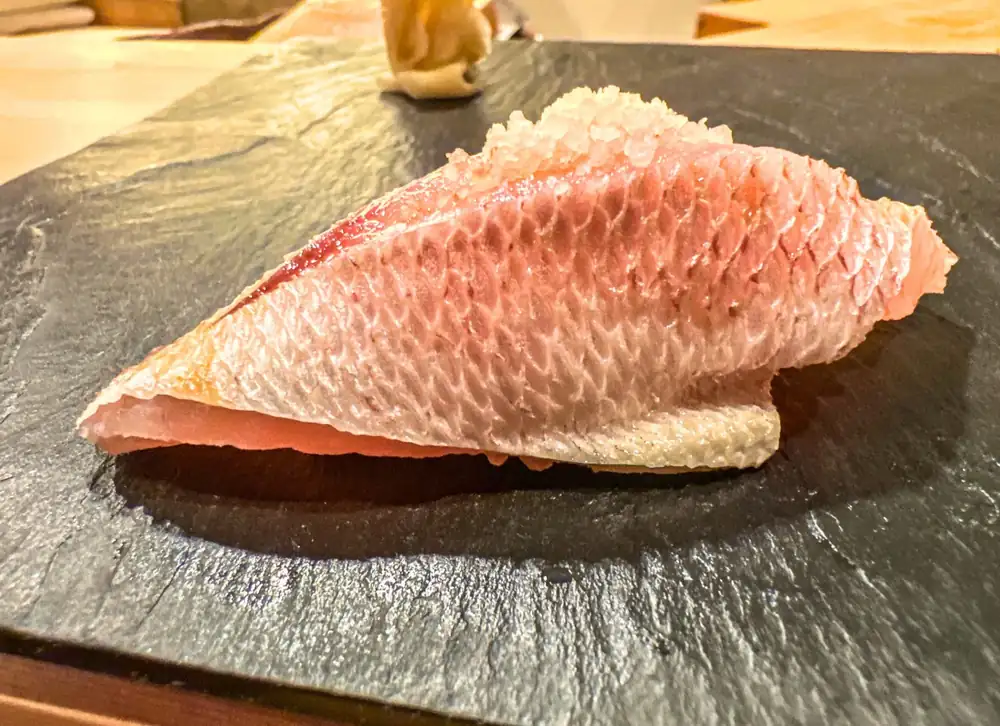
Alongside the prized specimens of Japanese red snapper, fugu or kinmedai, the golden-eyed seabream serves as a demonstration of how other more abundant and cheaper species can be just as good if they receive the proper treatment.
In Tokyo's finest sushi bars, cuts of 'aji' or Japanese jack mackerel (Trachurus japonicus) are commonly served, but yellowtail jack mackerel (Decapterus maruadsi) is rarely included. The former is highly prized by sushi chefs (itamae) because its flesh is firmer and its flavor more balanced, with umami notes, and it also allows for 'shime' or vinegar curing to intensify its taste. However, the latter had never before made it to the top sushi bars.
But Hasegawa has proven that the less attractive sibling of the horse mackerel can compete. In fact, at Sushi Dokoro Shiki, the Ginza bar (a 3-minute walk from Ginza Station) run by chef Yoshimura Masashi, they are served in sequence to demonstrate that both can be of the highest caliber.
The ikejime technique
Doroko Shiki is a traditional bar for eight people whose most unique feature is the number of spices offered. While the norm in such restaurants is between eight and ten different spices per service, Mr. Masashi presents up to thirty, thanks in large part to Hasegawa's knowledge and obsessive research. The criterion he uses to order the service is curious: from least to most intensely 'metallic' in each spice.
Every morning, Hiroki Hasegawa attends the auction at the small fishing port of Nagai, in the city of Yokosuka, just over an hour from Tokyo, and buys the best specimens caught. Few can compete with him and his company, "Fish People," because they have the best clients and, therefore, are the ones who can pay the most. The day we met, there was little variety due to the storm. Only one live squid was auctioned, which Hiroki bought to perform ikejime (the traditional Japanese technique of cutting squid into fish) so it would be ready to eat raw just a few hours later, which we did at the AO restaurant.
But how do you kill a squid? Hasegawa insists that the process is complicated, because while fish have a single brain, we could say that squid have four, or, to be more precise, one of the most developed nervous systems, with the equivalent of a central brain and three other 'mini-brains' or nerve ganglia. One 'thinks' for itself and controls the movement of each tentacle without the central brain's intervention, another is an independent vision system, and a third allows for camouflage, thanks to the autonomous control of its special cells or chromatophores.
In contrast to the traditional preparations of Masashi, we find a much more personal vision, influenced by Europe. Minemura, trained in France and Italy, uses techniques and sauces from these countries, which is very appealing to the Asian clientele who queue for almost a year to eat at his small restaurant. Westerners are less surprised, unlike his use of knives sharpened to stratospheric levels, so much so that his cuts alter the textures of the ingredients, making even a simple sliced onion neither smell nor make your eyes water.