A Good Chef Knows Everything Starts With Rice—That’s Why They Choose Lundberg
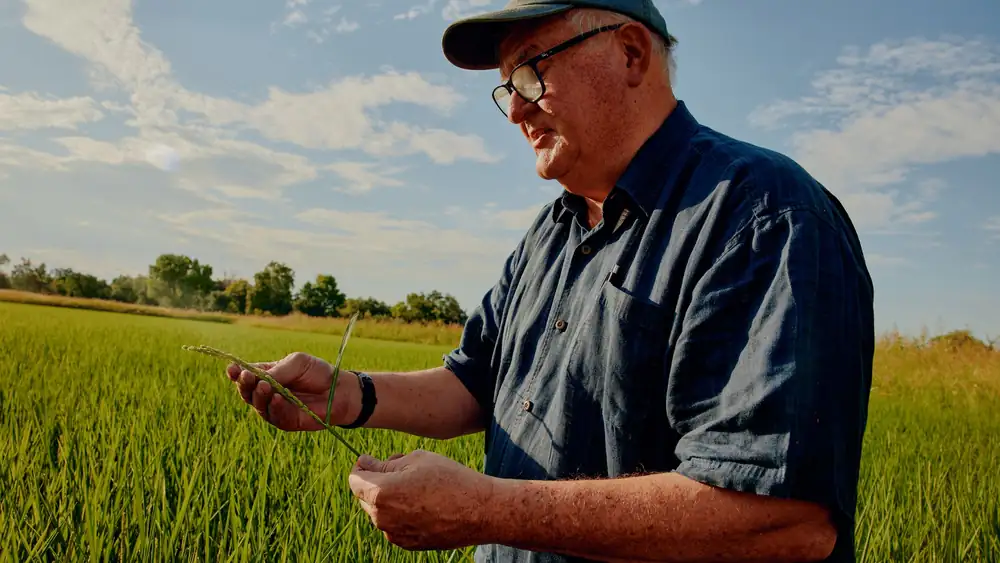
It’s 6 a.m. at Lundberg Family Farms, and Bryce Lundberg is pulling on his hip waders. Waterproof boots are necessary this time of year, when the rice fields look more like wetlands, and Bryce is here to do what he does every morning: read the rice.
“Rice can stay under water about 48 hours longer than weeds; it’s a tight window, but what a pure and simple idea, to control weeds with water instead of chemicals.”
It’s been a summer of record-breaking temperatures in Richvale, California, but the heat of the day hasn’t set in yet. The air is cool and fresh, and the green stalks sparkle with morning dew, tiny kernels just starting to emerge. For Bryce, “reading the rice” means monitoring water depth. Unlike most U.S. farmers, the Lundbergs use water instead of chemical herbicides to manage weeds. By carefully flooding and draining their fields, they drown the land-dwelling weeds and dry up aquatic ones without killing their crops. “It’s one of the tricks my dad taught me—he and my uncles actually discovered it by accident—and now it’s used by organic rice farmers all over the region,” Bryce says. “Rice can stay under water about 48 hours longer than weeds; it’s a tight window, but what a pure and simple idea, to control weeds with water instead of chemicals.”
Later in the week, the California Waterfowl Association will come by to release ducklings rescued from rice fields back in the spring before they hatched. Lundberg Family Farms is part of the Pacific Flyway, a major migratory pathway for birds, but the habitats the birds depend on have been disappearing for decades due to development—this particular region has lost 95% of its natural wetlands. So as part of their commitment to regenerative organic farming practices, the Lundbergs use a portion of their fields to replicate the ducks’ natural habitat, providing food and a place to rest as the birds travel up and down the coast. So far, they’ve rescued an estimated 30,000 duck eggs, sending them to a local hatchery to be incubated, hatched, raised until about five weeks of age, and then released back into the wild.
“What does regenerative farming mean? If you ask 10 different people, you'll probably get at least 10 different answers,” says Brita Lundberg, Bryce’s daughter and part of the fourth generation of Lundbergs to cultivate these fields. “To us, it means leaving the land better than we found it—not only farming organically but also caring for the creatures that call this place home.”
The Lundbergs helped pioneer the organic movement in the 1960s and 1970s, and recently introduced their first Regenerative Organic Certified ® rice, becoming the first U.S. grown rice brand to do so. But the full story of the Lundbergs’ legendary rice dates back to 1937, when Brita’s great grandfather Albert Lundberg fled his farmstead in the Nebraska Dust Bowl for the greener pastures of California. He left behind all his farm animals, but took with him the knowledge that shortsighted farming techniques like those traditionally used in the Midwest will strip the land of its topsoil, leaving it vulnerable to environmental disaster. When Albert purchased farmland he could afford in California, Bryce recalls, people told him nothing would grow there. "This isn't bad land,” he replied. “It just needs a good farmer."
Albert was right. Four generations later, Lundberg Family Farms banks on the idea that healthy soil begets healthy crops. Because the farm is vertically integrated, it handles the entire lifecycle of the rice, which is very rare in this industry. The process begins with seed development in the nursery, moves to the farm for growing and harvest, then to the silos for drying and storage, then to the in-house production facility, which takes the brand’s family of products to completion, from packaged rice to their famous rice cakes. The Lundbergs employ a staff of about 400 (with a focus on fair pay and good benefits, and a long list of tenured employees to prove it) and grow 17 different varieties of rice: brown and white, long grain and short grain, basmati and jasmine and arborio and black pearl. They sell to households all over the country and to a growing number of world-class chefs, including those running the acclaimed Momofuku restaurants.
“It's huge to be able to work with a rice farm that's able to keep up with the demands of a restaurant while maintaining the quality and their practices,” says Esther Ha, executive chef of New York City’s Momofuku Ko. “It's unheard of.”
But despite their ability to produce a whopping 100 million pounds of rice per year, Lundberg Family Farms has no problem maintaining quality and care, as Ha learned firsthand on a recent trip with Momofuku’s director of culinary, Max Ng. For the two chefs, the experience was eye-opening. Ha is Korean American and Ng grew up in Singapore, so rice has been woven into their culinary fabric since long before either entered a professional kitchen, but neither had ever witnessed the process by which it is grown. “I mean, how often do you actually get to come in contact with fourth-generation rice farmers?” asks Ng. “In cooking, process is everything, so it’s really cool to see the parallels in farming. From the way they grow organically to all these interesting natural crosses they’re making out of different rice varieties, it was really impressive. They live and breathe rice out there.”
With Bryce and Brita, Ha and Ng toured the farm—hip waders included—before cooking up a series of dishes built around three different varieties of Lundberg rice: first, a nori rice dish with roasted pork shoulder that’s on the menu at Momofuku Ko and made with Lundberg’s Regenerative Organic Certified ® White Basmati Rice. Next, Majordomo L.A.’s famous mushroom crispy rice, using Lundberg’s Arborio Rice. And finally, a rich lobster soymilk congee inspired by Ng’s dish from Momofuku 207, featuring Lundberg’s Organic White Jasmine Rice.
As the chefs, the Lundbergs, and other members of the farm staff ate together, looking out over the paddies from which their meal came, they chatted about how rice provides a backbone for cuisines all over the world. “In Korea, the word for dinner table or a meal is literally translated to ‘rice,’” says Ha. “I grew up eating rice three times a day when I was home—breakfast, lunch, and dinner. Rice acts as a vessel to eat all the other side dishes, but if the rice is bad, it ruins the whole meal. So getting to see where it comes from is huge—I've gone on the regular farm tours and picked a radish out of the ground and eaten it, but I would've never thought to go to a rice farm because rice farms don't exist in New York.”
Brita smiles knowingly at this anecdote. “I ran away from the farm for several years,” she recalls with a nod. She was in her early 20s then, trying to assert independence as 20-somethings often do, and took a job with a book publisher in New York City. “I remember sitting at my desk in Rockefeller Center at 10 o’clock at night and I would get a text from my dad from the fields—a video of pelicans one day, or a turtle the next. And I just started to think, ‘I'm doing something wrong here.’ I wanted to be a part of it. I wanted to be a part of carrying our family story forward. And now I am.”
At the end of the day, the heat recedes. The sky turns a lush shade of pink, and the electric green paddies glow as though lit from within. The hawks and ducks are sleeping now, but you can hear the owls, and the frogs, and especially the crickets, chirping as a chorus. This, says Brita, is the best part of the day. “Often my dad and I will be in the office wrapping up our desk work, and one of us will give the other a call. We’ll say, ‘Hey, you want to swing through the fields on our way home?’”
Together, they’ll pull on their hip waders, walk to the edge of the paddies, and step carefully into the still water. Together, they’ll read the rice.