
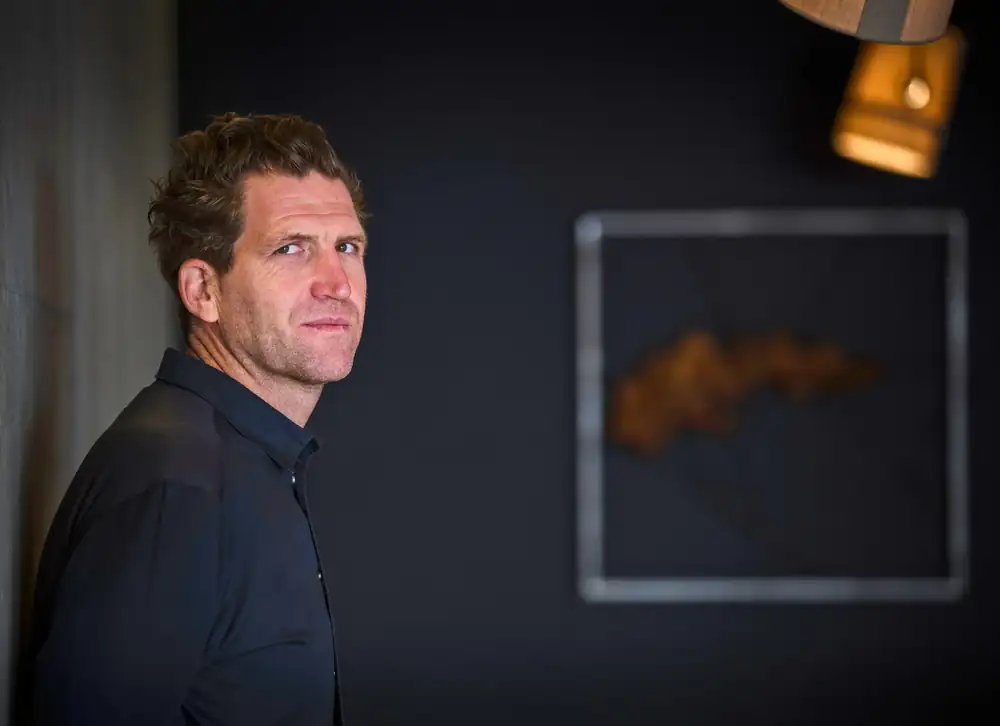
Alexandre Mazzia plasma en la cocina el alma mestiza de Marsella
Aterrizo en el aeropuerto. Durante mi viaje de tres días para descubrir los ingredientes que componen su paladar, Mazzia me recomienda algunos de sus lugares favoritos: ninguno forma parte de la escena de moda, pero todos capturan a la perfección su esencia.
I land at the airport. During my three-day trip to discover the ingredients that make up his palate, Mazzia recommends some of his favorite spots: none are part of the trendy scene, but they all perfectly capture his essence. We have dinner at [location missing]. His nearly two-meter height has made him stand out since he was young, something that Alexandre doesn't seem too keen on. He hunches over slightly and speaks in a quiet voice, in a vain attempt to go unnoticed. While we eat a hot dog at the food truck bearing his signature that stops every morning near AM, he tells me about his grandfather Michel, with whom he appears in an old photograph displayed on the outside of the van: “He was a man of few words, like most fishermen, demanding, he pushed me to be better than myself. His best advice was to choose something in life that I loved, 'and if you don't love it, don't do it,' that has resonated with me my whole life.” Those words, with an impeccable academic record and a brilliant career in professional basketball, pushed him to pursue the uncertain dream of becoming a chef.
“Chefs never starve” his grandmother used to tell him, and years later she would proudly boast when her grandson appeared in the newspaper: “The neighbors would come to congratulate him every time he earned a Michelin star.” Mazzia spent his childhood in the Congo, but his childhood memories are linked to summers with his grandparents in La Rochelle. This well-traveled childhood inoculated him against a certain short-sighted culinary nationalism and gave him the perspective to understand fusion cuisine as more than just a stylistic exercise. It seems no coincidence that among his greatest influences he cites his time at Can Fabes with Santi Santamaría: Mazzia’s cuisine is also exquisite, meticulous, far removed from excess or fleeting trends, and possesses a sophistication born of simplicity.
As we talk, a handful of neighbors approach the delivery van for a small glass of herb-infused broth or a lamb sausage with spinach, wrapped in a layer of gingerbread and mustard seeds. This street food stall, opened during the pandemic, demonstrates that a great chef must be able to adapt to any circumstance or budget, but it's also a way to maintain a close relationship with his neighbors. Many of them will rarely dine at his three-Michelin-starred restaurant, but they enjoy the daily privilege of having a world-class chef prepare their lunch.
Wines and vinegars
Just a few steps away lies one of Mazzia's hidden treasures, a space rarely seen by the public. It's the garage that serves as the restaurant's wine cellar, far too small to store the more than 1,500 wines on the menu, 500 of which are "sleeping" awaiting their peak. In this somewhat chaotic space, crammed full of wine boxes, the chef keeps his prized collection of flavored vinegars, hake, red mullet, scallops, citrus fruits, melon, peppers, the cornerstone of his culinary approach. Each week, the chef selects the three that will be used in the kitchen to add complexity to the dishes, a playful and creative choice that serves as a springboard for the team.
Back at the stoves, it's surprising that twelve professionals can work simultaneously in a mere seven square meters. A well-rehearsed choreography and monastic calm manage to overcome the cramped conditions. Mazzia has been offered a move to a larger space several times, but the chef is fond of this place. "Besides, I can see the entire dining room from the kitchen," he says with a satisfied smile, a chef who insists on being present for every service. "When there's a trip, an awards ceremony, or a conference, the restaurant closes," his team explains.
Before enjoying the dinner that justifies the trip, we still have time to visit a couple of the chef's close collaborators. One is the Zafiropulo family, owners of the restaurant. The other piece of the puzzle is...
Risky game
When we finally sat down at AM's table, all those sensations that make up the chef's universe, the memory of his grandparents, his past as an athlete, chatting with his neighbors around the food truck, his unusual vinegars, the sea breeze rustling through the vines of Clos Sainte Magdeleine, or the delicate touch of Martina's dishes, were still swirling in our minds. What's to come fuels that feeling of unbridled play where every spark of inspiration finds its place naturally. The decor itself helps break down barriers from the very first moment: it's not grandiose, it could be that of a bistro. It's in the details, the finishes, and above all, the service, where you realize you're in a three-Michelin-starred establishment.
The table awaits almost bare, only a few cards with the three menu options, or journeys, resting on the white surface. “Savor, explore, play, don’t overthink” invites Jean Philippe Rock, the head waiter, before the team arranges the table with the guests already seated, in a unique choreography that unfolds up to ten dishes at once before the diner. A game of discovery then begins, awakening an almost childlike pleasure: you decide the order in which you savor exquisite creations, presented on diverse surfaces, and surrender to wandering around the table, in an atmosphere of freshness I haven’t found in a restaurant of such high cuisine for a long time.
The approach is risky, but it proves effective. Less brilliant ideas go more unnoticed than if they were given absolute prominence for several minutes, while the truly brilliant ones always manage to shine through. This is the case with the trout and salmon roe marinated in sake with smoked milk foam and a crunchy base of toasted hazelnuts, a well-rounded combination presented in a discreet, unphotogenic package, yet one that lingers in the palate. Something similar happens with the beetroot in scallop milk and scallop vinegar granita, again understated visually but triumphant on the palate. Overall, the skillful handling of contrasts is admirable: acidic, salty, sweet, and smoky flavors converge in each dish like an echo of that bustling port of Marseille, once the gateway for spices.
The grand finale is thrilling, a sheer accumulation of stimuli. Again, a dozen dishes, this time with more generous portions that allow you to return again and again to those that best capture your attention. It's impossible to mention them all, and that would spoil the experience, you recall emotions, bursts of flavor, moments of epiphany. Someone at the table remarks that Mazzia's cuisine doesn't seem French. I think it's linked to that old dream of French colonialism: to build a Francophone world. The background music, a blend of Caribbean, African, and Indo-Asian rhythms, only reinforces that impression.
With coffee, the chef sits down at the table, but far from launching into a speech, he silently listens to each diner's impressions. He almost finds it difficult to talk about his own work, after having been so expressive on the plate. We talk about the path that has led him here. There are chefs who reach the top by following the instruction manual to the letter. That's not the case with him. AM doesn't follow the rules and, at first glance, doesn't even look like a three-Michelin-starred restaurant. Perhaps that's why it's one of the few in the world that still retains its capacity to surprise.