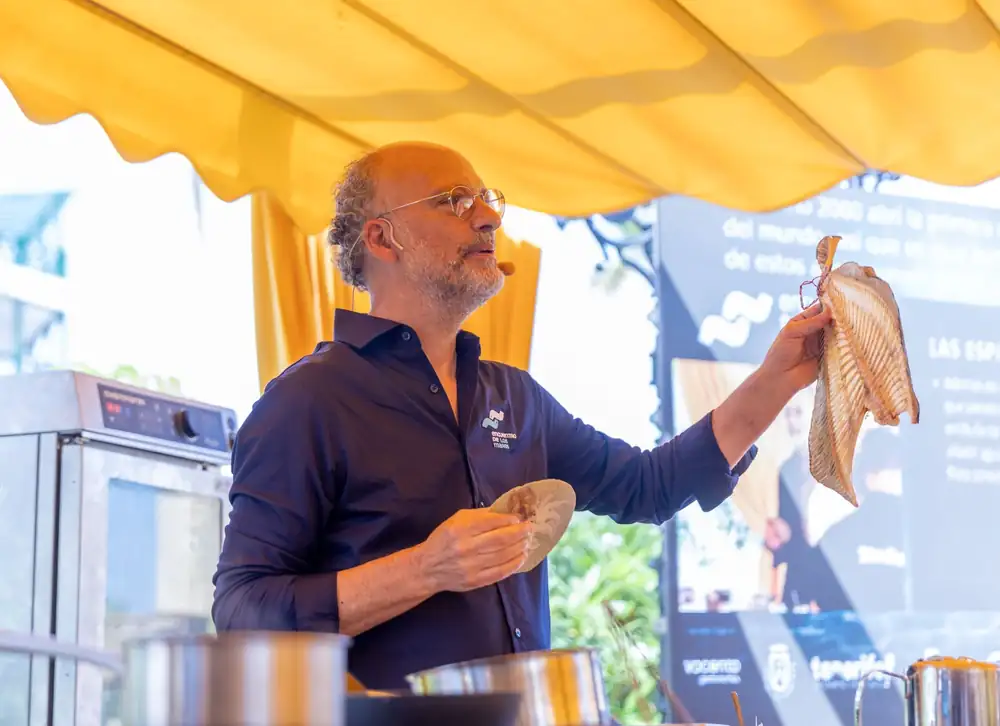
Atlantic fishermen are asking chefs to also work with fish considered “less attractive” in order to educate the consumer
For three days, the seventh edition of Encuentro de los Mares (Meeting of the Seas) – an event promoted by the Tenerife Island Council through its Tourism and Primary Sector departments, and organized by Vocento Gastronomía – explored the many facets of salt: its impact on our health, its role in the green energy revolution, its repercussions on climate change, its role in history, and its gastron
To contribute to this goal, modifying some of our behaviors is key, and for this reason, the congress director, Benjamín Lana, explained during the closing ceremony that the next edition will further its commitment to education with a Junior Seas Encounter day focused on educating young people about fish consumption. Furthermore, to ensure that consumption is diverse, participating chefs will be asked to feature lesser-known fish as the stars of their dishes. This is a way to set an example and support the fishing sector. The Vice President and Tourism Councilor of the Tenerife Island Council, Lope Afonso, also referred to the primary sector, stating that "the combination of the primary sector, gastronomy, and tourism is a powerful catalyst for employment opportunities, local development, and the differentiation of tourist destinations." The Councillor for Primary Sector of the Island Council, Valentín González, added that “with the Meeting of the Seas held in Tenerife we are highlighting what is ours, which is the product and proximity, and responsible tourism.”
Salt, cooking and health
With Luis Valls, chef in charge of the Dacosta group's El Poblet** restaurant (Valencia), it was demonstrated at Encuentro de los Mares that salt is much more than a seasoning; it is "a fire with a flame that is worked over time," in the chef's own words. Through his explanations, Valls detailed the different methods used in El Poblet's kitchen to use salt "not only as an addition, but as an enhancer, giving dishes depth and complexity." This is achieved through curing and fermentation, which also "generates foods that are healthy for the body by creating beneficial microbes." As an example, he prepared a dish incorporating several salt techniques: a pine nut gazpachuelo emulsified in the water from the lacto-fermentation of asparagus, enhanced by garum and a miso, aged over time, made from sunflower seeds.
Beyond its culinary uses, Encuentro de los Mares also wanted to delve into how salt affects our health. They did so with the help of Arancha Aparicio, a pharmacist and professor in the Department of Nutrition and Food Science at the Complutense University of Madrid, who warned that excessive salt consumption “is a risk factor not only for hypertension but also for many other diseases, such as stomach cancer or cognitive decline.” Therefore, Aparicio recommends reducing salt intake with tricks such as “substituting salt with spices, citrus fruits, vinegars, or fermented foods; buying low-sodium salts; prioritizing fresh foods; using cooking techniques that enhance the flavor of food; and, above all, learning to read the nutritional labels of processed foods.”
From salt as the star ingredient to fish bones. Italian chef Moreno Cedroni (Madonnina del Pescatore**, Senigallia) presented his latest work at Encuentro de los Mares: a menu designed around fish bones. “Beyond sustainability and making the most of the product, we wanted to know why, until now, we liked fish bones but only up to a point,” Cedroni explained. The answer is that we couldn't cook them properly. Fish bones contain 50-60% calcium and 20-30% collagen. Moreno and his team have managed to break down the collagen using a Korean double-pressure cooker that cooks with both heat and infrared radiation. The next step, the chef revealed, is “to age the bones.”
The future of fishing and fish consumption
The future of artisanal fishing was thoroughly debated on the final day of Encuentro de los Mares (Meeting of the Seas), an event held with the support of Tenerife Despierta Emociones (Tenerife Awakens Emotions). The goal, as Roberto Rodríguez, manager of Artesáns da Pesca (Fishing Artisans), stated, was "to find solutions together, not to assign blame." All the participants, from various coasts of the Atlantic, agreed that it is essential "to educate people to promote secondary fish" and that to do so, "we must break free from the trends to which we are subject in gastronomy." In this regard, Emilio Marín, a fisherman and collaborator at the Cataria restaurant (Cádiz), explained that "people buy one-kilo pieces because aesthetically they look better on the plate for the chef, but the same species comes in different sizes and can be bought in larger pieces, which are more economical and allow the animal to continue reproducing." Following this line of thought, Pedro Bastos (head of the Portuguese fish and seafood distribution company Nutrifesco) urged chefs to “be flexible and understand that fish are seasonal, that the sea doesn't offer the same thing every day, and that fishermen can decide what to catch each day, because one day the tuna might be too far away and they might opt for amberjack, for example.” Bastos also shared the intuition of Manuel Alejandro Rodríguez, a fisherman from the Cofradía de Nuestra Señora de la Luz (Tenerife), that “the ocean is unpredictable, and whether due to natural cycles or the effects of climate change, the truth is that the ocean is dynamic, and some years certain species appear and others don't.” Therefore, Rodríguez asked people “not to be afraid to try new things” and advocated “reviving the tradition of eating fish at home, many different species, bones and all, with our hands, so that new generations can eat fish without prejudice.”
Not in opposition to, but rather as a complement to, artisanal fishing, aquaculture then took center stage at the Meeting of the Seas. This was thanks to Rafael Ginés, coordinator of the Aquaculture Facilities at the University of Las Palmas de Gran Canaria, who spoke about the differences between wild-caught and farmed fish. Ginés aimed to dispel prejudices by explaining that many surveys conducted by his department showed that "the ratings assigned to farmed fish, when it wasn't explicitly stated as such, were higher, sometimes even higher than those given to wild fish." During his presentation, the researcher emphasized the higher fat content of farmed fish, "which contributes to a more intense flavor," but he also highlighted that the accelerated growth of these fish—"because they eat large quantities every day"—affects their firmness. "For fish of the same size, farmed fish are younger and don't have such a firm muscle structure." The open debate that this presentation has left is about the diets of these fish and the substitution of fishmeal with vegetables, something that can lead to a lower amount of Omega 3 in these pieces or the environmental problem of the water consumption involved in their production.
Beyond this controversy, the truth is that haute cuisine is embracing farmed fish, as evidenced by the presentation of Andalusian chef Juanlu Fernández (LÚ, Cocina y Alma**, Jerez de la Frontera) who, while showing attendees his particular adaptations of traditional Andalusian dishes such as mackerel with piriñaca and 'bienmesabe' (a fried shark dish), stated that "the important thing in aquaculture is to do a good job in a sustainable way."
The final point of the seventh edition of Encuentro de los Mares was carried out by the local chefs Jorge Peñate and Luis Martín (La Terrasse) who accompanied by Marcos Ymia, marine and manager of Impescan, demonstrated through their culinary creations how the salinity of the ocean, according to its depth, transforms the flavors.