“It’s boring being a chef only for rich people” Christopher Haatuft and sustainability at the bottom of the fjords
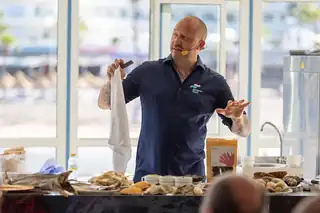
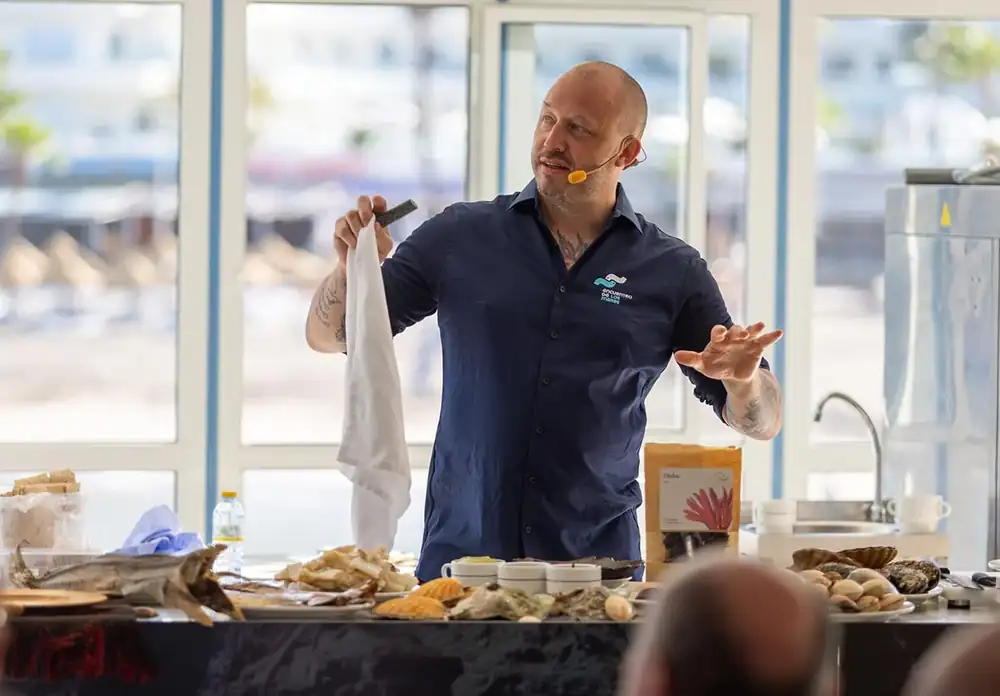
“This is a horse mussel (Modiolus modiolus), but none of these have names,” explains Christopher Haatuft as he lays out a selection of mollusks on the kitchen table, which he has brought from the Norwegian fjords for his talk at the 7th edition of Encuentro de los Mares (Meeting of the Seas), recently held in Tenerife. His restaurant, Lysverket in Bergen, has taken the so-called New Nordic Cuisine
A punk? An anarchist? Haatuft smiles as he continues pulling dried cod and a type of smoked mackerel with a very strong smell and taste from his travel bags. He points out that for centuries, this fish was used to feed African slaves. “These things aren’t usually talked about because in Norway we’re very ethical,” he remarks ironically. Something of that punk past remains, which he recalls in every conversation, although now he claims to be more pragmatic. “If you’re only against something, you’re not invited to the debate, and to change things you have to be part of the conversation.”
His discourse leaves no one indifferent. Whether he's talking about whale meat consumption, salmon farming—a nearly taboo subject in Norway—or the continuation of fishing as the only way to contain the oil companies eyeing the fjord bottoms with interest. But behind this long list of controversial topics, which he unfolds one after another without being asked, there isn't simply a search for headlines, but rather a way of understanding cuisine as part of a specific moment and social context.
The diver and the menu
Scallops and various types of shellfish are the focus of the menu at his restaurant, located in a museum in Bergem, western Norway, which boasts a Michelin star. A diver searches for these products beneath the sand of the fjords, so, in a way, it is he and his catches that dictate the daily menu at Lysverket, the chef acknowledges.
“Sustainability, the future, lies there,” he argues. “There are no more aquifers or land available for agriculture; we have to find new systems, look to the ocean, learn to produce from it, and add value to new species in the kitchen.” In his case, scallops, an abundant and relatively inexpensive product in Norway, are served grilled, but the other shellfish are barely cooked on the menu.
Are these dishes and this discourse the essence of “neo-fjordic cuisine” (new fjord cuisine), whose creation is attributed to Christopher Haatuft? The chef laughs at this concept, which, he admits, he invented as a joke, as a response to the trend of new Nordic cuisine from their Danish neighbors and to reclaim the ingredients and recipes of the fjords.
But the idea caught on, the headlines started rolling in, he recalls, and he had to flesh out and flesh out a label that, it must be said, has real pull. In fact, time has passed, but today you only need to search his name to confirm that punk and fjord cuisine remain two terms inextricably linked to his persona and career.
From whale to wild salmon
The large shells he takes out of the refrigerator or the Norwegian brown cheese—sweet, like salted caramel—generate anticipation. Whale meat, of course, is much more surprising when the topic is the sustainability of the seas.
“If you don’t eat meat, I respect that. But if you do eat meat…,” argues the chef, who doesn’t hesitate to call whaling sustainable. There’s only one whaling ship left, it’s only in season, and besides, very little of the meat is eaten—that’s the key to its sustainability, he maintains. It’s a sensitive issue in Norway, one of the few countries in the world that authorizes whaling.
Salmon production is also important, one of the country's flagship products and of great economic significance. He shows us a loin of wild salmon, with a much less intense color than farmed salmon. "I only have it one day a year, there's none left," he admits.
“We can’t say that aquaculture is bad just because millions of people can’t afford wild fish. We have to confront the issue, debate it, not romanticize it,” he acknowledges, while defending regulated and well-managed aquaculture as the only option. He tells us that asking for better practices in his country, and a commitment to more sustainable and monitored salmon farming, earned him a few reprimands.
He worked in some of the best kitchens and elegant restaurants—as he puts it—in New York before opening his Lysverket. And he doesn't hesitate to say that haute cuisine, or rather, cooking only for the rich, bores him.
Perhaps to combat that boredom arose the torrent of ideas and themes that seem to be bubbling in his head. And projects like Mat Tak, dedicated to creating urban gardens on rooftops, which, among other things, supply part of the vegetable pantry for his restaurant.
So, to move beyond the punk and neo-fjordic labels, perhaps those two places that focus Haatuft's work lend themselves to a much better and more real one: the chef who seeks sustainability at the bottom of the fjords and on the rooftops of Norway.