Once you try this pastry, you'll understand why it's so popular
If there's one pastry that can instantly evoke nostalgia and memories of home cooking, it's the bee sting. It's a classic that our grandmothers baked on weekends, family celebrations and special occasions - and for good reason.
Although bee sting originates from Germany, where it is known as Bienenstich, this dessert has long been a part of our culinary tradition. At a time when desserts were still handmade from basic ingredients, this pastry was an ideal choice – it requires some patience, but not a complicated technique, which is why local housewives often prepared it. Over time, it became a true classic of domestic kitchens.
Today, we are rediscovering it – not only for its authentic taste, but also because it reminds us of the times when the smell of freshly baked pastries was something we took for granted. The recipe for bee pie from the baking sheet below preserves everything that makes this dessert so special: simple preparation, rich flavor, and that unmistakable combination of soft cream and crispy crust.
Once you try it, you'll quickly understand why this pastry is one of the most sought-after recipes - and why we call it the dessert that "stings" at the heart.
For the yeast dough we need:
- 100 g melted butter - 500 g plain flour - 70 g sugar - 1 sachet of dry yeast - 200 ml lukewarm milk - 0.5 teaspoon of salt - 1 egg (size M) - 1 teaspoon of vanilla extract
For a crispy crust we need:
- 150 g butter - 100 g sugar - 2 tablespoons honey - 200 g almond flakes
For the cream we need:
- 2 sachets of vanilla pudding powder - 80 g sugar - 750 ml milk - 100 g butter
Preparing the bee sting:
Add all the ingredients for the yeast dough to the bowl of a food processor and knead on high speed with the dough hook for about 8 minutes until the dough is completely smooth and soft. Shape it into a ball, cover and let it rise in a clean bowl in a warm place for about 60 minutes or until the dough has doubled in size.
Meanwhile, in a small saucepan, bring the butter, sugar and honey to a boil and simmer for one minute. Remove from the heat and stir in the almond flakes. Stir occasionally and let the mixture cool slightly.
Once the yeast dough has risen, transfer it to a floured surface and knead briefly. Then roll it out to the size of the baking tray (approximately 30 x 40 cm) and transfer it to the baking tray along with the baking paper. Prick the dough several times with a fork. Spread the almond mixture evenly over the surface and let it rise for another 20 minutes.
Meanwhile, preheat the oven to 180 degrees Celsius (if using a fan oven, preheat to 160 degrees Celsius). Bake the base for about 22 minutes, or until the pastry is nicely golden brown. Then remove from the oven and leave to cool completely on a wire rack.
Cook the vanilla pudding according to the instructions on the package, but use 750 ml of milk. Remove from the heat, add the cubed butter and mix well until smooth. Cover loosely with cling film (to prevent a skin forming) and leave to cool.
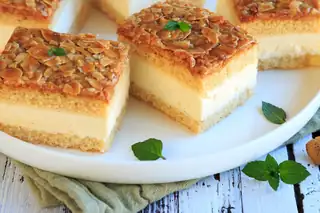
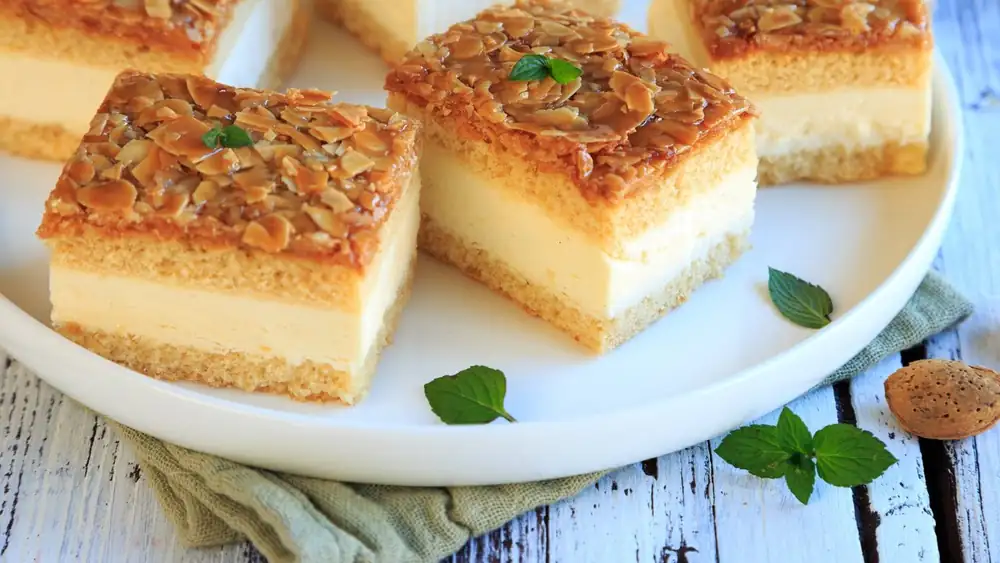
Cut the cooled cake into four rectangles. Carefully cut each rectangle in half horizontally. Return the bottom halves to the baking sheet and spread with vanilla cream and top with the top layers. Press down lightly and leave to cool and firm.
We recommend that you also try:
The recipe for bee sting in a baking dish is adapted from Einfachbacken.de