Tres horas de minimalismo con Ferran Adrià
En la década de 1990, Ferran Adrià creó el minimalismo culinario, una forma de alta cocina que influyó en las generaciones posteriores.
In the 1990s, Ferran Adrià created culinary minimalism, a form of haute cuisine that influenced subsequent generations. But what exactly is minimalism? the renowned chef asked, in the 'Dreams' space at #spainfoodtechnation during Madrid Fusión Alimentos de España, in an intense afternoon session packed with attendees, including other top chefs, some of whom even sat on the carpet. Borrowing the term from the art world, it navigates the waters of style and movements, about which Adrià, the mastermind behind elBulli, has reflected and written extensively. "Types of cuisine should be discussed in general terms, because they are impersonal characteristics that encompass everything from techniques to preparations. But movements are about people," while style "would involve describing his entire gastronomic offering," from interior design and "ritual" to "tasting tools."
So, what exactly is minimalism? The answer comes from food critic Alba Torres, who researched this cuisine for her doctoral thesis, which impressed even Adrià himself. "It's based on limiting the number of intermediate preparations (those that are visually present on the plate), the main ingredients, and the techniques used," explains Torres, who cites 'Bone Marrow and Caviar' as an example. "It was conceptualized at elBulli in 1996, but the first dish was made in 1992."
To sum it up, one phrase: "Less is more." A 'less' exclusive to "creative haute cuisine" and which "appears in menu format," Torres specifies.
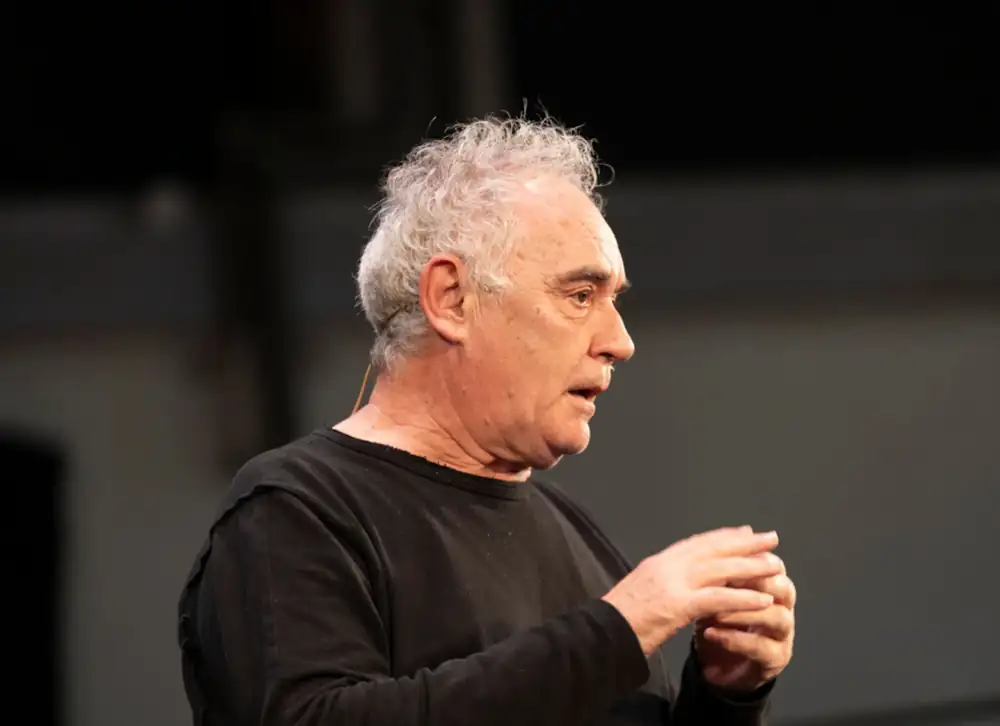
Provocative, cheerful, dynamic, Adrià, during three hours, in conversation with four chefs, gradually reveals some premises of an informal creed.
Adrià's first premise: "Having four intermediate preparations is better than having two. Doing minimalist cuisine is neither good nor bad."
"If there is little transformation, it goes from minimalism to oversimplification," says chef Pedrito Sánchez, from the Bagá restaurant in Jaén, while explaining his oxidized pear with eel during the talk.
"And is Japanese cuisine simplistic?" Adrià asks.
"You're trying to pull the wool over my eyes!" exclaims Sánchez.
Laughter. The mind games continue:
"Nori seaweed is a processed product; when I buy it, there are wizards who cook it for you," says Adrià.
"Just like olive oil or butter," replies Sánchez.
-Simplicity is like a grilled ribeye steak. But saying it like that isn't pejorative.
A second of Adrià's principles concerns the quality of life of those who work at his establishment: at elBulli, we were the first to close at midday, and by noon, we were all home. Chef Josean Alija, from the Nerua restaurant in Bilbao and one of the last to work 17-hour shifts at that temple of gastronomy, reminded him: "Cook what makes you happy, what sets you apart, and what defines you, that's what will help you. You often told us that."
Another fact, more than a dogma, of Adrià's: the restaurants I like to eat at most only have one Michelin star. That's a characteristic. (The restaurants of the four chefs invited to this Valle-Inclán-inspired gathering at Madrid Fusion) are the restaurants where I like to eat. And they are among the least recognized. When I go out to eat, I don't talk about food. Don't bore me. (The other two restaurants this afternoon are Enigma, owned by his brother Albert and where Rubén Zubiri works, and Aürt, owned by Artur Martínez, both in Barcelona).
And more keys
-You can't be dogmatic. There are 50 truths. You can change your style.
-A good sardine is better than a bad lobster.
The soul doesn't think. The mind does. Nor does the heart. The heart doesn't exist, nor do the butterflies in love. They are emotions, which are produced in the mind.
"Good ingredients are a must. If you're paying 400 euros for a menu, of course! If it's nearby, great, but if there's something amazing elsewhere, I'll buy it too. When people tell me a place uses its ingredients really well, I say: 'Are you kidding me? For 400 euros? It has to be!' It's a must! Fine dining starts with this: good ingredients and good execution."
-What is the opposite of raw? There isn't a word. It's not cooked, nor processed, nor has it been exposed to fire.
At its core, minimalism is like a discourse. To make one that takes five hours, you need ten minutes, and to make one that takes ten minutes, you need five hours. But the dish doesn't lie.