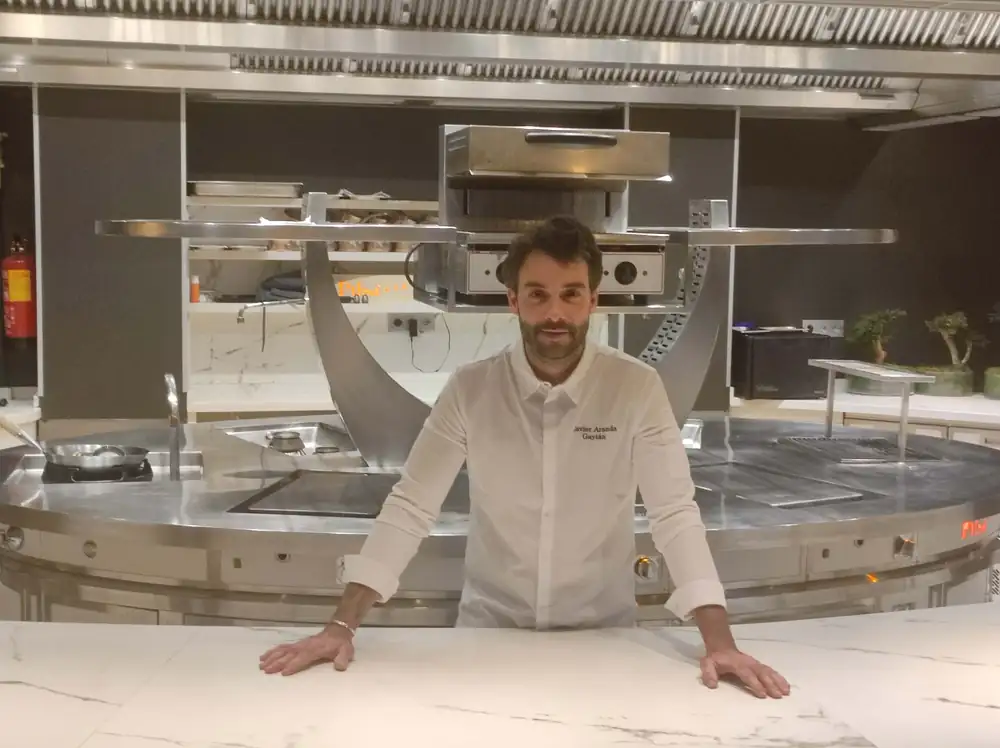
Gaytán, the clandestine star in Madrid
When a dozen Madrid food enthusiasts were asked which Michelin-starred restaurants in the capital immediately came to mind, none of them mentioned Gaytán. Furthermore, several admitted they weren't even aware of its existence.
When a dozen Madrid food enthusiasts were asked which Michelin-starred restaurants in the capital immediately came to mind, none of them mentioned Gaytán. Furthermore, several admitted they weren't even aware of its existence.
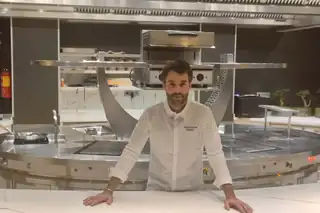
It's certainly remarkable, especially considering it's a restaurant that opened in 2016 and has held the prestigious French guide's top spot continuously since 2017. Perhaps it's due to its location, tucked away in a pedestrian alley perpendicular to Príncipe de Vergara. Or perhaps it's the rather low profile of its chef, Javier Aranda, a thirty-something from Toledo, who stays out of the media spotlight.
Or who knows why, the fact is that Gaytán is probably Madrid's unsung hero. And it's not fair, because not only is she a true star, but in our opinion, it wouldn't be at all unreasonable or unjust for her to receive a second star sooner rather than later.
The chef from La Mancha has always been a model of precocity: at just over 20 years old, he had already worked in the kitchens of Santceloni and El Bohío and was the head chef at Piñera. Before turning 30, in the mid-2010s, he already boasted a Michelin star for his first personal project, La Cabra, which he doubled in 2017 with the addition of Gaytán. For a time, he managed both establishments, but a few years ago he left the former to dedicate himself exclusively to the latter (although he tells us that starting this spring he will be advising a restaurant in Ibiza, Madunia, located in a luxury hotel complex), where he has reached a very high level of culinary maturity.
Gaytán occupies the premises where those with gray hair will remember one of the city's legendary Andalusian establishments, Los Borrachos de Velázquez. Completely renovated, the dining room is like a grand stage, an open space where a dozen tables are arranged in a semicircle around a large, oval, open kitchen, so that all diners who wish to can follow even the smallest detail of the meticulous processes of preparing and plating the dishes.
Complex and laborious processes, because Aranda's cuisine, besides being highly creative, is complex and laborious. Unconcerned with trends, his recipes favor combinations of numerous ingredients, each treated in a technically distinct way. The goal isn't for us to try to identify each ingredient individually, but rather for them to combine to create a harmonious and coherent whole, which he achieves most of the time.
To all this must be added an unquestionable wanderlust that allows him to make stops on almost all five continents and seamlessly blend products from here, there and everywhere, and a remarkable aesthetic sensibility, which translates into presentations that exude good taste.
At Gaytán, you can order à la carte, but it's more common to choose one of their three tasting menus: the short one, Inaurem (€140, €205 with wine pairing); the medium one, the Javier Aranda Menu (€190, €268 with wine pairing); and the long one, the Gran Menú Javier Aranda (€250, €370 with wine pairing). The latter consists of more than twenty courses and requires ample time, as, at a brisk pace, it lasts at least three hours.
It starts with a battery of six appetizers, among which the truffle brioche and Galician blonde cow carpaccio presented as nigiri stand out; the coca of creamy beans and compango with piparra emulsion that pays homage to the Asturian fabada; the intense and very long tuna tartare with crispy bone marrow and caviar, and the version of the gilda, whose resemblance to the gilda is zero but which is very good (oh!, this damned fashion of calling almost everything gilda), with smoked mackerel, tomato granita, piparra noodle and cold gordal olive soup.
After a short intermission featuring a selection of Panic breads accompanied by Castillo de Canena arbequina olive oil and superb Échiré butter, it's time for the Vegetable Sequence. It opens with a very personal nod, full of contrasts, to Catalan escudella: peas from Maresme, escudella broth, pickled red onion, and Vinaròs prawns, with a touch of caviar.
From there, the Málaga-La Mancha pairing moves to a gazpachuelo of smoked eel and roast chicken with a duxelles of saffron milk cap mushrooms, foie gras, and chestnuts, and a delightfully exciting counterpoint of freshly grated horseradish. To conclude the sequence, Italy meets Madrid in cappelletti filled with Madrid-style snails, tripe sauce, and toasted celery cream.
Second course, the Marina. Scottish langoustine (enormous, truly) with champagne and tarragon beurre blanc essence. Hake kokotxa in pil-pil sauce with spiced beef labneh (a Lebanese lactic ferment). Both impeccable. The baby cuttlefish from Palamós with aromatic pesto on codium aguachile suffers from too many calcium crystals, which unnecessarily sweeten it, and perhaps the caviar, which is used repeatedly as a seasoning. The sea bream with seaweed and cockle cream, quinoa, kale, and citrus gel is simply perfect.
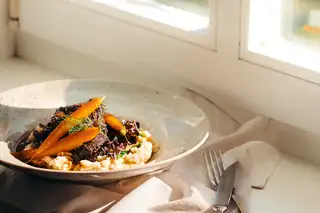
The Land Sequence comprises four dishes. Silky and delicate is the confit farmhouse egg yolk with foie gras, truffle, and a mushroom stew with port curry. Juicy is the salt-crusted wild pigeon with Jerusalem artichoke cream, Almagro eggplant stew, and gnocchi that add little to the meal. The suckling pig from Ávila with fermented garlic cream is good, but far surpassed by the wok-fried zucchini noodles. To finish, there's venison osmotically in stew broth with sardines in miso, a true surf and turf. To be honest, this sequence is a step below the previous ones.
For those who haven't given up along the way, two light and not overly sweet desserts: braised pineapple with palo cortado sherry, roasted pineapple sorbet, mint pesto, and a very assertive basil. 90% cacao mousse, coffee namelaka (a Japanese cream), and corn in various textures.
The service is impeccable, overseen by Javier Gil, who presents the dishes with just the right amount of attention to detail, only going into specifics when requested. The wine cellar, managed by Valentín Checa, is very well-considered, with a strong preference for international labels, and, as one would expect from this cuisine, sparkling and white wines take center stage.