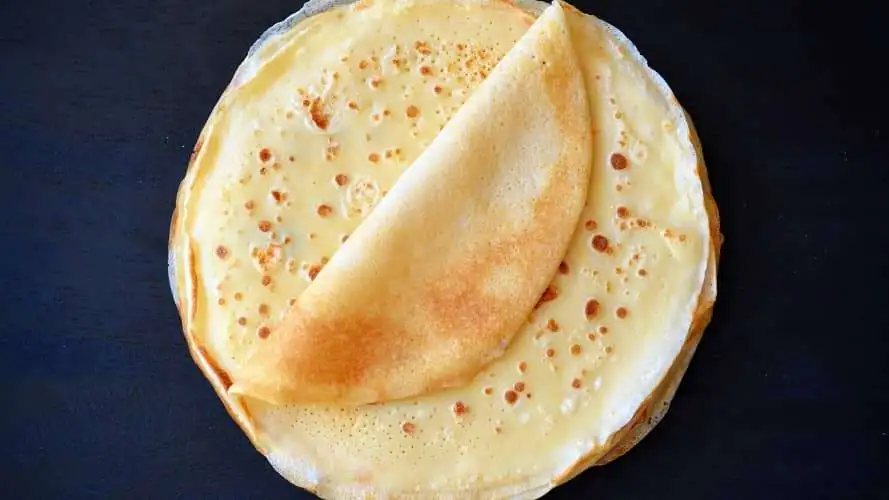
Pancake batter
Pancake batter, as prepared in Brazil, is a recipe made with wheat flour, milk, and eggs. It is based on the Italian savory crepe, which in turn is based on the French crepe recipe.
- 500 ml of whole milk (2 cups)
- 250 grams of wheat flour ((2 cups))
- 5 grams of salt ((1 teaspoon))
- 3 eggs
- butter for greasing (if needed)
- Eggs: In a bowl, place the eggs and salt.
- Mix: beat eggs and salt until you obtain a smooth mixture.
- Flour and milk: add flour and milk gradually. Do not add all the flour and milk at once, as this will cause lumps to form.
- Mix: Mix, preferably with a whisk or hand mixer, until all the flour has been incorporated. Then add more flour and milk, always gradually.
- Final mixture: In the end, we should have a homogeneous mixture, without lumps. It will be quite liquid, only slightly more consistent than a beaten egg.
- Resting: Cover with plastic wrap and let the dough rest in the refrigerator for at least 30 minutes. You can leave it overnight if you prefer.
- Ratio: Use about 1/4 cup of batter (60ml) for each pancake. Pancakes are usually a little thicker than crepes.
- Preheating: Heat the skillet over medium-low heat. High temperatures will cause the pancake to cook too quickly, making it difficult to spread evenly. We used a very simple aluminum skillet because it heats up and cools down quickly, making it easier to spread the batter while it's still liquid.
- Grease: Grease the pan with a thin layer of butter. If the pan has a good non-stick coating, greasing it every 3 or 4 pancakes is sufficient.
- Spread: Remove the pan from the heat and wait about 10 seconds for it to cool slightly. To pour the pancake batter, hold the pan with your right hand and the batter with your left hand (opposite for left-handed people). Tilt the pan and pour the pancake batter into the center of the pan. The batter will spread to the edge.
- Circular motion: Quickly make a circular motion (1 or 2 times) so that the batter spreads throughout the pan. Place the pan back on the stovetop.
- Detaching: As soon as the pancake starts to detach from the pan or begins to brown at the edges (in about 1 to 1 1/2 minutes), loosen it with your hand or a long, flexible spatula.
- Flip: Flip the pancake using your hands or a spatula.
- Finishing: Cook until the batter has slightly burnt bubbles on the bottom (about 2 minutes). Don't wait too long, as the pancake will start to harden.
- Adjust: Check if the pancake batter is thin. If it's too thick, reduce the amount of batter slightly for the next pancake.
- This recipe yields approximately 16 pancakes, each 18 cm in diameter.
The French wheat flour crepe is traditionally made with sugar and served with sweet fillings as a dessert. The savory French crepe, made with buckwheat flour, does not contain wheat flour and is called a galette de blé noir.
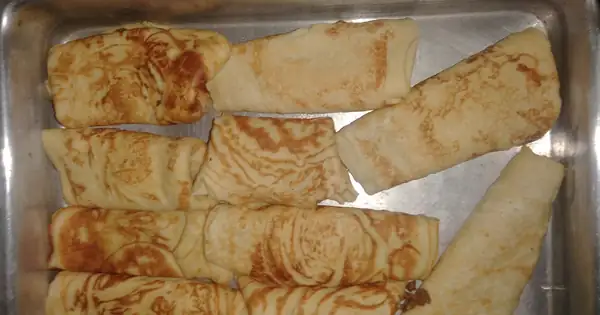
In Brazil and Italy, it's common to use the basic wheat flour crepe recipe for savory dishes – rolled and filled with meat, ricotta, or cheese/ham. In Brazil, these dishes are usually called pancakes, while in Italy they are called cannelloni di crespelle.
How many eggs and how much milk should I use in pancake batter?
Pancake batter is a type of batter (liquid or soft batter) – a batter with a high liquid content. Unlike dough, this type of batter cannot be shaped by hand, so we use a container to give the pancake its shape (frying pan or mold).
In pancake batter, we want to create a structure that is not very elastic, and to achieve this we avoid the formation of gluten. But we need structure so that the batter doesn't fall apart. One of the elements responsible for the formation of structure is starch, which gelatinizes with heat. Eggs are another element responsible for the structure of the pancake.
Egg proteins coagulate with heat and give a non-elastic structure to the pancake (and crepe) batter, making it possible for pancakes to be rolled and folded easily without breaking.
In the sweet crepe recipe, we use 8 eggs for every kilogram of wheat flour. For this pancake recipe, we use a higher ratio of 12 eggs per kilogram. We do not recommend using more than that, as the pancake will be very similar to an omelet if the quantity of eggs is excessive.
As for the milk, we use the same proportion as in the sweet crepe batter recipe: double the amount of wheat flour (2 liters of milk for every kilogram of flour).
Pancake Batter Recipe
Our pancake batter recipe follows the traditional ingredient ratios of Italian crespelle and French crepe.
We use a ratio of 3 medium eggs and 500 ml of whole milk for every 250 grams of wheat flour. We also use 2% salt (5 grams) for every 250 grams of wheat flour.
This is a recipe for dishes made with savory pancakes. For sweet crepes, see our sweet crepe batter recipe.
- Large bowl
- Wire whisk/whisk or similar
- Plastic film/cling film
- Frying pan with a base of 17 to 21 cm.
- Preheating: Heat the skillet over medium-low heat. High temperatures will cause the pancake to cook too quickly, making it difficult to spread evenly. We use a fairly simple aluminum skillet because it heats up and cools down quickly, making it easier to spread the batter while it's still liquid.
- This recipe yields approximately 16 pancakes, each measuring 18 cm.