Corte Sconta in Venice, review: the history and dynamism of an evocative sign
Corte Sconta is a place of the imagination even before it's real. It lends its title to one of Corto Maltese's adventures—"Corte Sconta detta Arcana"—in which the protagonist sets out from a suggestive and hidden corner of Venice to reach China and Siberia.
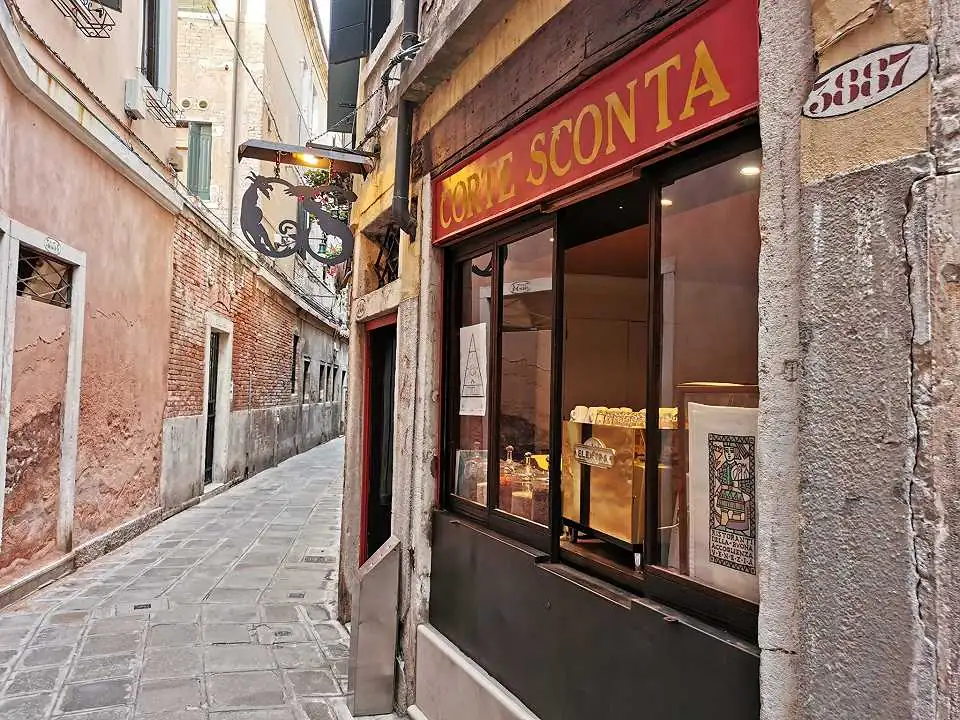
Located in the Castello district, it's a historic address in the lagoon city. Leaving the crowded Riva Schiavoni and entering the handful of streets that open to the left toward the Arsenale, it shares the same—fortunate—gastronomical fortune as two other must-sees, Il Covo and Il Covino. Finally, the fact that a Calle del Forno and a Calle del Pestrin (in the Venetian Republic, the Pestrineri were artisans who processed and sold milk and its products) resolves any remaining doubts about the area's vocation.
History and environment
Recovered in the 1980s from the ashes of an old bacaro, it owes its name to the husband of one of the two owners (sisters-in-law)'s passion for the sailor created by Hugo Pratt. An internal courtyard—adorned with plants that give it the feel of a garden—is not a literary fiction, but exists and is one of the most evocative features of the place, perfectly suited to hosting customers in the warmer months. Equally beautiful, perhaps immediately noticeable by the trained eye, is the solid counter at the entrance: designed by Carlo Scarpa, it's made of brass and has a meticulously polished finish. Compared to the city average, the space is spacious: two internal rooms, a courtyard, and a kitchen that allows the staff to move around easily. The overall look is that of a trattoria, free of frills and clever touches. Wooden tables and chairs, unvarnished walls, and a Venetian-style floor lend an overall sobriety. Accustomed to the absence of a place setting, they are pleased to find a paper placemat and a double napkin, made of paper and cloth, at the table.
From the old management, the baton has now been passed to Marco Proietto, Lucia's grandson, who has inherited the legacy of a gastronomically solid but dated establishment and has embarked on a new path. The welcome and hospitality remain unchanged from the past, catering equally to Venetians and foreigners.
The menu and the dishes
While the menu has in the past shifted from Venetian classics to slightly less predictable dishes, today's Corte Sconta continues its transformation, despite the presence of a few key staples that have been reinterpreted in an effort to create a more dynamic version. Overall, the offerings are—happily—moderate, with seasonal variations based on market availability. The dishes have a more contemporary feel, both in terms of combinations, ingredient introductions, and plating. Goodwill is evident, and with a few adjustments, the overall direction is the right one.
The appetizers (€18-23) range from more reassuring options (saor and creamed sauce, spider crab and mixed vegetables) to others where the addition of aromatic herbs and spices adds a touch of rhythm. The first courses (€20-28) play gently with fish, vegetables, and nuts/spices, while the second courses (€25-30) follow the same lines as the appetizers, with grilled and fried dishes paired with more relaxed seafood dishes. The wine list is well-conceived, alternating well-known labels with less obvious options, and offering both by the glass and in bottles.
The opening is entrusted to an appetizer of the day, not on the menu: dehydrated sea bass, marinated with passion fruit, daikon, and coriander. A good hand is able to elevate this delicate fish beyond its usual confines. The dehydration has the effect of making the flesh firmer, and the passion fruit lends a lively sweetness. The daikon probably deserves more attention, while the coriander is perhaps the dish's weak point, perhaps overpowering its presence. Overall, however, the dish is pleasant. Among the first courses, the homemade macaroni with beetroot (maccheroncini) with monkfish bites and zucchini flowers is well executed, colorfully inviting, and has the virtue of not overshadowing either the fish or the lightness of the flowers. The flavor is there, and with a slight adjustment in the consistency of the sauce to ensure it clings more to the pasta, it would be even more satisfying. The sea bass fillet, served with creamed peas and purple shallot potatoes, is also a good one. Here, the fish regains its familiar dimension, accompanied by the comforting peas and potatoes. The chromatic interplay of white, green, and purple is echoed by the rice flour foil (the "Murano glass" of the dish's name), which contributes to the recipe's crunchiness.
The dessert is decidedly delightful, and its simplicity and compositional accuracy make it a perfect match: grappa semifreddo—applause for the serving temperature, which often has the drawback of hardening the inside from the cold—accompanied by a small chocolate glass whose '90s-style appearance is forgiven in favor of the raisins and grappa contained within. Above all, it serves as the perfect companion to the semifreddo, with a mutual enhancement of flavor, alcohol balance, and palate-pleasing appeal.
Opinion
This historic establishment near the Arsenale evokes the most authentic Venice, thanks in part to its charming internal courtyard. The menu features a diverse selection of local seafood, with a focus on modernizing and bringing contemporary classics to the forefront. The restaurant is on the right track, thanks in part to the pleasant management.
PRO
- Evocative atmosphere and very pleasant, precise and well-conducted service.
AGAINST
- Some dishes still deserve some adjustments for a greater overall enhancement.