Osteria Al Cantinon in Venice: A Review
Strada Nova is one of Venice's most popular tourist routes. A thoroughfare connecting Santa Lucia station—via Lista di Spagna—to Rialto, it features a succession of restaurants that have gradually adapted their offerings to a passing clientele, offering standardized fare, laminated menus with disturbing photos, and overcrowded options, including frozen and pre-cooked foods. To escape the hustle an
The place
Evocative, with its series of tables arranged one behind the other under a portico defined and embellished by a series of columns, Osteria Al Cantinon is a place that invites a pleasant lingering, embodying exactly what one would expect to find when visiting Venice. Opened in February 2020—not exactly a happy time—it is run by Sergei Hachi, in the kitchen, and his wife, who manages the dining room. For those familiar with cooking reality shows, Hachi is a familiar face, having participated in one of the editions of the talent show "Cuochi D'Italia." Of Russian origin, after a series of experiences in the United States and Northern Europe, he finally arrived in Italy about fifteen years ago, choosing Venice as his final destination. After a couple of stints in the Lagoon—at the Lido and at Osteria Giorgione, not far from Cantinon—he decided to take over a restaurant and gradually oversee its growth.
The outdoor space undoubtedly represents the most charming aspect of the restaurant: the small tables, carefully decorated with lights/lanterns and floral arrangements, are undoubtedly the restaurant's strong point, which also demonstrates its character inside: two rooms, a palette of pastels—the chairs—walls punctuated by shelves displaying cookbooks and Venetian traditions, and a display cabinet for wines. In total, there are about sixty seats, both inside and out, managed with professionalism and punctuality.
The kitchen and the dishes
Anyone familiar with the contemporary Venetian culinary scene, observing initiatives and events, will have noticed Cantinon's presence among the participating restaurants. The same consistency is evident in the menu, which pairs timeless traditional dishes (Venetian-style liver, fried fish, tiramisu) with dishes that focus on a contemporary and dynamic reinterpretation of recipes and ingredients (spaghetti with cuttlefish in ink), and even dishes that play with contrasting textures and colors. In short, the intention is not so much to blend into a context, but rather to learn the basics of local tradition, and to create a place that expresses an identity and a personal journey. The menu features primarily fish dishes, complemented by a few meat dishes and a few vegetarian options. The national-popular element concludes, which in a tourist city is a sort of obligatory choice, or at least guarantees greater coverage (the evergreen prosciutto and melon and tagliatelle with meat sauce). Prices range from 13 to 18 euros for appetizers, 14-18 for first courses, and 24-27 for second courses. Desserts range from 6 to 10 euros. There's also a five-course tasting menu option for 75 euros. The wine list boasts around 150 labels and is well-selected.
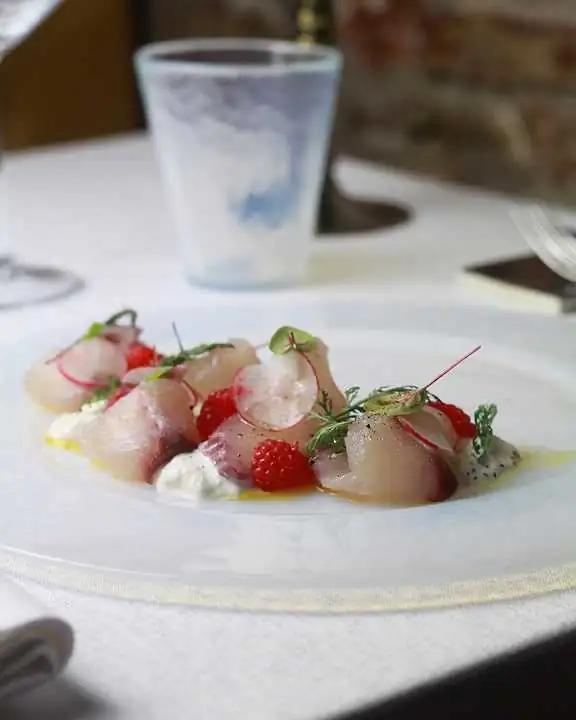
Among the appetizers, the meal begins with baked scallops in a crust. The crust, in this case, is a thin coating of almonds and beets, but it doesn't quite achieve the desired effect, leaving each bite a bit watery overall. The crispy squid ink wafer isn't enough to elevate the contrasts, which remain aesthetically pleasing, with the purple of the beets contrasting with the black, leading to the orange of the carrots. The effort put into crafting a good dish is evident: with a few more technical touches, the result can certainly be achieved. Among the first courses, the choice falls on spaghetti rosso with marinated scampi tartare, burrata cream, and herring roe. Chromatically, the dish works: the ruby red of the beets, the pale pink of the scampi, the white of the burrata, and the black of the herring roe, along with that of the holster, are all pleasing.
The pairings, however, don't adequately showcase the ingredients, which, while individually strong, are compromised overall, impacting the flavor. The acidity of the beetroot, unfortunately, isn't balanced by the sweetness of the shrimp or the smoothness of the burrata. The intention is likely to create a dish with ingredients that showcase the best of the gastronomic offering, but overzealousness penalizes the final result. Opting for different pairings or calibrating the ingredients differently by subtraction can achieve a happier outcome and do justice to the kitchen's hard work. The dish concludes with the twice-cooked octopus. The octopus was cooked just right, not rubbery: overall, the dish could also be improved by eliminating ingredients. While the creamed potato soup works, the broccoli (out of season), the Chinese cabbage leaf, and the gherkin provide a distinct touch. While the intention behind their addition is understandable, they ultimately undermine the effort made.
In closing, if we may offer some advice, though undoubtedly unsolicited, we'd say that the commitment is evident—the restaurant itself, after all, has undergone constant improvements since it opened—as is the desire to do things well. Don't be afraid to subtract rather than add, perhaps even perfecting the technique. Simplicity and quality always work.
Opinion
A charming address just steps from a well-trodden path, Osteria Al Cantinon still needs to refine its techniques and refine its skills to fully express its potential. However, the goodwill is evident, and the service is pleasant.
PRO
- Pleasant and intimate setting
AGAINST
- The hand is still uncertain about the combination of ingredients.