Nin Restaurant in Brenzone, review: were we missing Terry Giacomello's cuisine?
To reach Brenzone, on the Verona shore of Lake Garda, you take the regional road 249, which runs along the lake, offering a beautiful view along the drive. The rippling waters, the mountains framing the Brescia shore, the sun illuminating the colors, the beautiful season.
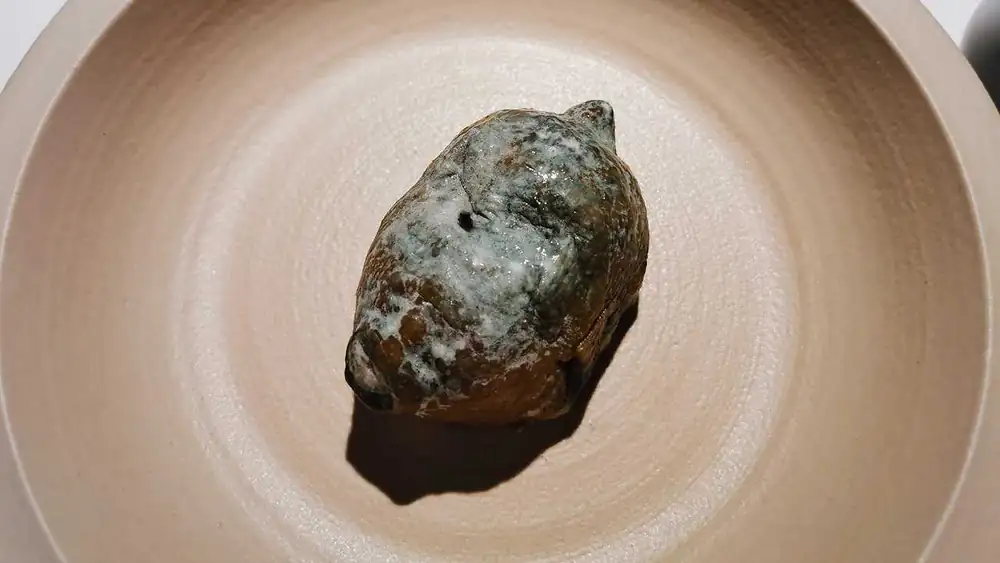
Yet, without that deluge and that darkness, which can be interpreted as the suspended moment in the theater when the lights go out, the applause hasn't yet begun, and the curtain rises, dinner at Nin's wouldn't have been the same. Without any "environmental" distractions, in short, the focus on the individual courses was total, arriving at "that" lemon full of anticipation and a hint of emotion.
The Return of Terry Giacomello
Since July 31, 2021, when Giacomello ended his time at Inkiostro in Parma, many recurring questions have been asked: will he reopen? And if so, where? Will he continue to offer his gastronomic vision? Will he regain his star? The opening of Nin answers all these questions, and also one that perhaps we don't dare ask out loud, perhaps not even among those in the know: do we need Terry Giacomello's cuisine?
In Friulian dialect, "Nin" means "boy," and while there are many interpretations of the term's meaning, here it seems more significant to emphasize that the choice to give itself a name not only pays homage to its own region (there are numerous references on the menu), but above all, to bring Friuli out of the marginalized zone to which it is confined and from which it manages to emerge only on "special" occasions (Ein Prosit, for example). Giacomello succeeds in the herculean task of making Friuli and Friuli speak, and anyone who has experienced that land and its people (or has roots there) knows how demanding it is.
The new arrival in Brenzone is also a bit of a gamble, in an area that, yes, has a strong tourist vocation, but with significant differences. The "Riviera degli olivi," as the eastern shore of Lake Garda is known, still lacks the same liveliness and appeal as its western, Brescian counterpart. While the myth of the German tourist has almost faded, and the landscape is increasingly international, it's also true that the two shores are different, and the decision by the owners of the Belfiore Park Hotel, which houses Nin, to focus on Giacomello likely signals a desire to make the leap to the eastern side as well. Nin's location isn't the permanent one: the restaurant is currently being moved to a separate location from the main building: as if to say, we're nearby but have a "physical," creative space all our own.
A brief review of Giacomello's resume helps us understand many things, especially the international scope of a menu that knows no bounds—not just geographical but also, and above all, stylistic, one might say, classy, as well as tastes, classifications, and pairings. The beauty and defining characteristic of the Aviano chef's cuisine is his ability to blend ingredients, styles, and influences, breaking down barriers, juxtaposing high and low, playing with personal memories, and forcing those sitting at the table, perhaps intimidated or a little nervous, to trust (or rely on) the kitchen staff. As we mentioned, his resume includes Niederkofler at Rosalpina, Andoni Luis Aduriz at Mugaritz, and Ferran Adrià at El Bulli; then Noma, Alex Atala's DOM, Marc Veyrat, and Michel Bras.
The Nin menu: menus and prices
The menu includes two menus, the 13-course “Percorso NIN” (140 euros) and the 9-course “Percorso Classici” (110). A first glance confirms what has been said: ingredients that cross cultures and countries, small strips of Friuli that coexist alongside the Andes and Japan, butter alongside algae, molds and gelatines. The 13-course menu – the one we tasted – is definitely a disconcerting journey, which transforms often unused or discarded components into edibles and demonstrates that the best way to enjoy a dish is to abandon any prejudice.
The technique and research behind each dish are impressive, but they never turn into a competition with the customer, nor into a desire to demonstrate one's skill by confining those at the table to the ignorant corner. It's frankly impossible to know the names and characteristics of the ingredients used, and even if it were, the competition would be pointless: the generous dose of irony in Giacomello's dishes is there to mock any oversized egos.
How to Eat at Nin: Terry Giacomello's Dishes
Among the mousse-bouche, noteworthy are the calamari—a ring of shredded squid and gelatin, in which the main ingredient is absent but reconstructed to create a fried effect—and the rice cake, chicken cotton, and Asìno cheese, which has a playful, caressing effect on the palate, reminiscent of cotton candy, in a savory version and with a nearly unknown Friulian cheese. In place of the ubiquitous whipped butter or oil, here's a brilliantly rancid prosciutto fat, featuring the restaurant's logo.
From Garda to the Andes (solid lemon juice, Peruvian Pisco) it takes us to Myoga: a ginger bud, Shropshire foam, and fermented red azuki beans. The acidity and pungent character of the ginger find a perfect companion in the richness of the cheese foam, a characterful English blue cheese.
Roots return in Omaggio al Friuli, a dish that begins by playing with its flaws and imperfections, giving them a different destiny and ennobling them, a common thread that guides the entire journey. From a mushroom that develops inside corn cobs, the huitlacoche, and morchia (a sauce made by mixing melted butter and corn flour, which tells the story of a lesser-known Friuli), here comes a dish with the softness of gnocchi, the perfect comfort food, that finally hits the palate with a spicy kick.
An olfactory and gustatory immersion in a wheel of Parmigiano: that's what Capelli d'angelo is, made from the whey, served in a mushroom and kelp broth. The effect is like ramen rooted in the Po Valley: elegant and concentrated.
With the Flying Lotus, you can relax (but only briefly). The crunchy, sour lotus root, the rich richness of the toasted butter hollandaise sauce, the burst of green mole and marigold oil, create a dish that becomes a garden. While plain pasta has long since shown its gourmet side, here Giacomello takes it a step further and provokes: the trofie are made with veal tendon, accompanied by a butter sauce and freeze-dried Parmigiano Reggiano, grated directly onto the plate. The immediate connection to buttered pasta is even more significant if you try the trofie alone, such is the ability to work with a practically inedible ingredient. While the flavors work, the dish is nevertheless penalized by being served too cold, which detracts from much of its value and ingenuity.
The Roast Chicken seems almost like an ideal continuation, in which chicken cartilage is spooned with citron and BBQ spices: essentially a roast chicken that expands in the mouth. The Espadenya, or sea cucumber, is incredibly elegant. A surprising, highly refined dish, it harks back to more familiar flavors (razor clams or scallops) but skillfully uses mentaiko (marinated cod roe) and sake paste.
The seaweed ravioli with Jerusalem artichoke pâté are a concentration of velvety, umami, and marine notes, leading to a dish of complex classification (is it a pre-dessert? Is it a dessert? Is it a side dish?) like the Ricordo di mio zio (Memory of My Uncle), in which a sweet, thin, and crunchy casing, covered in a concentrated meat-based gelatin, encloses a potato foam: a touch of disorientation, with sweet and salty both pulling the strings but slightly missing the mark. A more pronounced savory note would have provided the necessary boost.
The Toast is a game, made with puffed milk, banana jelly, licorice powder, and hibiscus ketchup: a fun idea for a pre-dessert that works and would do even better with a better dose of licorice, which is a bit too prevalent. Finally, the Forgotten Lemon. Much has been said and written, perhaps too much: here, let's just say that behind it lies the history of candying, the history of using colors at the table, while on the palate, powerful, refined, and subtle—and extracted, expertly hidden, among the freshest lemons—is a dessert that works on the declinations of a single ingredient, bringing it to its maximum expression. The lemon arrives soft, caresses the palate, and departs leaving a trail whose intensity lasts hours. Memorable and, undoubtedly, one of the best desserts I've ever eaten.
The answer to the question asked at the beginning is therefore obvious: yes, we need Terry Giacomello's cooking.
Opinion
Nin, in Brenzone, marks the return of Terry Giacomello after his experience at Inkiostro. A return that confirms the Friulian chef's brilliance and his ability to harness creative flair, pausing just before it becomes excess, and conveying a profound technical expertise in working with ingredients from all over the world.
AGAINST
- Serving temperature to be reviewed