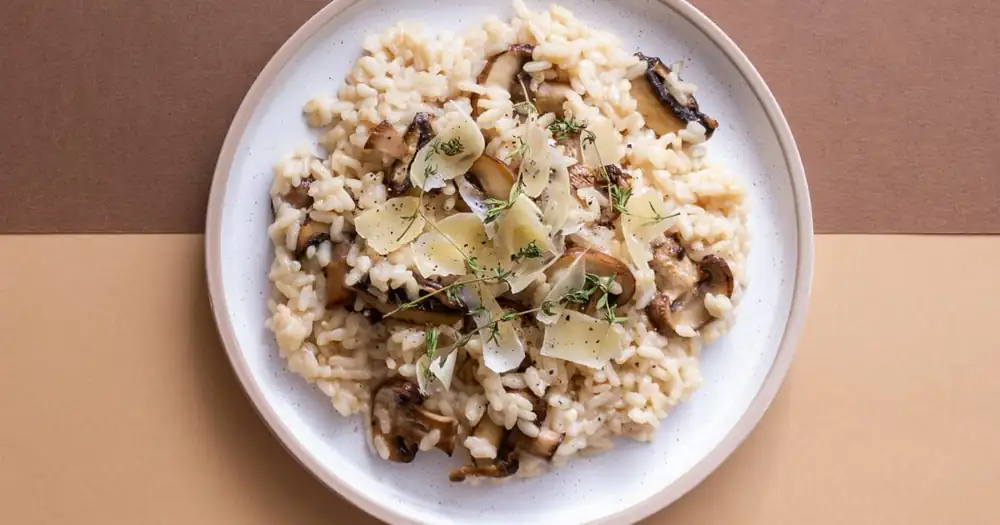
cooking risotto
1. The right risotto rice?
Suitable rice varieties for risotto include Carnaroli, Arborio, Vialone, or Lotu from Ticino. Can you cook risotto with short-grain rice? While short-grain rice is also a type of rice, it cooks faster and becomes softer/creamier, whereas the risotto rice varieties mentioned above retain a firmer texture.
2. How to use leftover risotto?
You can plan on 80-100g of risotto rice (dry weight) per person if risotto is your main course (see our tip on risotto quantities for more details). Despite careful planning, there are often a few leftovers when making risotto. You can easily use these the next day, for example, to make delicious arancini. Or you can add them to a soup. Generally, cool leftover risotto quickly, ideally in a shallow bowl. Once cooled, store it in a tightly covered container in the refrigerator. Stored this way, you can keep leftover risotto for 1-2 days.
3. Should I reheat the risotto?
To reheat leftover risotto, add a little broth, milk, or cream. Quickly heat it in a pan, stirring constantly. Alternatively, reheat the risotto in the microwave. Stir briefly, return it to the microwave, and continue heating until cooked through. In both cases, the risotto will become slightly softer.
4. Freezing risotto?
You can easily freeze leftover risotto, although the texture will change slightly. As with all leftovers, we recommend freezing it in suitable/small portion sizes and labeling the containers. Shallow containers are best. Reheating it is the same as reheating leftovers. Ideally, let the frozen risotto thaw for a few hours in the refrigerator, then transfer it to a pan with a little liquid and heat it quickly while stirring (see question 2). Alternatively, you can thaw it in a steamer/microwave using the appropriate setting and then heat it as described.
If you're intentionally cooking extra risotto to freeze, set aside the portion about ten minutes before the end of the cooking time. Let it cool quickly and then freeze it. When reheated, the risotto will finish cooking and retain a good consistency.
5. Should risotto be pre-cooked?
Want to pre-cook the risotto, perhaps because you're expecting guests or hungry (little) mouths? No problem. To prevent it from becoming too soft when reheated (see question 3), here's an alternative: Pre-cook the risotto, but not quite until fully cooked – the rice shouldn't be completely tender. Shortly before serving, finish cooking the risotto for a few more minutes by adding a little broth, milk, or cream. This way, the finished risotto will be beautifully creamy and have a perfect al dente texture, just as it should be.
6. Risotto without wine?
Of course, you can also prepare a delicious risotto without wine. Simply use a little more broth, apple juice, or even non-alcoholic (sparkling) wine for deglazing.
7. Risotto im Steamer?
Is stirring while cooking risotto too complicated for you? The good news: you can skip that step if you prepare your risotto in a steamer. This also guarantees that nothing will burn. Another advantage: cooking in hot steam helps to preserve the vitamins and minerals in the food. A minor drawback: the risotto might not be cooked to the perfect al dente texture because you set the amount of liquid at the beginning and can't constantly adjust it. But don't worry, we can assure you: risotto from a steamer tastes great and turns out perfectly every time.