Markus Shimizu
Mimi Ferments in Berlin – Japanese delicacies by Markus Shimizu
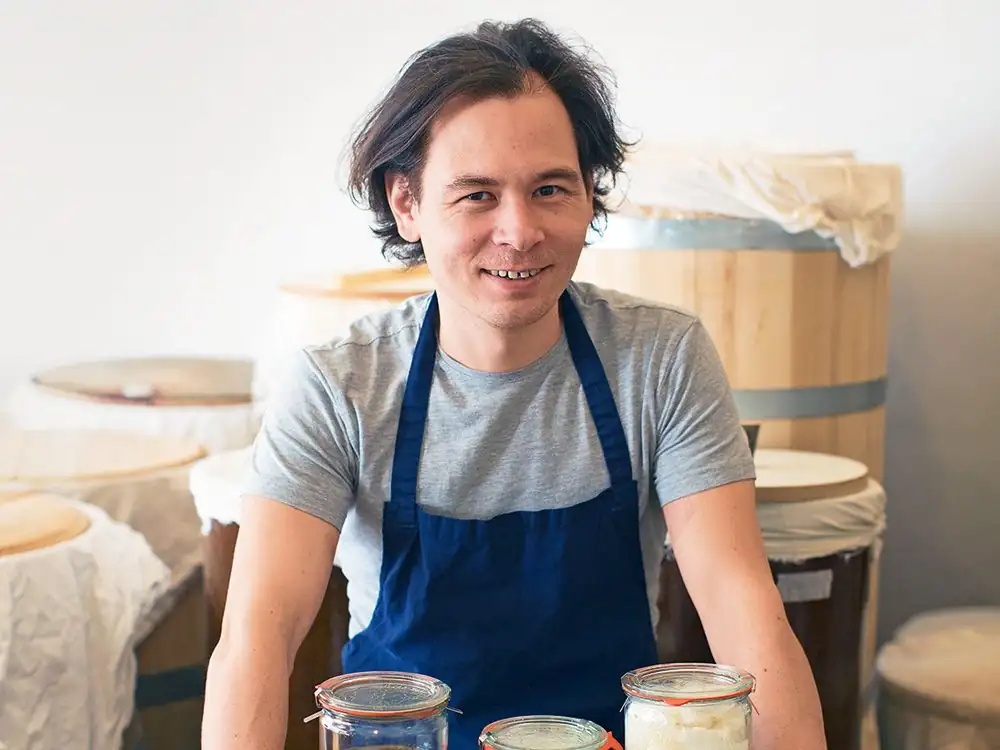
It doesn't get more minimalist than this. Walking along Stephanstrasse in Berlin-Moabit, you have to look very closely to spot Markus Shimizu's workshop. Only the word "Mimi" is written above the entrance in tiny, flowing script. In Japanese, this means "beauty" and "taste," perfectly describing what Markus Shimizu produces here in a small space in a former café: miso, soy sauce, tempeh, and other food products of traditional Japanese origin – unique and of such outstanding quality that his list of customers from top restaurants and private kitchens is constantly growing. Inside, the air is fragrant with the scent of Swiss pine, slightly sweet and subtly fruity.
Around Markus Shimizu and on a shelf stand countless barrels, vats, clay pots, and jars. They hold his treasures, some for only a few weeks, others for years. But none of this was his original plan. The son of a Japanese father and a German mother, Markus Shimizu spent the first eight years of his life in Tokyo, then his family moved to The Hague. There he studied art, later continuing his studies at the art academy in Berlin-Weißensee. In his early twenties, he began exploring fermentation on his own, reading up on the subject and launching his shop, "Mimi Ferments Berlin." "What could possibly go wrong?" he thought.
For example, an upset stomach? "No," the 41-year-old laughs and dismisses the idea, "common sense protects against that. If something doesn't smell good or looks strange, you simply shouldn't eat it." If it smells good, however, then yes – many exciting products have come about by chance. For instance, when Shimizu forgot about a batch of miso, opened it again after some time, and was delighted by the taste: "Through this experience, you learn to sharpen your intuition. You have to recognize whether the perfect taste has been achieved or whether it still needs time."
From workshops to professional production
A friend suggested to Markus Shimizu that he share his knowledge in workshops. They were so well received that he took the step towards professional production. He now supplies the Austrian culinary enfant terrible Lukas Mraz ("Mraz und Sohn," Vienna), the vegetable specialist Paul Ivicé ("Tian," Vienna), the Berlin stars Tim Raue, Michael Kempf ("Facil") and Michael Frank ("Coda"), as well as a growing number of curious home cooks. One of his first customers was Micha Schäfer from "Nobelhart & Schmutzig" in Berlin. He says: "What Markus does is traditional craftsmanship. The result is high-quality, the origin is regional, which is why it's a perfect fit for us. And you can work very creatively with Markus." The first thing Schäfer ordered from Markus Shimizu was a buckwheat shio-koji, fermented buckwheat in a kind of brine. He combined it with butter to make a sauce, on which he placed wood ear mushrooms – earthy, profound, and hearty. But what exactly is Markus Shimizu doing in his small shop that makes top chefs so enthusiastic about it?
Koji mushroom as a base for miso and soy sauce
Whether it's miso or soy sauce from Germany, none of it would be possible without the mold known scientifically as Aspergillus oryzae. This fungus, called koji in Japanese, is Shimizu's most important helper. With its enzymes, it breaks down carbohydrates and proteins from various grains and legumes, creating aromas that are as diverse as a painter's palette, depending on the starting material. Above all, it produces a savory umami flavor: The fungal enzymes break down proteins into their individual amino acids, releasing glutamic acid, among other things, which then becomes perceptible. This is why the fermented products act as a natural flavor enhancer. Classic miso production begins with washing white short-grain rice. It is then soaked and steamed until al dente – boiling it would be too soft. Markus Shimizu then inoculates it with the koji spores and lets it ferment in a kind of sauna at 30 degrees Celsius and 90 percent humidity. After two days, during which the fungus has infused the rice with its enzymes, it is mixed with cooked and crushed soybeans and salt. "Traditionally, the miso then matures in barrels," explains Markus Shimizu. "In Japan, these are often kept in barns and are thus exposed to the seasonal temperatures. This is what makes the miso so unique." He, too, deliberately heats his workshop only minimally in winter in order to take advantage of the changing weather.
Experimentation at Mimi Ferments Berlin
But it's not just heat or cold that makes the miso from Berlin so unique. Shimizu can vary almost every element of the production process – sometimes roughly mixing the rice and soy, sometimes grinding them homogeneously, changing their proportions, the salt content, and, last but not least, the ingredients. This allows him to not only produce traditional Japanese products but also to constantly experiment: miso made from bread or beetroot, and for a change, using buckwheat, hemp, or barley instead of rice. Markus Shimizu can also replace the soybeans, for example, with lupins, lentils, or peas. He has also worked with nuts, hemp seeds, and chestnuts. The next variable is the containers. “Glass and ceramic don’t impart any flavor,” explains Shimizu, “but the barrels, depending on their previous use, do so quite significantly: vanilla notes and sweetness from rum barrels, roasted aromas from bourbon barrels, and more savory aromas from red wine barrels.” The possibilities of miso production seem limitless, and one can be sure that Markus Shimizu will try to experiment with as many of them as possible – to give chance a chance to play a part.