Fried egg cake
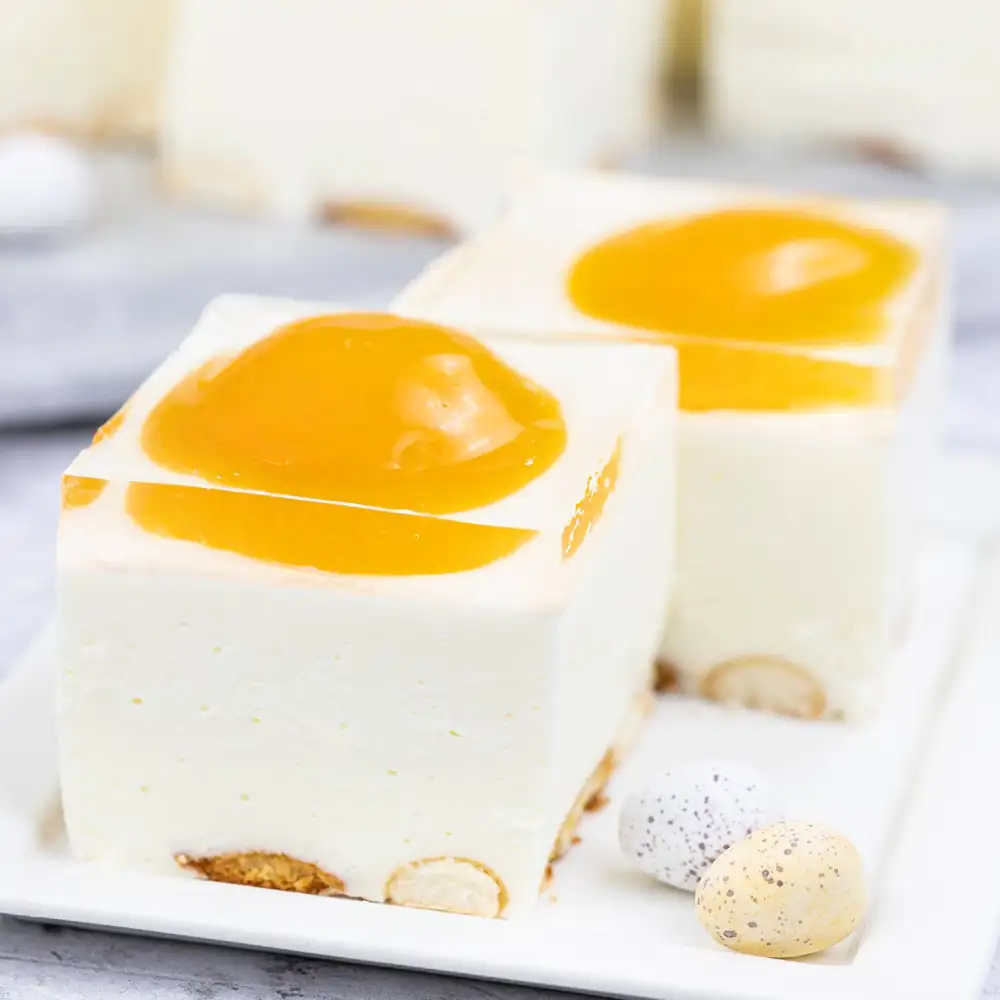
Fried egg cake is a beautiful, simple, and delicious cold cheesecake made with a sponge cake base. Arrange canned apricots or peaches on top and pour crystalline jelly over the top.
- a great cheesecake for Easter and beyond - a very creative and beautiful no-bake cake - a detailed step-by-step description and many tips
Preparation time: 2 hours Cheesecake setting time: 4 hours Number of servings: approximately 2500 g Energy value 154 kcal Carbohydrates 16 g - Including sugars 14 g Protein 9 g Fat 6 g Diet: high protein.
- kg of full-fat cottage cheese or ground cottage cheese, e.g. from a bucket
- 2 lemon or crystal jellies
- 400 ml of boiling water
- 260 g of whipping cream 30% - 1 cup
- 60 g powdered sugar - 3 tablespoons
- 100 g of any sponge cake for the cheesecake base
- 1 crystal or grape jelly
- 350 ml of boiling water
- 300 g apricot or peach halves in syrup
Fried egg cheesecake
My glass holds 250 ml. Keep a glass of 30% whipping cream (this is the thinner kind) chilled in the refrigerator. Cake pan: I used a 24x24 cm pan with removable sides. 20x30 cm pans or 24-25 cm springform pans will also work.
The calories were calculated based on the ingredients I used. This is an approximate calorie count, as your ingredients may have a different calorie count than the ones I used. The listed ingredients yield a no-bake fried egg cake weighing approximately 2500 grams. Before you start preparing the cake, I recommend reading the entire recipe to prepare for the next steps in advance.
Fried egg cheesecake recipe
Boil 400 ml of water. Pour two packages of lemon, grape, or crystal jelly into a bowl of boiling water and stir until the gelatin dissolves. (I recommend light jellies to keep the curd cheese white. Also, use good quality, tried-and-true jellies.) You might think it's impossible to dissolve such a large amount of gelatin in 400 ml of boiling water, but you'll notice the gelatin particles gradually dissolving. Stir constantly until the liquid is smooth and free of gelatin particles. Set aside to cool. In a large bowl, place one kilogram of ground full-fat or semi-fat cottage cheese, or one kilogram of good-quality ground cottage cheese from a bucket (I use Piątnica).
Pour the cooled jelly (it can still be slightly warm) into the ground cottage cheese. Mix thoroughly at once. I usually use a hand blender, like a giraffe, because the mixer's paddles tend to slosh around the runny mixture too much. Once the mixture is perfectly smooth, you can set the bowl aside. The still-runny jelly, combined with the cold cottage cheese, will begin to set very quickly (keep the bowl on the counter).
Immediately begin whipping the heavy cream with powdered sugar until stiff peaks form. Place a well-chilled cup of 30% whipping cream in a tall container. This will be about 260 grams of cream. Add three tablespoons of powdered sugar, or about 60 grams of sugar, to the bowl with the cream. Immediately begin whipping everything with a mixer. Start on low speed to avoid splashing the entire kitchen, then increase the speed to maximum. Whip the cream until it begins to stiffen. This may take a minute or a little longer, or even less. Be careful not to overwhip, as the cream will begin to curdle and separate into buttermilk and butter. How quickly you achieve perfectly whipped cream depends on the fat content of the cream, its chilled state, and the power of your mixer.
Place the whipped cream in the bowl with the already thickening cheese mixture. Mix everything together using a spatula or, alternatively, use a mixer on the lowest speed. Set the bowl with the already thickened cheese mixture aside to slowly thicken.
Meanwhile, prepare your baking tin. I used a square 24 x 24 cm baking tin. My tin is slightly rounded and has removable sides. Line the bottom and sides of the tin with baking paper. Cut out higher edges to extend the height of the rims. To ensure the parchment adheres to the inner rims of the tin, I recommend greasing them with a little butter beforehand. Line the bottom of the tin with ladyfingers. I used round ladyfingers, but you can also use oblong ladyfingers. I filled the spaces between the round ladyfingers with mini ladyfingers, which I baked using my recipe for
sponge cakes (this time super mini version).
Tip: You can also make the fried egg cake without a base, or swap the sponge cake for biscuits. You can also bake it.
sponge cake with 3 eggs and use it as a base for the cake.
Begin spreading the slightly thickening cheesecake mixture onto the sponge cake base. Be careful not to lift or shift the sponge cakes. Once the mixture has been spread, smooth the surface of the cheesecake. While you prepare the fruit and jelly topping, I recommend placing the cake in the refrigerator to allow the cheesecake mixture to set.
Pour boiling water over one sachet of crystal jelly (any clear jelly). This time, use 350 ml of boiling water. Stir the jelly until the gelatin is completely dissolved. Set the bowl aside to cool and thicken slightly. Sometimes I speed up the setting process and refrigerate the cooled jelly. However, remember to stir the contents of the bowl every few minutes. You don't want the jelly to set too much. When it reaches the consistency of a thin jelly, it's ready to use.
Remove the cheesecake pan from the refrigerator. Spread the halved apricots or canned peaches (the fruit halves are in syrup) over the now stiff cheesecake base. Carefully pour the slightly thickening clear jelly over the fruit. I use a spoon to pour the jelly over the entire fruit, filling in any gaps. If your jelly is still quite runny, I recommend pouring just enough jelly to cover the top layer of cheesecake, then refrigerate the pan for about 10 minutes (this allows the poured jelly to set quickly and secure the fruit on top, which might shift when pouring the entire, runny jelly). After 10 minutes, pour the remaining jelly into the pan.
The cheesecake is now ready. Just place it in the refrigerator until the cheesecake and jelly are fully set. After two hours, it's usually perfect to serve, but I recommend waiting up to four hours to be sure.
If you don't have clear or grape jelly, you can make jelly with gelatin and water with a little syrup (from a canned fruit). You'll need 350 ml of liquid (pour in all the syrup from the can and top up the missing liquid with water). Bring the syrup and water to a boil in a pot and immediately remove from the heat. Add three teaspoons of powdered gelatin and stir immediately until the gelatin is completely dissolved. You can pour some of the syrup over the gelatin first and wait 10-15 minutes for it to swell – this gelatin will dissolve more quickly in the hot syrup and water. Then proceed as above with the crystal jelly. Sweeten the jelly as needed.
Store the cold "fried egg" cheesecake in the refrigerator, covered, before serving. It will be best within 4 days of preparation.
Also try my other ideas for great no-bake cakes.
Enjoy your meal.