There should be a little humor in it that makes you smile: a situation report with Renáto Kovács from Hilda and Voila
A year and a half ago, we talked about how unpredictable the hospitality industry in Budapest had become. What has been your experience since then, and how well can you plan ahead today?
This is still very typical, and I think it has only become more noticeable. Tourists are also different now than before, they are much more price-sensitive. I was recently in Rome, where they said in several places that Budapest is already an expensive city – I feel this myself and indeed, Rome is cheaper in many ways, even though we are talking about a much larger world city. My specific example is that we went to a very good place, with a beautiful interior, quality ingredients, ate appetizers, pizza, drank a bottle of crémant, and at the end even Unicum, and the three of us paid about sixty thousand forints. It would be difficult to get this in Budapest today with the same quality for so much money.
The beginning of the year was very hectic at Hilda, January-February was particularly weak, March-April was also fluctuating, now May is fortunately much better.
What about the team?
Several people are leaving the team right now, so there is a complete redesign at every level. This is stressful because we are very careful not to let the quality deteriorate, to avoid mistakes. Fortunately, there are good candidates, they come for trial days, but the whole selection process takes a lot of time and energy. The new menu developments have now taken a bit of a back seat.
What is a young chef looking for in a job today?
First of all, not to burn out – the current young generation is much more aware of this. They have a lot of impulses, they think much faster, they realize sooner that you can't work 280-300 hours in the long run, like we did before. I think you shouldn't go over two hundred hours. I know that this still sounds like a lot compared to an office job, but in hospitality it is considered a more livable system.
Competitive pay, time off, quality staff meals spent in peace and quiet, and being able to talk about problems are important. Ágnes Szalai, the owner of Hilda, is very strong in this. She always tells her colleagues to dare to ask and tell her if something is not working. These used to be taboo topics in kitchens, so it's good to make people aware of talking about it if something is bothering them or hindering them at work.
What can you say about Hilda's current audience?
About ninety percent of our guests are foreign, and the Hungarian audience is present in a smaller proportion, which I think is because the vision of Hilda is less accessible to them. Now we have more of an audience of 40-45 plus, there are also many retired guests who like the calmer, quieter place, but we would like to appeal to young people as well. There are attempts with thematic evenings, discussions, improvisational theater, or now, for example, we have also introduced the weekend lunch menu, but the question is how to build a returning domestic clientele from these in the long term.
What are foreign guests looking for in gastronomy in Budapest?
My starting point is that when I go abroad, I also want to get to know the traditional flavors of the given country, but at the same time I am also interested in how they can show this in a modern form. I would like to do something like that at Hilda. We work with a lot of Hungarian ingredients, with innovative technologies, and we always try to bring a little excitement and fun to the dishes. I love it when there is a flavor or texture in a dish that you don't expect: for example, when a Sichuan pepper oil takes a dish in a completely new direction. I see that tourists are also looking for places like this. Let it be sophisticated, let it be clean, let it be honest.
How do you see the current state of Budapest's gastronomy?
I feel like people are increasingly moving towards comfort food. With inflation, value for money has become very important, so many people are looking for the opportunity to eat well at a good price.
Of course, there are very good restaurants in Budapest, I think the field is strong. I meet a lot of inspiring people, Endre Kollár, for example, is one of them. I think what he does is incredibly exciting, and I also hold him in high regard as a person.
What makes you optimistic about the profession – or what worries you?
It is cause for optimism that we have increasingly better Hungarian raw materials. However, this is related to what worries me: that good small producers are in an increasingly difficult situation. I work with more than thirty suppliers and many of them complain that orders are falling due to the economic circumstances. Some keep fewer animals because their supplies have become so expensive, others cannot find labor. Meanwhile, I see that multinationals are increasingly offering better quality products at good prices, much more predictably, which creates a difficult situation for those who truly represent value.
You and two of your friends opened Voila last fall, which is a completely different world than Hilda. What experiences have you gained over the past six months?
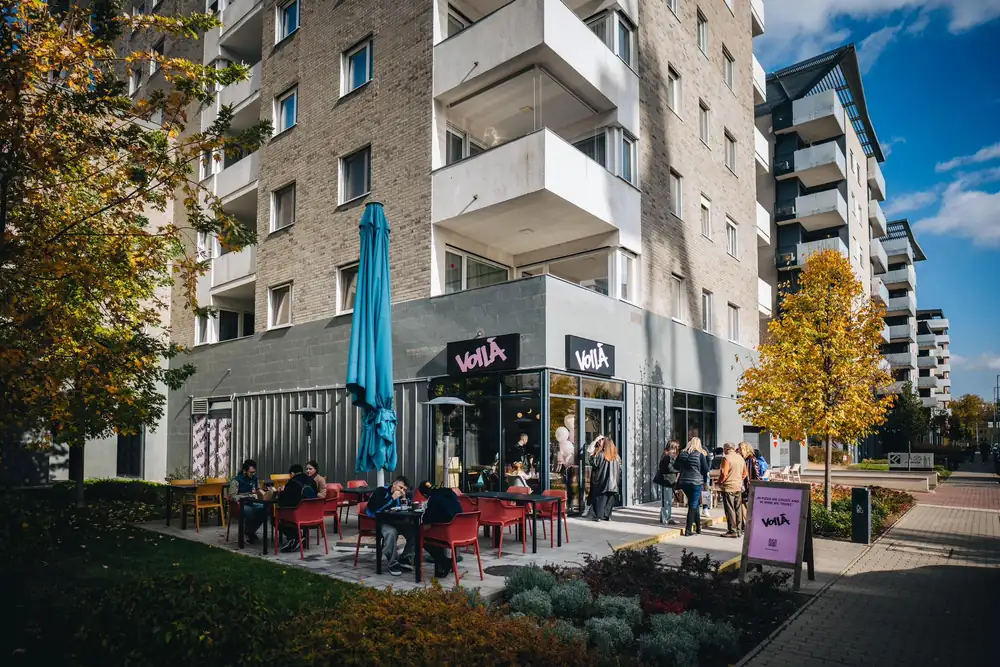
If I had to summarize briefly, it would be very good. We opened in October and we felt from the very beginning that this concept would work. We wanted a simple, accessible place near Klapka Street, where you can drink a good wine or beer, eat a good pizza, and which also functions as a community space.
My co-owner, Nick Balázs, and I had joked a lot about opening a place here in the 13th district, and when the opportunity arose, the story was already in our heads. We started developing the concept together with Dávid Varga, who had extensive experience in pizza and Italian food.
How did you develop the offering?
We were inspired a lot by our travels and places we love. Pizza was the base, but we wanted more than a pizza place: comfort food, salads, single-dish meals, good drinks. For example, the approach of the old Blitz Kitchen was very decisive for me: it was a relaxed place, with good ingredients, and a good price-value ratio.
At Voila, we also try to work with Hungarian producers, so for example the sausage comes from near Békéscsaba, and some of the salads come from Falusi Kosár. Of course, you also have to realize that in a place of this size, it is much more difficult to work exclusively with small producers.
You mentioned that one of your goals is to create a community, to what extent has this been achieved so far?
The best part is that Voilá has really become a community building place. We have a lot of locals coming to us, families with children, neighbors, and people feel that it's good to spend time there. I would say it's like the Rózsa Bistro was in Barátok Közt: everyone can relate to it, and it becomes a little bit a part of their own lives.
For example, recently, the power went out on the next block due to construction, and almost everyone came over to Voila because they couldn't cook at home. It was completely natural for them to come to us. That's when you really feel that a place really works.
I think the key to success is that Voila is not a place to play. There is good music, good coffee – which we get from Rosenstein Robi – good drinks, and we work with people who are honest about what they do. The guests feel this, and I think that's what really matters in hospitality today.