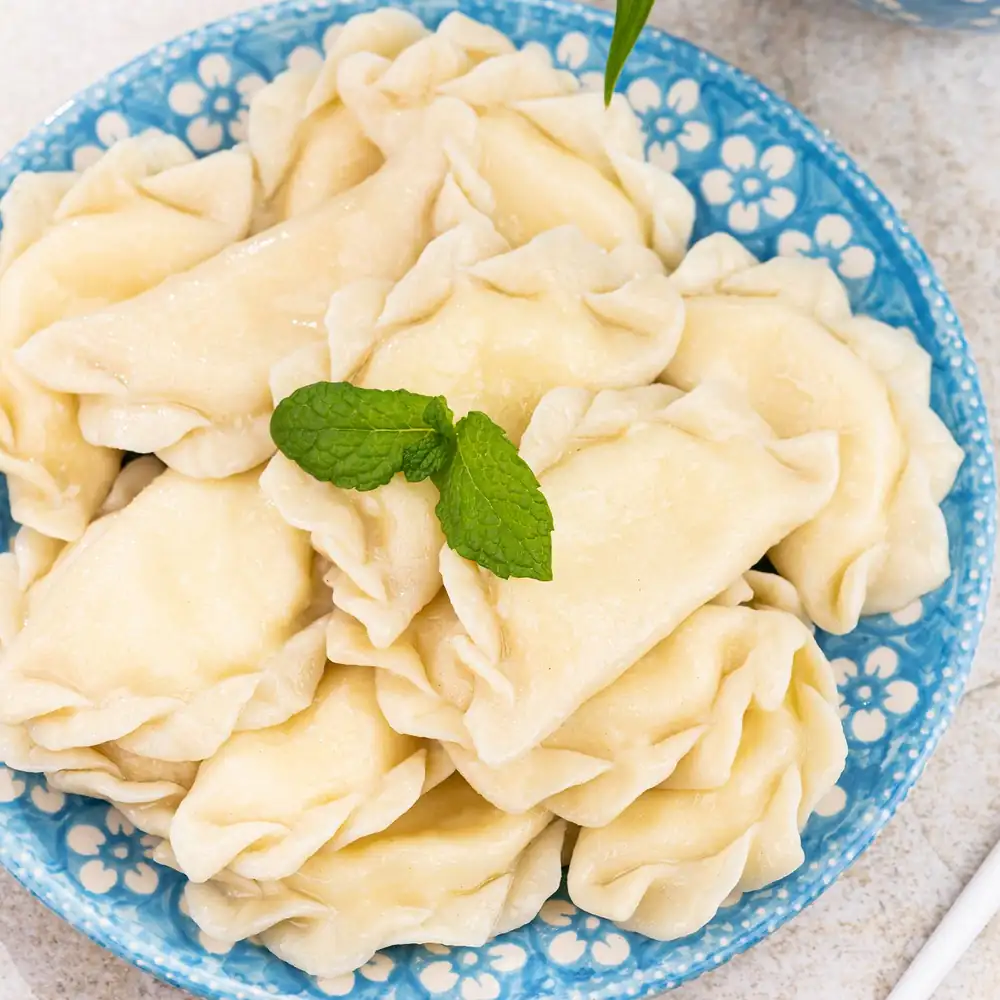
Pierogi with cheese
Dough, shaping, filling, cooking, and delicious toppings. See how to make the perfect cheese pierogi. You can serve these sweet pierogi with your favorite fruit, vanilla sauce, or sour cream.
- perfect, delicate dough - two cheese fillings to choose from - detailed description and photos of the steps
Preparation time: 1 hour 30 minutes Total cooking time: 25 minutes Number of servings: minimum 60 dumplings Energy value 195 kcal Carbohydrates 32 g - Including sugars 5 g Protein 10 g Fat 3 g Diet: low-fat, vegetarian, high-protein.
- 500 g cake flour
- 300 ml of very hot water
- a flat teaspoon of salt
- 500 g of ground cottage cheese
- seeds from a vanilla pod or a pinch of vanilla essence
- 2 tablespoons of powdered sugar
- 500 g semi-fat cottage cheese
- 100 g sour cream 18% - 4 full tablespoons
- 40 g of fine sugar - 2 full tablespoons
- 1 sachet of vanilla sugar - 16 g
Pierogi with cheese
My glass has a capacity of 250 ml.
To make dumplings, you will also need: a clean countertop or pastry board for rolling out the dough; a rolling pin; a round dumpling cutter with a diameter of about 6.5-9 cm; a cotton cloth; a wide pot; and a strainer for catching dumplings.
The calories were calculated based on the ingredients I used (based on a filling made with cottage cheese cubes). This is an approximate calorie count, as your ingredients may have a different calorie count than the ones I used. The listed ingredients yielded approximately 60 cheese pierogi. Before you start making the cheese pierogi, I recommend reading the entire recipe to prepare for the next steps.
NOTE: The ingredients include a filling made from a bucket of cottage cheese and a filling made from a cube of cottage cheese. Choose one and prepare your cheese pierogi as described below.
Also watch the video on my YouTube channel.
Pierogi with cheese recipe
Cheese filling with bucket cottage cheese: Mix good-quality, bucket-ground cottage cheese (I used Piątnica) with vanilla and powdered sugar in a bowl, then set aside. If the cheese filling is too loose (you used thin cottage cheese), you can add up to 50 grams of instant semolina to the bowl with the mixture.
Cheese filling made of semi-fat, unground cottage cheese:
Place good-quality, semi-fat cottage cheese in a bowl. Add 100 grams of sour cream (12-18%), 40 grams of caster sugar (regular sugar will work too), and a sachet of vanilla sugar (you can use homemade vanilla sugar or add a level teaspoon of vanilla paste). Mash everything together with a fork and mix.
Tips: If the filling is very firm (e.g., using curd cheese), you can add 1-2 raw egg yolks or more cream, or even a few tablespoons of pre-cooked vanilla or cream pudding. If the filling is too loose, you can add up to 50 grams of instant semolina to the bowl of mixture. To thicken the filling, you can also add 1-3 tablespoons of vanilla or cream pudding powder.
For both ground and unground cottage cheese fillings, you can also add up to 200 grams of previously cooked, very thick, and cooled semolina or millet (cooked in water or milk). This method will yield more filling, give it a more interesting flavor, and is significantly cheaper than one made primarily with cottage cheese. You will likely need to sweeten the filling slightly.
Cheese Pierogi Dough: Sift flour and salt into a large bowl. Bring water to a boil and measure exactly 300 ml. Wait until the water cools enough to briefly dip your fingers in it, or mix the boiling water with a little cold water. Remember, the hot water should not exceed 300 ml!
Pour very hot water into the flour. You can start by stirring everything with a spoon, and then use your hands. Knead the dough into an elastic, compact mass (like modeling clay). The dough should feel slightly hot in your hands. Wrap the ball in a cotton cloth to prevent it from drying out.
Use a wooden board to roll out the dough. Divide the ball into two. Wrap one half in a cloth. Roll out the other half into a thin sheet—no thicker than 1 mm. Using a glass or a round cookie cutter, cut out circles (mine was 9 cm in diameter). Place a small teaspoon of cheese in the center of each circle. The filling should not touch the edges of the dough, as this will make it difficult to seal the dumplings. Soak your finger in water and gently run it along the edge of the dough, halfway down. Place the other half on the moistened half (or vice versa) and close the dumpling. Using three fingers of your other hand, make a few ruffles.
After cutting out the dumplings, knead the remaining dough again into a compact ball and roll it out as before. After the second or third batch, combine the dough with the second portion, which was initially wrapped in a cloth. Cut out and shape the dumplings until all the dough is used. It's very important to place the finished (uncooked) dumplings on a dry surface (you can sprinkle the surface with flour) and cover them with a cloth to prevent them from drying out. The dumplings should not touch each other while resting.
- Very hot water in the dough makes it elastic and prevents it from tearing.
- A wooden pastry board is better than, for example, a stone countertop because you can use a knife without worrying about scratching the surface. The dough requires almost no flouring.
- Use round cookie cutters to cut out dumplings. They have thinner, sharper edges.
Cooking Cheese Pierogi: In a large pot, bring water to a boil with a teaspoon of salt and two tablespoons of vegetable oil. Covered with a cloth, carefully place the pierogi into the pot, one at a time, so they float to the surface. Reduce the heat so the water is just bubbling. Once the pierogi rise to the surface, wait another 3-4 minutes and then remove them using a flat strainer.
Place the cooked dumplings on a greased plate.
- Remember to drain the dumplings well to remove excess water.
- A moment after immersing the still raw dumplings in the pot, stir them gently with a strainer to make sure that none of the dumplings have stuck to the pot or to another one.
- After a few minutes, place the dumplings on a plate and move them around slightly to prevent them from sticking together.
Cheese pierogi are best served immediately after cooking. Serve them on their own or with plain yogurt and fruit. A hot sauce made with 30% whipping cream, vanilla sugar, and a little butter is also very good.
Enjoy your meal.