The myth of tender meat under the saddle
The Tatar beefsteak as we know it today most likely did not originate in the nomadic world of the steppes, but in the milieu of 19th-century European hospitality. Behind its name, historical misunderstandings, exotic cultural associations, and the gastronomic fashions of the time can all be discovered.
What is beefsteak tartare?
Today, steak tartare is a finely chopped or minced raw beef dish, seasoned with various spices and seasonings. Classic versions often include egg yolk, capers, onions, mustard, Worcestershire sauce, or pickled vegetables, but the exact recipe can vary significantly from country to country and restaurant to restaurant.
However, the consumption of raw meat is a much older tradition than the Tatar beefsteak itself. Similar dishes have been found in different regions of the world for centuries. In Middle Eastern cuisines, kibbeh nayyeh, in Ethiopia, kitfo, and in Germany, mett represent this category. Raw meat is therefore not at all an invention of the Tatars or French restaurants, but rather a gastronomic trend that appeared independently in different cultures.
The legend of meat tenderized under the saddle
The most well-known story about the origin of the Tatar beefsteak is that Tatar or Mongolian horse warriors would place raw cuts of meat under their saddles, which would soften during long rides due to the pressure and body heat. According to legend, this is how the meat became edible, and later the Tatar beefsteak was created. The story is so widespread that it is still often found in cookbooks and newspaper articles today. The only problem is that historians and gastronomists have not found enough convincing evidence to support it. One of the earliest sources for the legend is the account of the French chronicler Jean de Joinville, who wrote about the Mongols and Tatars in the 13th century, but had no personal experience with them. Later authors took up this story again and again, and over time it took on a life of its own.
Modern research suggests that it is more likely that the meat placed under the saddle served a practical purpose: to protect the saddle straps and the horse's back, rather than to prepare food. The legend nevertheless proved remarkably enduring, and played a major role in the name "tart" eventually being associated with raw beef dishes.
If it wasn't invented by the Tatars, where did it come from?
Most researchers associate the birth of the modern beefsteak tartare with the European restaurant culture of the 19th century, when so-called "American-style" raw meat dishes, served with various sauces and spices, became increasingly popular in France, and steak à l'Américaine, served with tartar sauce, appeared on menus. One of the turning points in the story is that meat and tartar sauce became associated with each other in the minds of guests over time. By the beginning of the 20th century, the name steak tartare appeared more and more often, which eventually became known in its current form. The name therefore most likely does not refer to a Central Asian origin, but is the result of a European gastronomic association. This is a good example of how gastronomic myths are born. An exotic story, a misunderstood historical reference, and a few decades of restaurant practice were enough to make one of the world's most famous raw meat dishes famous under a name that is probably only indirectly related to its true origins.
The world-conquering journey of the beefsteak tartare
By the first half of the 20th century, steak tartare was appearing on menus in more and more European countries, largely because the dish embodied both the elegance of French cuisine and the increasingly strong individualism of modern hospitality.
Steak tartare was a dish that the guest had a hand in preparing, as in many places in classic French service, the ingredients were mixed at the table. The waiter brought out the raw beef with various additives – such as capers, shallots, mustard, Worcestershire sauce or egg yolk – and then put together the final version according to the guest’s taste. This kind of personalization contributed significantly to the dish’s popularity, as no two steak tartares were prepared exactly the same.
Egg yolks weren't always part of the recipe
One of the most recognizable elements of today's beefsteak tartare is the egg yolk that sits on top of the meat, and many believe that it has been an essential part of the dish since ancient times. However, historical sources paint a more nuanced picture. Early versions did not necessarily contain eggs, and different recipes coexisted for a long time. Egg yolk gradually became one of the most important components of the dish, as it naturally creams the meat, while giving it a richer texture and a softer taste. By the second half of the 20th century, it had become so intertwined with the image of beefsteak tartare that it is almost unimaginable today without it. The classic accompaniments followed a similar path: capers, chopped onions, pickles or mustard did not appear all at once and not everywhere, but gradually developed into the combination that we consider classic today.
Raw meat as a matter of trust
Another factor that helped the spread of steak tartare was the development of refrigeration technologies and improved food safety. While previously consuming raw meat posed a much greater risk, with the development of modern catering, more and more restaurants were able to guarantee the quality and freshness necessary to safely prepare such a dish.
Beefsteak tartare therefore occupies a special place in gastronomy, few dishes require as much trust from the guest as a dish made from raw meat. That is why one of the most important criteria for a good beefsteak tartare today is not the seasoning or the presentation, but the impeccable quality of the ingredients.
The unique life of the Hungarian beefsteak tartare
In Hungary, beefsteak tartare has taken a special path. Although it arrived mainly through French and Central European hospitality, it has acquired its own character over time. While in many Western European countries it still appears more as a bistro dish or appetizer, here it is often known as a kind of community dish. Many people still encounter it today with the spices and accessories coming in separate bowls alongside the meat, and the assembly takes place at the table. The buttered toast, garlic, mustard, red onion or even the stronger paprika flavoring are elements that partially separate the Hungarian beefsteak tartare culture from the French version.
The dish became a particularly popular restaurant dish around the time of the regime change and in the decades that followed, appearing on the menu of many taverns and pubs, while more serious restaurants did not give it up either. This duality has remained to this day: there are few classics that feel at home in an elegant restaurant, a wine bar, or even on the menu of a traditional tavern.
Beefsteak tartare, as prepared by Renátó Kovács
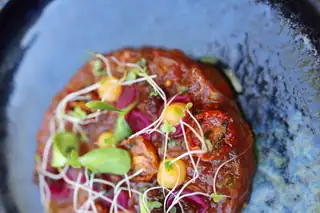
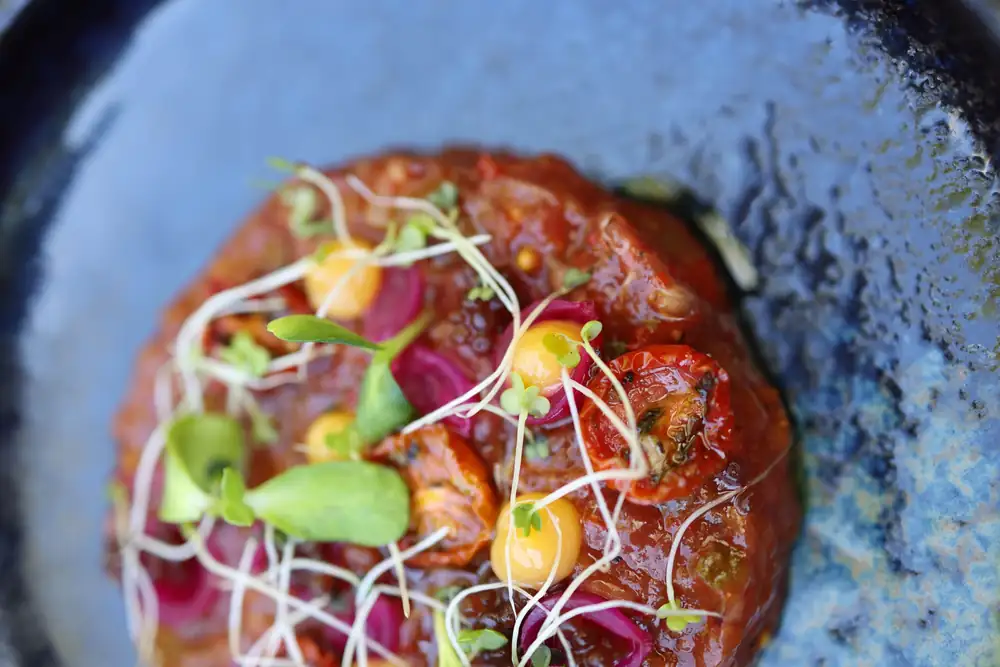
Beefsteak tartare is a defining dish in Hilda's kitchen, and Renátó Kovács' interpretation clearly shows that in the case of such a classic, the details are at least as important as the raw material itself. The chef makes the tartare from tenderloin, which he finely chops with a knife, so that the texture of the meat is preserved and does not become mushy. The goal is balance rather than excessive seasoning: creating a flavor profile that highlights the character of the beef, while giving the dish sufficient depth and complexity.
In the Hilda chef's version, in addition to the classic additions, there are also elements that bring freshness and extra texture to the plate. The more acidic and salty components consciously offset the fullness of the raw meat, while the different textures – the creamier and crispier elements – make the dish exciting throughout. According to Renátó Kovács, one of the most important characteristics of a good tartare is that each ingredient has a precise role, yet none of them can overwhelm the taste of the meat.