Habibi showcases the distinction of Lebanese cuisine in Mérida
One of Mérida's surprises is Habibi, a restaurant far removed from corn, tacos, stews, chili peppers, or nixtamal. It sounds strange, almost provocative, but I started thinking this shortly after lunch began, and the feeling grew with each course until it solidified into a certainty the moment the kachapuri arrived.
It is not often in Latin America to find such a refined and thoughtful approach to the recipes and culinary traditions originating in Lebanon, or its neighbor Syria, which are usually the most represented. From there, and also from Palestine and Armenia, came some of the main migratory currents in the region, and with them came a cuisine that is always festive, with a vocation for collective ceremony, with far fewer public displays than one might expect, and which are generally presented in a subdued, restrained, almost familial tone.
The hummus with awarma signals its differences. It starts with a somewhat conventional preparation—a good chickpea hummus seasoned with tahini and lemon—and elevates it with the addition of lamb confit in its own fat (awarma) and a poached egg that softens the combination. I see it as a statement of intent on a table that is gradually becoming filled with mezze.
Lebanese cuisine is never simple, and Habibi's (my beloved or my dear in Lebanese) is nourished by meticulous, detail-oriented cooking, with a desire to stand out. This is evident in dishes like baba ganoush and muhammara. The former lives up to its name: a cream of roasted eggplant seasoned with tahini and za'atar, the traditional spice blend of Arab cuisines. At its heart, a relish of chopped peppers and onions and a few spoonfuls of good extra virgin olive oil add complexity, aromas, and nuances to a dish that feels both worldly and contemporary.
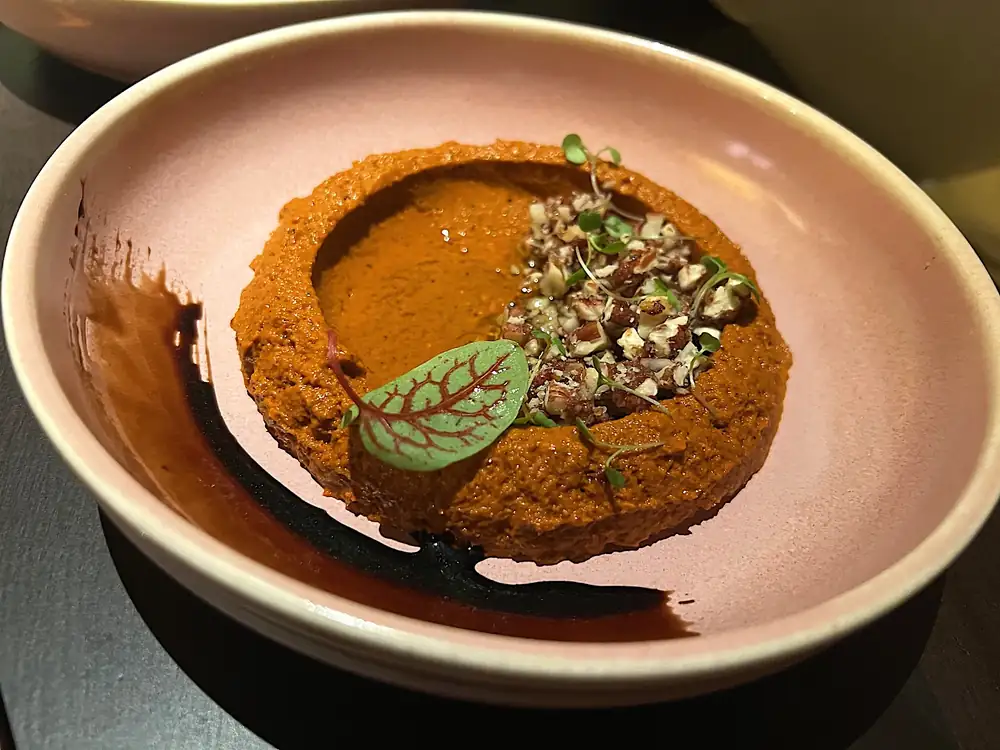
Muhammara is a roasted red pepper dip that I have a weakness for. It's a dish with nuances—the character imparted by the oven, the robust flavor of the pepper, the understated elegance of the olive oil—and its character is further enhanced by a topping of caramelized walnuts that adds a delightful interplay of textures. The dish can be served without the balsamic reduction brushed on the side.
Habibi establishes its distinctiveness even before you step into the dining room. Opened in August of last year, I find it surrounded by luxury brands in the central courtyard of City 32, a commercial and work space built in Fundura Montebello, the residential area that currently marks almost the northern limit of the city as you head towards the sea in Progreso.
The cold mezze prove to be a good showcase of the state of this cuisine. Starting with the pita bread—puffed, thin, freshly baked—always useful in this cuisine that advertises itself amidst cream and has placed bread in the place of cutlery. The labneh works, always creamy, with the appropriate touch of acidity. I enjoy a version with Kalamata olives and extra virgin olive oil, in which the labneh, on a path that, with the help of fermentation, could lead from what we know as Greek yogurt to cheese, arrives sprinkled with a crunchy olive topping. Their tartare (kibbeh nayeh) is also excellent, in which the ground beef is compacted with the addition of bulgur (processed wheat) and pine nuts. It is accompanied by labneh prepared with a restrained garlic sauce (toum).
I knew khachapuri as a Georgian dish before it was revealed to me as Lebanese. It's a traditional dish in the country's bakeries: open, cylindrical loaves that serve as containers for a mixture of feta and mozzarella cheese, which adds softness and elasticity. The almost millimetric baking of the dough is key to the result. If it weren't for everything mentioned above and what follows, I'd order another one.
Gabriel Ignacio Rosiles's work at the helm of the kitchen has resulted in a menu that celebrates traditional meats like chicken, lamb, and beef. I sampled a delicious lamb stew with walnut and date couscous, followed by a slow-cooked short rib that could have been even more succulent if the temperature and cooking time were adjusted to suit the nature of the meat. Latin American kitchens approach low-temperature cooking with the Roca brothers' sous-vide cookbook as their absolute reference, failing to grasp that the techniques they developed were created for products that are rarely comparable to those found in our own pantries. The differences in breed, age at slaughter, rearing methods, and diet are so vast that each case demands a specific approach.
I begin with the subtle elegance of a light orange blossom water custard topped with a layer of pistachio powder, which I would prefer to be lighter so it doesn't weigh so heavily. A frozen mango mousse completes the dish.