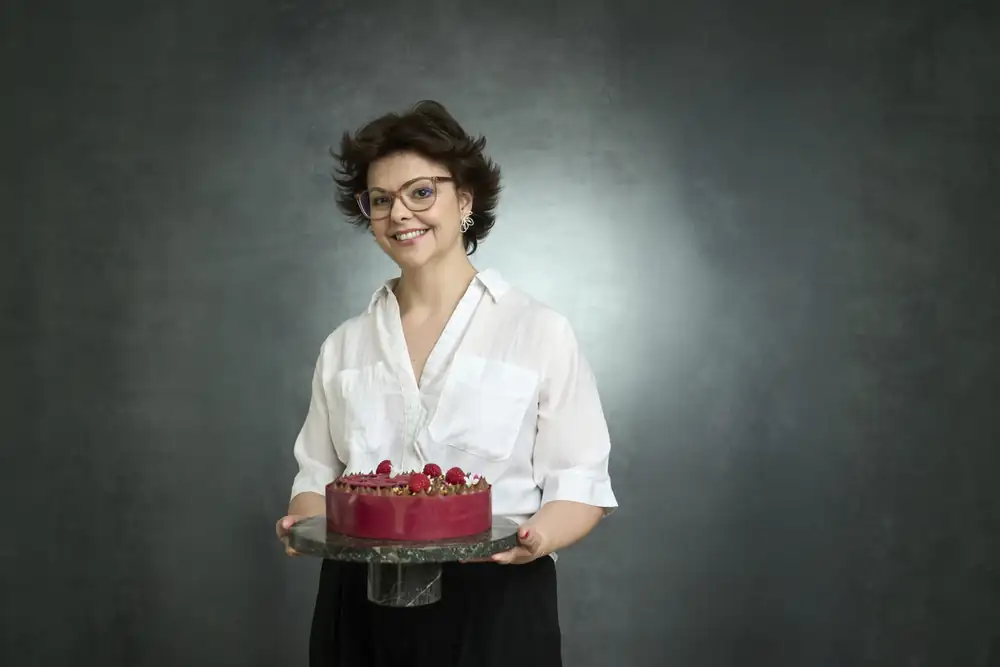
“If someone had told me years ago that I would be writing a vegan dessert book in 2026, I would have laughed at them”
What was the moment or realization when you decided to write a plant-based dessert book?
I felt the need for such a book when I was looking for recipes. I wanted simple, usable, understandable descriptions that didn't require the arsenal of a chemistry lab, but there wasn't one. I wrote the book I wanted to find in 2019. I saw in the restaurant industry that there was a need, since we can't tell a guest that we can't serve a dairy- and egg-free dessert. The other side of the coin was when I myself felt ready for this kind of work.
In 2019, when we were preparing to open Laurel, we were confronted with the fact that there would be a vegan menu at the opening, which would also require vegan desserts. I was a bit shocked when I heard the news, but it didn't deter me. External pressure, a mandatory work assignment, started me on this path. Today, I don't regret it at all that it turned out this way.
How is creating a book like this different from your previous volumes?
The format was not new to me, this is my fourth book. Although not completely copied, I wanted to go back a little to the logical structure of my first book, Creative Dessert School. I tried to use a didactic, textbook-like approach: in each chapter, different branches of confectionery and types of dough appear, taking into account pragmatic, practical aspects. It was important that I could suggest as many variations as possible for each recipe, and not have a book that only reflects my taste.
You recommend the book to both beginners and professionals. How can you address two seemingly very different target groups?
The recipes represent different levels of difficulty: from simple American cookies to islers, to jerboas and coconut cubes, there is a lot to choose from. Most of the recipes can be easily made at home. There is always room for simplification, and those who are involved in this at a professional level can also make it themselves. The last chapter of the plate dessert is cuckoo's egg, which is specifically for those who deal with this topic in a restaurant environment. 5 of the 35 recipes were created for them, but it can also be useful for those who do not have commercial kitchen equipment.
Before the book was published, you held quite a few tastings for your friends. Did you also try the recipes with less experienced hobby bakers?
I have been giving many workshops and courses over the past five years, and I have tested the recipes more widely on these occasions. Participants come with different levels of knowledge. Some people prefer to eat than make desserts, but I try to explain everything in a way that they can also make the sweets.
Experience shows that hobby confectioners can be at the same level as those who do it professionally. Gastronomy has also become a hobby, and it is often impossible to tell from the finished work whether it was made by an amateur or a professional. Knowledge is available to everyone on Instagram, YouTube and TikTok. You can learn many techniques from videos and cookbooks, but you have to devote time and money to it. Books, ingredients and experimentation cost a lot.
You are also self-taught, a career-changing confectioner. How does your personal journey shape your professional perspective and the process of writing the book?
Last year, while I was working for Tibi Szántó, I completed my pastry chef OKJ, but I don't use any of that knowledge. My own story and background help me a lot when writing books. For example, it's no problem to give recipes for household quantities, since I also started experimenting at home. I also mobilize my liberal arts knowledge when writing. Structured thinking is already evident in how I develop the framework of a book and how I fill it with content.
Did you experience any resistance to vegan desserts during the book writing process?
At first, the publisher didn't believe in this book either, because he thought that gluten-free desserts could never be as delicious as traditional ones. He thought they were only good for those who couldn't eat anything else. I feel it's my mission to prove that vegan desserts can also be uncompromising in taste and texture. There is a prejudice that needs to be confronted. During the tastings, I made a point of not revealing that these were vegan desserts. It's more effective to test on omnivores, because they know exactly what the traditional versions are like and immediately compare them to them.
How has vegan confectionery changed in the last five years?
There are more and more different types of ingredients to choose from, and purchasing has also become easier. Instead of butter, you can now not only get margarine, but there is also a wide selection of other butter substitutes. There is almost no seed that has not been made into seed milk. I see a big leap in this. Various catering establishments are also catching up with the ever-growing demands.
Is there anywhere you can taste the cookies in the book?
I'm hosting Marumba on June 11-12 during the evening service. I'm making three desserts to accompany Sajben Csabi's wonderful vegetarian dishes. I'm bringing the strawberry-ginger-black sesame slice, the malted tonka bean mille-feuille with berries, and a spicy carrot cake with apricots, sunflower praline, and miso sunflower cream.
After finishing a book, do you always look forward to the next one?
The choice of topic always depends on what interests me at a given time. What I see as an area of lack. In fact, each of my books was inspired by a lack of some kind. If someone had told me years ago that I would write a vegan dessert book in 2026, I would have laughed, because vegan desserts are notoriously inedible. A lot has changed in me and around me in recent years.
When did your opinion about vegan desserts change?
There was a point when the mandatory work task turned into something I started to enjoy the challenge part of. Can I make the folded brioche just as good in a vegan version? This is the part I love most about pastry: when I can experiment, come up with my own recipes, incorporate existing recipes into my own system.
How has your creative process changed?
My own thinking was formed, the experiences of success continuously broke down my skepticism towards the topic, and I became more and more open. For example, three or four years ago, it would not have occurred to me to taste vegan desserts when traveling abroad, or to choose a vegan menu in a fine dining restaurant. As I saw that I too could prepare the desired recipes with the dreamt-of textures and flavors, my confidence and courage in tasting grew.
Was there a memorable tasting that was a turning point?
In the summer of 2023, I attended Philip Khoury's two-day course in Budapest. He was the head pastry chef at Harrods between 2018 and 2025, and he specialized in making plant-based desserts. His work was not communicated as vegan desserts, but these were the "a" desserts at Harrods. There was nothing else.
I liked Philip's approach, I felt close to his thoughts. He made very beautiful and delicious sweets from very simple ingredients. He didn't simplify things so much as to use margarine instead of butter. It was important for me to see: plant-based desserts can be made at such a high level.
I'm still proud to this day that after the first day of the course, he came to Laurel and ate the vegan menu, which he really enjoyed. He also tried the laurel and cherry puff pastry dessert, which is also in the book.
You have written four books and regularly give master classes for professionals and hobby confectioners. What is the next step?
I've been working on a larger project of my own for a while now, which I don't want to reveal much about yet. I'm preparing for an opening this fall, I'll tell you about it later.